
When selling a product, you must understand its features. That goes for electronics, automobiles, and yes, compound bows. How do the features work, and how do they enhance the end-user’s experience? If you can’t clearly and confidently articulate those points, you’re not credible to the customer — and consider them out the door and on the way to your competitor.
In today’s advanced state of compound bows, keeping up with all of the features, how they work, and the benefits they deliver isn’t easy, especially when handling multiple bow brands. Aptly, Bowtech simplifies this for both consumers and dealers. On its website, each bow model is anatomically dissected by its features. Hover the cursor over a feature, and a window appears with the feature’s name and a description of what it does. There are also video components for each bow and some of the features to help further expand your knowledge of the bow and its workings. It also helps that every Bowtech feature has a definitive purpose — no marketing fluff here, just benefits to the end-user.
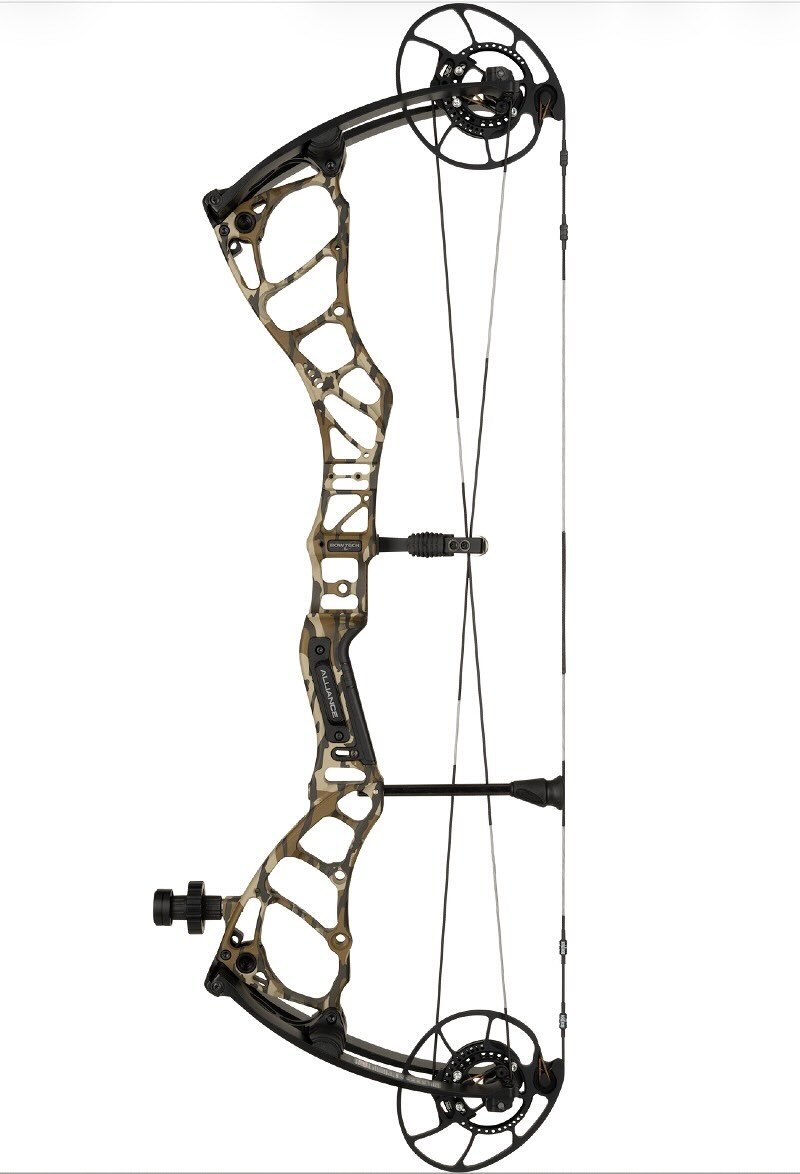
When you know what you’re talking about and put the new-for-2026 Bowtech Alliance in a serious bow buyer’s hand, I’d be surprised if they don’t get out their cash or card. The Alliance was rated the best new bow at the 2026 ATA Show, and after running it through its paces on my snowy, frigid Wisconsin testing grounds, I’m honestly not surprised.
The Alliance is available in two sub-models. The 30.5-inch Alliance is ideal for mobile bowhunters or those hunting in tight confines, while the 33-inch Alliance 33 is ideal for archers with longer wingspans and those who bowhunt the West, where long shot opportunities demand maximum stability. The Alliance is rated at 338 fps, while the Alliance 33 is 334 fps. Now, let’s dive into my test.
Test Bow Specs
- Axle-to-Axle Length: 30.5 inches
- Brace Height: 6.43 inches
- Draw Length: 28 inches
- Draw Weight: 70.4 pounds
- Let-off: 80/85%
- Bow-only Weight: 4.09 pounds
- Accessorized Total Weight: 5.6 pounds (including sight, rest and stabilizer)
- Velocity: 278 fps (with 468-grain Easton 6.5mm Acu-Carbon 340 arrow); 281 fps (with 456-grain CX Maxima Triad 350 arrow); 284 fps (with 441-grain Victory VAP SS 350 arrow); 304 fps (with 388-grain CX Predator 350 arrow)
- Kinetic Energy: 80.33 foot-pounds (Easton); 79.97 foot-pounds (CX); 79 foot-pounds (Victory); 79.64 foot-pounds (CX Predator)
- Test-Bow Finish: Mossy Oak Bottomland
- MSRP: $1,499.99
- Contact: bowtecharchery.com
Building the Alliance
Setting up the Alliance was virtually a plug-and-play experience. I grabbed last year’s Virtue off the hook, removed the Ripcord Ratchet IMS-compatible rest and Bowtech CenterMass Dual Trac sight, and had them anchored to the new Alliance in no time. It was a convenient and seamless transition. I absolutely love these accessory mounts, but I’m particularly entertained by the Gen 2 CenterMass sight-mount because it’s completely original. While most other companies offer Picatinny sight mounts, Bowtech blazed its own path. I respect that. Plus, it’s a solid sight mount that effectively positions the sight weight at the center of the bow, optimizing balance.

One caveat: The CenterMass mount is compatible only with Bowtech CenterMass sights, meaning your customers cannot use it with other sights. However, a conventional bolt-on sight will adapt to the standard sight mount. The only downside is that conventional sights must be mounted to the outside of the riser, which yields a counterbalancing dilemma.
If you didn’t know, CenterMass is part of Bowtech’s Stability and Balance System, which also includes the lower Stabilizer Dampener, which mounts just above the lower limb pocket. The net result is a completely equalized system that balances like a boss.

Customization
As with previous Bowtech models, rotating the clearly labeled FlipDisc modules to my draw length was a slam dunk. First, I tried the FlipDisc in Comfort. The draw cycle is silky smooth. I’m a tough guy, so I flipped the modules to Performance. The draw cycle is certainly more difficult, but it’s manageable and delivers a harder-hitting arrow. I’d say the main difference is at the hump right before the cam breaks over into the valley.
I left the FlipDisc set to Performance for most of my test, which was conducted in single-digit temperatures. With snow flying sideways at times, I was bundled in my winter apparel but found no trouble with drawing the bow. I also did some testing in even colder temperatures in the Comfort setting. If I were doing lots of cold-weather bowhunting, I’d favor Comfort over Performance. The good thing is that FlipDisc gives your customer two different draw cycles, which is sort of like two bows in one.
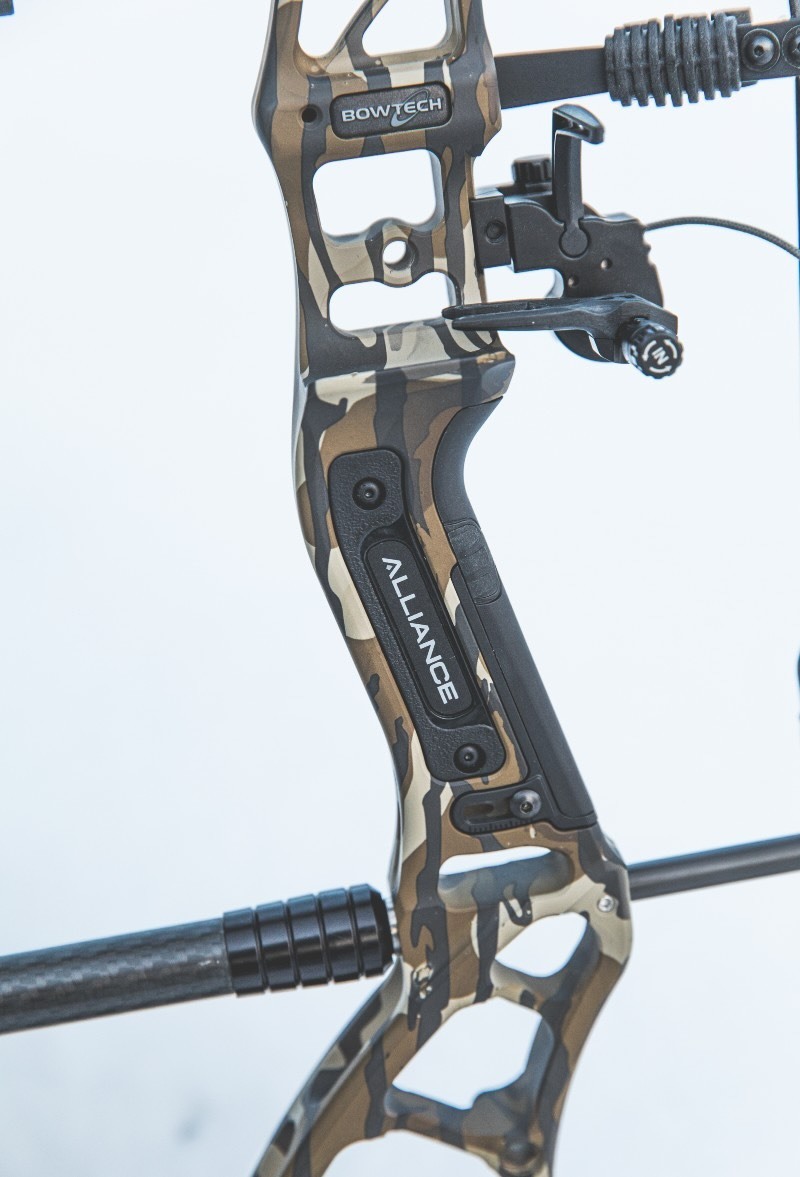
Everyone is slightly different in terms of grip preference. Some folks love everything about a particular bow except the grip. Bowtech’s GripLock solves the dilemma. Simply loosen the grip’s two locking screws, adjust the grip to your client’s preferred angle, and tighten the screws. Heck, your client can play with this at home. I also love the small rubber inset at the grip’s throat, which provides just enough hand traction.
I’m a proponent of starting with a fairly lightweight bow and adding weights where they are needed. The Alliance is outfitted with multiple stabilizer locations so you can add what you want, where you want it. It’s just one more level of customization that helps users dial in the bow to their exact preferences.
Heavy-Duty Without the Heavy
Every time I hold onto a Bowtech bow, I feel like I’m ready to go sheep hunting. And that has been true throughout the bow company’s existence. The Alliance is no different. I’m amazed that a 4.09-pound bow (30.5-inch model) can feel so tough yet be so lightweight and balanced. That’s engineering at its finest.
Speaking of engineering, the Alliance features a reimagined riser. As with previous riser designs, the Alliance’s riser focuses on durability, first and foremost. However, weight savings and weight distribution are clearly at play in this sleek and more skeletonized design. It feels as tough as a tank, but it’s also lightweight and well-balanced. It looks awesome, too.
Making a virtually seamless transition from the riser to the limbs are the wide but minimal locking pockets. These bury all worries, plus they widen the lateral profile, yielding a stabler aiming experience. My level of confidence in the riser, pockets, and limbs for unforgiving backcountry hunting is indescribable. From top to bottom, the bow simply feels bombproof.
DeadLock Reimagined
Next, the Alliance’s DeadLock Cam System has some updates. On the Virtue, the axle is positioned behind the limb tips. On the Alliance, the axle is directly on top of the limb tips. The new positioning is designed to boost efficiency. The beefier DeadLock tuning screws are more user-friendly than the previous design, and the adjustment system allows for finer adjustments with the ability to positively track adjustments by referencing the laser-etched marks. Bowtech has had DeadLock for years, and this advanced iteration steps up the game.
How It Performs
I already touched on the draw cycle, so I’ll begin this portion by saying that sighting in was a slam dunk. Even in the brutally cold weather and wind, I was nailing 10 and 12 rings with little trouble at 60 yards within 20 minutes. That level of accuracy out of the gate is outstanding. I assume the Alliance 33 would naturally be even more accurate at extended ranges, and the obvious choice for those who hunt the West and/or hit Total Archery Challenge’s double black diamond courses.
I noticed more noise while shooting the Alliance than some of the other bows I’ve recently tested. Granted, it doesn’t come with limb or string dampeners. Honestly, I think most of the noise came from the Dual Trac sight. On the sight, the connection point where the scope bracket clamps onto the elevation bar has a little bit of slop. It doesn’t affect accuracy, but I hear it when I shoot. Also, when I smack the riser with my fist, I hear that same connection point buzzing. And that’s with everything locked tight. This is my only complaint from the test.

A Do-All Bowhunter’s Bow
In short, the Alliance’s reimagined riser and updated DeadLock Cam System combine with tried-and-true Bowtech features to yield a sweet-shooting hunting bow that’s built for sheep country but just as nice to carry to a ladder stand in the whitetail woods. Bowtech has made your job easy as far as understanding the concepts behind the bow and how it can enhance the end-user’s experience. The only thing left is to put it in a serious bow buyer’s hand. The Alliance will do the rest.
Additional Notes: The Bowtech Alliance was set up using a Last Chance Archery EZ Green Bow Press and EZ Green Bow Vise, and the draw weight was calculated using Last Chance Archery’s Digital Bow Scale. A Caldwell Ballistic Precision Chronograph measured the arrow velocities. Other products used were Easton’s Nock and D-Loop Pliers and Pro Hex Fold-Up Allen Set. Arrows were weighed on Last Chance Archery’s Pro Grain Scale.
In-the-field photos by Becca McDougal