
Chopper pilot Ed Spencer landed on a ridge-top 60 miles out of Fairbanks to drop Cynthia Dusel-Bacon, who was mapping Yukon-Tanana uplands for the Geological Survey. Unarmed per protocol, she carried in her rucksack only lunch, a rock hammer and a radio.
The walking was easy. Then: “A sudden crash in the bush startled me. I looked up and saw a black bear rise just 10 feet away.” She yelled and waved her arms. Instead of leaving, the bear crept toward her. Then it rushed. Felled by “a staggering blow,” Cynthia willed herself to stay still. But the bear pressed its attack, biting deep into a shoulder. She reached without success for the radio pocket. The motion brought more violence: “I [felt] my flesh being torn, teeth against bone … canines crunching on my skull.”
The bear pulled its victim into the brush, licking at blood from its continued mauling. After many agonizing minutes, Cynthia got her one functional hand to the torn pack pocket and keyed the radio. “Ed! Come quick! I’m being eaten by a bear!” The beast pounced again.
Eighty miles away, Ed’s wife picked up the transmission on the camp radio. Ed left immediately, but he had trouble finding Cynthia in the brush when did arrive, and then he had to fetch help to move her. Cynthia would lose both arms in surgery.
Hunters commonly bump into bears, partly because during hunting seasons bears are most active, stocking up on calories for hibernation. In the West, the smell of fallen game is a magnet for grizzlies, and hunters field-dressing animals have become victims. Two years ago, a guide working on a client’s elk was killed by a grizzly. Five years ago in Alaska, a hunter was butchering a moose he’d taken while his friend ferried meat. Returning to the carcass, this man found his partner dead from a bear mauling.
Grizzly attacks are often the result of protective actions of bears with cubs or over kills. Surprise trail meetings trigger some. But the black bear that savaged Cynthia Dusel-Bacon was stalking her. Lying still eliminates a perceived threat, thus it can stop a grizzly mauling. But a bear killing to eat simply finds inert prey a convenience. In 1978, a year after Cynthia’s nightmare, a black bear killed three boys fishing an Ontario river. These events made news partly because bear predation on humans is very rare. But it is not going away. On September 3, 2025, a Franklin County, Arkansas, farmer was attacked in a field. The man died of his injuries 10 days later. Killed by officers, the offending animal weighed only 70 pounds — but any bear with predatory intent can inflict serious wounds. Reportedly, the 72-year-old farmer was the state’s first human fatality from a bear since 1892. Eerily, a month later, a man was found mauled to death in his campsite in Newton County, Arkansas. That bear was also located by authorities and shot.
In a 1989 book, Larry Kanuit compiled a list of 170-odd bear maulings recorded in Alaska since 1900. All but 19 were caused by grizzlies, including Alaskan brown bears, their coastal ecotype. A study published a decade earlier by Canadian journalist Mike Cramond credited 72 attacks to wild black bears, 80 to wild grizzlies. These figures reflect the greater numbers of black bears in Canada. Resulting human fatalities: 12 and 14. Half the victims of both species were fed upon.
By the mid-20th century, habitat loss and hunting had pared grizzly numbers to roughly 1,600 in the Lower 48. Two years after the Endangered Species Act of 1973, the bears were declared “threatened” there. Grizzly numbers have since grown steadily. As many as 50,000 grizzlies live above the Canadian border, the total about evenly split between Alaska and western provinces.
Even hunters in prime grizzly country seldom see the bears. Still, like meeting someone to whom you owe an apology, chance encounters happen. Hunting elk, I once descended a rock-slide in deep snow to rest against a pine at the edge of the woods. Too late, an elk carcass caught my eye. As if on cue, a big grizzly, silvered coat rippling, catapulted down the slide in a cloud of powder. It passed me, skidding to a halt at the elk. I hugged the pine. Batting the skull about, the bear picked up my scent at 19 steps. All was suddenly still. Tense seconds later, the bear disappeared into the timber. I put the pine between us and strode quickly away.
The idea of a back-up for bear encounters dates to the Corps of Discovery, 1804-1806. During the trek across the Louisiana Purchase, Lewis and Clark were warned by Native Americans to avoid bears with frosted humps and dark-rimmed eyes. Ignoring that caution, the men had close calls until Lewis insisted no shots be taken at grizzlies by a lone hunter. The Corps killed 43 of the bears. Unrecorded numbers were lost.
Even soldiers learned to respect grizzlies. In Thirty Years of Army Life on the Border, Colonel R.B Marcy wrote of missing a grizzly with his rifle, then setting his cavalry to the task. Troops rode close and fired “10 or 12 shots” with Navy Colts, to no effect. A .44 Dragoon killed the bear. The .36 balls had penetrated “only about an inch.”
The .44 Magnum’s 1956 debut inspired hunters to pack N-Frame S&Ws afield. An Alaskan guide I knew assured his clients their fortunes lay with his .375 rifle. But once, thinking a client’s bear had died in alders, he followed with only his .44. The bear ran him over as he emptied the revolver into its ribs. “It just wanted out,” he said. “It could have killed me.”
Ordinary loads from hunting rifles hit harder than the stiffest from handguns. Sending 1,300 ft./lbs. out the muzzle, a .44 Magnum registers half the punch of a 180-grain softnose from a .308. Accurate aim is also easier with a rifle. Hitting with a handgun is hard when everything is in motion and heartbeats race by. Bears can endure lethal wounds while inflicting their own.
Sales of big-bore revolvers — classic back-up in bear attacks — are hostage to their vaulting prices. Ammunition for the most powerful is frightfully expensive, too. But retailers can tap a new profit center: “bear emergency” loads for affordable, widely-owned handguns. Their non-expanding or bonded bullets are designed to reach bear vitals from the front. Jacketed hollowpoints for home defense can fail to pierce a bear’s coat, skin and skull, thick bone and muscle.
Some loads to stop bears are for revolvers, but many serve autoloaders, flat for easier carry, and lighter despite their greater firepower. The 9mm is included in several of these line extensions. Not that it’s a go-to bear-stopper, but it is the top-selling handgun round and popular for everyday carry. Customers who won’t spring for costly, heavy, hard-kicking revolvers will readily spill a few bucks for ammo that gives their 9mms sharper bite or justifies a new striker-fired pistol. As much as buying protection from possible threat, they’re adding versatility to carry guns.
And “carry” is key. A big gun in the tent offers no salvation when you’re outside it. In Alaska, a bear appeared near clients walking streamside behind their guide close to camp. Absent his .44, he had to hope the beast was benevolent or dispatch it with his 9mm. Several well-aimed shots to its chest dropped it.
The 10mm Auto cartridge has buoyed sales of 1911s and pistols like Springfield’s XD-M. Dating to 1983, it packs half again the punch of stiff 9mm loads and more than .45 ACP +Ps.
Black Hills Ammunition has 10 Honey Badger loads for handgunners. The non-expanding, solid-copper HB bullet was designed to drive straight and deep through tough barriers. A 100-grain 9mm leaves at a claimed 1,250 fps, with 347 ft./lbs. of punch. In .40 S&W and 10mm, 115-grain HBs clock 1,325 and 1,600 fps, respectively, for 448 and 654 ft./lbs. A 135-grain .45 ACP load at 1,250 fps carries 468 ft./lbs. In revolvers, there’s a 127-grain .357 Magnum load at 1,365 fps, a 160-grain .44 Magnum at 1,700.
Federal’s new Solid Core loads replace the Castcore clan. Each flat-nose SC bullet is of hard lead with a tough blue polymer jacket. Federal offers six SC loads in its Hunting Handgun stable: A 147-grain 9mm at 1,120 fps lands 409 ft./lbs.; 200-grain .40 S&W and 10mm loads at 1,000 and 1,200 fps hurl 444 and 639 ft./lbs.; a 240-grain .45 ACP+P load clocks 1,000 fps to send 533 ft./lbs. Federal serves revolvers with a 180-grain .357 Magnum SC load at 1,400 fps and a 300-grain .44 Magnum at 1,300.
Hornady features non-expanding DGH (Dangerous Game Handgun) bullets in new Backcountry Defense ammo. Jackets folded over a shallowly dished nose lock in the lead core. Heavy for the caliber, DGH bullets penetrate deep and straight. A 138-grain 9mm+P load clocks 1,150 fps to deliver 405 ft./lbs. A 200-grain 10mm DGH at 1,160 fps carries 598 ft./lbs. Backcountry Defense loads are for revolvers too: 165-grain .357 Magnum (1,510 fps), 240-grain .44 Magnum (1,620) and 300-grain .454 Casull at 1,820.
Nosler’s deadly AccuBond rifle bullet may have helped inspire its new Defense pistol loads — two each in 9mm+P with 124-grain bullets at 1,200 fps for 396 ft./lbs., .40 S&W with 200-grain missiles at 900 fps for 360 ft./lbs. and .45 ACP+P with 230-grain bullets at 950 fps for 461 ft./lbs. Choose the bonded JHP without a polymer tip, or a tipped version with durable rounded nose. A single 10mm load features a 200-grain bonded JHP at 1,000 fps. Energy: 444 ft./lbs.
Remington has no non-expanding hunting bullets in handgun ammo. But its Golden Saber Brass-Jacketed Bonded bullets appear in eight loads for autos: a 125-grain .357 Sig at 1,350 fps (506 ft./lbs.), a 124-grain 9mm+P at 1,125 fps (348 ft./lbs.), a 147-grain 9mm at 990 fps (320 ft./lbs.), 165- and 180-grain grain .40 S&Ws at 1,150 and 1,015 fps (484 and 412 ft./lbs.), a 180-grain 10mm at 1,160 fps (538 ft./lbs.), plus two .45 ACP+P loads, 185- and 230 grains at 1,015 fps (423 ft./lbs.) and 875 fps (391 ft./lbs.).
New Winchester Big Bore handgun loads with bonded semi-jacketed hollowpoints include a 200-grain 10mm at 1,175 fps, hurling 613 ft./lbs. Mostly, this series is for revolvers: a 158-grain .357 Magnum at 1,460 fps, a 240-grain .44 Magnum at 1,485, a 250-grain .45 Colt at 845 and a 300-grain .454 Casull at 1,560 fps. But Winchester’s 9mm+P Defender loads with 124- and 147-grain JHPs at 1,200 and 1,030 fps send 396 and 346 ft./lbs. out the muzzle. Defender 10mm loads hurl 180s at 1,240 fps, for 614 ft./lbs.
The 10mm gets attention from semi-custom ammo houses, too. Buffalo Bore lists a 180-grain JHP at 1,350 fps, for 728 ft./lbs., and a 220-grain hard-cast at 1,200 fps, for 703. Grizzly Cartridge gets 694 ft./lbs. from 200-grain 10mm bullets at 1,250 fps. Underwood’s 150-grain solid at 1,425 fps carries 676 ft./lbs. The only .40-bore matching the 10mm is the.400 Corbon, developed in 1995 by Peter Pi to launch 165-grain bullets at 1,300 fps. Energy: 619 ft./lbs.
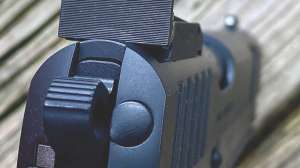
Velocities were measured with a Garmin Xero C1 Doppler chronograph. The 3.8-inch barrel of my Springfield XD-M Elite Compact bled measurable speed from that registered from 5-inch test barrels. But this 11-shot pistol, with its Hex Dragonfly red-dot sight, is short and light enough to wear without thinking about it. A chest holster keeps it readily available.
The Honey Badger’s speed comes at the expense of bullet weight and sectional density (SD), both of which also enhance penetration. Its .103 SD is modest next to the .161 SDs of 180-grain bullets and the .179 SDs of 200-grain. All achieve deep, straight-line penetration in ballistic gelatin.
The speed and ensuing mayhem of a bear attack defy description. In an alder thicket in 1988, a grizzly leaped upon L.W. Jones, slapping his rifle aside. On his back, Jones jammed the muzzle into the bear’s mouth, but the beast wrenched it out. The swipe of a paw shredded Jones’ shoulder holster, spilling his .44 Magnum. Canines clamping his clavicle, the animal picked him up, shook him, slammed him down, savaged his head, jerked him aloft by a thigh, then dashed him to earth again. Great claws tore at his stomach. With effort, he lay still. His companions and four hours of surgery saved him.
A back-up pistol must be easy to reach instantly and fire accurately with one hand from any position. Sprawled on your back or belly or going fetal, you’ll instinctively curl up and clutch your chest to shield your vitals. Grabbing a pistol there requires less movement than clearing one at the waist or shoulder. Need to pull a mitten? Your teeth are inches from your fingers.
Galco’s Great Alaskan chest holster is my pick. Intelligently designed and beautifully crafted of top-quality leather, it’s available for pistols and revolvers. A similar rig, also impeccably built, is offered by the Italian company Falco. (Its name derives from “falcon”; early products were gloves for falconers.)
Knowing how to reach and operate a companion’s gun can prove useful in dust-ups with bears, as people panic and guns slip from hands or are torn away. Recently a grizzly killed a hunting guide while the client fumbled with the guide’s handgun. Advice worth sharing with customers.