
Variety is the spice of life.
While I’m not a big fan of the idea of a carry rotation for your EDC pistol, I think it’s a little easier to make a case for an EDC knife rotation. We can quibble over calibers and brands, semi-auto or revolver all we want, but no matter what, guns are essentially all long-distance wireless hole punchers.
Knives, no. Knives are a very different thing. Blade shape or length, handle design, size, fixed, folder. Some slice, some puncture. Some with a reverse grip. Different styles do different things when deployed by a person with different skills. The knife you carry today to do a specific job may not be the knife you want to carry tomorrow to do a different job.
You need an every-day carry gun. You could even argue you need a different knife to carry every day.
Why Knives?
More people slide knives into their pockets every day than they do guns. Put 100 people in a room and ask how many people have lost a gun. Now ask that same group how many have lost a knife.
Any good business is acutely aware of consumable goods. Those are the things that keep people coming back. Grocery stores don’t make money because of great margins, but because you’ll be back every Wednesday night to stock your shelves again. That’s what knives can do for your store. And if you think gun collectors can amass a trove, wait ’til you meet a few of those knife guys.
Sure, some of that sounds humorous, but there’s truth in every bit of it. Lots of people go to work every day and can’t or don’t want to carry a gun, but they’ll put a knife in their pocket.
Some do it because their job calls for cutting open boxes or bindings, but a significantly less-than-zero number of them do it because they know the knife is a weapon of last resort. If you run a greater-than-zero chance of getting into a fight, a knife may not being as good as a gun, but four inches of steel is a far sight better than an empty hand.
The Wrong Way to Sell Knives
Perceived effort on your part is perceived value to the customer.
It can’t just be my town that has that same spinning display case, six feet tall, full of $19 knives at every gas station in town. It’s always full, and I’ve never, not once, ever seen anyone actually look at the knives in that case. For all I know, they’ve been in there since the Bush I years.
Don’t make that same mistake in your shop. Loading up part of a case with knives dropped in haphazardly, waiting for someone to ask to see them, isn’t going to create the interest or the revenue you are after. And bringing in knives without really looking at the assortment, just presenting a grab bag of options to say that you offer knives, is no plan.
I’m no knife savant, but I know a thing or two, and I know what I like. Even for me, I am constantly frustrated by the assortment I find in a shop. The same cookie-cutter configurations. They’re all 3.5-inch blades, they’re all drop points or tanto blades. They’re all $50. Every single one a folding back lock. Oh, look. One Case Stockman for us farm kids or old guys.
It would be like having your entire firearm assortment being different brands of Gen 3 Glock clones. Why bother?
The Right Way to Sell Knives
You should give the same amount of consideration to your customer profile when choosing knives as you do to your firearm assortment.
Yes. You should take it that seriously. I promise you have customers who do.
You have to build an assortment that is as varied as your customer base, and covers as many configuration options as possible. If that case is full of different blade styles, handle types, and designs, you’ll hear a lot more, “let me see that thing.”
And more and more of them will walk out the door with a new blade.
Sample Assortment
It would be impossible to cover every brand and style, but let’s talk about a sample assortment that would cover more bases than not, get people asking questions, trying new knifes, and showing you what you can move when you give them options.
AROUND $50 OR LESS
This is your meat-and-potatoes assortment. Even if you’re a higher-end shop, it’s important to have some affordable knives. Remember all those people that would raise their hand when asked if they lost a knife?
For my part, I don’t carry the same knife when I’m on the road as I do when I’m running around near home. Too much chance of dropping it, or leaving it somewhere that I’m not going back to. Similarly, I may need a knife for something while I’m out cutting wood, so I’m going to pick one that can get me out of a bind, but won’t make me cry if I lose it in a swamp.
One of my favorite knives in this group, and a go-to for me, is the Gerber Paraframe. The cutouts make it light enough to be in your pocket without causing problems, but it’s still sturdy enough to hold up to daily use for normal knife tasks. At just $35, it’s a great staple knife.
The RAV series of knives from Real Avid, making a push back into knives after a bit of an absence, is made up of seven different folder models with varying features, but the same basic configuration. The points or materials may change slightly, but they’re all in the $30-$55 range, and blister packed. Some are more task-tilted, others lean more in the fighting knife style, but they all cover the same price point and give you a lot of options to cover a lot of ground and tastes, with just one brand of knives, not to mention all the firearm accessories you probably already have in the store.
In this same general price range, you can find offerings from Spyderco as well. The Cara Cara comes in around $50 retail as part of the affordable byrd line of knives from Spyderco. Manufactured in China, rather than Japan, Taiwan or the USA, these models still take their inspiration from the rest of the Spyderco line but come with a price tag that fits virtually any user. The easiest way to spot the byrd line is by the comet-shaped thumb hole, rather than the telltale round from the mainline knives.
Don’t forget the fixed blades! The Outdoor Edge Pivot is a great fixed-blade option that hits right at that $35 price point. It’s available in drop point or Wharncliffe blade designs, but for me, the Wharncliffe is the way to go. It’s just a sharp looking little piece, pun intended. It comes with a MOLLE-compatible sheath that also clips right on most any belt. The hollow grip is rubberized for a superior grip. This is a great around-the-house knife for me, but the possibilities are endless.
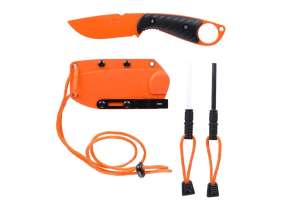
Ka-Bar is still one of the most recognizable names in knives, and for good reason. Mention the name Ka-Bar and everyone knows what you’re talking about, but very few would immediately picture the Ka-Bar LDK, or Last Ditch Knife. Noted trainer Greg Ellifritz designed the knife as an option that could be carried on-person in such a way that a casual search would miss it after his travels in South America, where kidnapping was a concern. The sheath has multiple holes, so choosing how to carry it is truly a choose-your-own-adventure experience. It can be laced up in boots, slid into a wallet, or hung down the back of your jeans off a belt loop, as Ellifritz recommends. While it may be small, it’s mighty, and it’s designed to mimic a #11 scalpel blade. And it’s out the door for less than $25 — we’ve all spent more on less useful novelty.
$50 to $200
There’s a lot of ground to cover in knives, and for those who are really into the tool, higher-end options are quite desirable. Your shop may top out in this category, and that’s fine, but this really is the midline of even mainstrem knives.
Sticking with Ka-Bar, the TDI is a great fixed -blade defensive knife that works well for EDC purposes as well. It fits well in hand and is quite secure for cutting boxes or cordage. With an MSRP around $70, it can fit in just about any case as a fixed-blade option, with a slightly different design than usual.
Two models from CRKT slot in next, with the Viento at $75 and the M16-03XK at $85. They’re similar prices from the same brand, but with very different profiles. The Viento stuck out to me because of just how smooth that flipper system is and the sheepsfoot blade profile. I’ve already mentioned I’m a sucker for a Wharncliffe, and the sheepsfoot is similar enough to get my attention. The M16 is one of the latest additions to the popular family from CRKT. It uses a crossbar lock and ball-bearing pivot for a silly-smooth-silly-fast one-handed deployment. The handle is made from Grivory, which is an aircraft-grade thermoplastic with a ridiculously positive grip. Both of these models from CRKT present a unique profile that will stand out in even a crowded knife case.
Speaking of standing out, we need to touch on a couple offerings from Shivworks as well. Designed by Craig Douglas, one of the most prolific and respected trainers out there, with a focus on edged weapons, the Clinch Pick 2.0 (MSRP $122) and Push Dagger (MSRP $137) won’t look like anything else in the case. The Clinch Pick is a small fixed-blade designed to be worn horizontally on the waist, with a slight downward tip of the handle. It’s just a 2 5/8-inch blade, but the oversized handle provides a great deal of control, and as an EDC knife, it’s been designed for close-quarters engagement.
The Push Dagger is the knife for people who don’t want to learn to knife fight. Designed to be gripped in a close fist and deployed as an extension of that fist, delivering a thrusting blow when making impact, it’s been made to resist rolling in the hand and to be easy to conceal. If you want something with a lot of eye appeal in your knife case, few things on this list will draw more “what is that” questions than the Shivworks Push Dagger.
The Spyderco Lil’ Temperance 3 Lightweight rounds out this middle tier. Made in Japan, this sub-3-inch blade presents a beautiful non-traditional profile that maximizes edge length. At $180, you’re offering a lot of performance in a very packable EDC configuration, and a lot of style points.
MORE THAN $200
Not all brands will have options that hit this part of the budget line, and some brands are going to put their entire line beyond this point. Still, it’s good to have some premium offerings when premium shoppers come through the door.
We’ve touched on Spyderco already, so we’re going to add a couple more of their most popular blades that will attract attention from shoppers in the know. The Yojimbo 2 and the Para Military 2 both come in with an MSRP around $265. The Yojimbo was a revolutionary design by Micheal Janich, edged weapon and self defense expert, that brought the Wharncliffe blade profile to the tactical folder segment, and it has been incredibly popular since its arrival.
The Para Military 2 is a more traditional-looking Spyderco design, which has been knocked off and copied by dozens of imitators of less-than-reputable origins. With an overall length just over 8.25 inches, it’s the biggest knife in the list, with a good bit of that size coming from the open-backed handle design with grippy G-10 scales. It always feels under control in hand and is easy to work with.
Of course, if you really want to offer something different, you can lean into the world of titanium with the Spyerco Stovepipe. The clever-style stainless steel blade is a full 4mm thick, with a unique, eye-catching design. The handle employs two titanium slabs and a titanium backspacer. The whole thing uses a stonewashed finish, adding the final bit of curb appeal to an already spicy-looking knife. With an MSRP of $640, it might not be everyone’s EDC knife, but you’d be surprised how many folks would give it a look.
If you have the kind of clientele that can support this end of the knife market, you might also look into some names like Emerson or Microtech, but the list goes on and on. Your customer can help tell you what they want to see when you start showing that you’re willing to make the investment.
Other Considerations
We didn’t touch on it, but don’t forget the classic Swiss Army Knife, whose appeal never seems to go out of style. It makes for great gifts for those kids coming of knife-carrying age.
You might also look locally to find custom knife makers. Home forges have gotten more popular of late, and you may find a local maker looking to place his work in a shop where he can get some more visibility with some more mainstream designs.
There’s no one way to sell knives well, but you can certainly screw it up if you aren’t willing to put the time into building out an offering that gives your customers options of style, price, and configuration.
Stay sharp.