
Not that long ago, the very term “9mm” referred to a pistol. For good reason, considering the millions of 9mm semi-automatic pistols across the globe.
But with the popularity and versatility of the 9mm round, gunmakers began building it into non-pistol platforms. One gunmaker that has experienced real success in doing so is Henry Repeating Arms, manufacturer of the Homesteader semi-auto carbine.
Yet, as I watched companies like Henry roll out rifles chambered in 9mm, I kept asking myself: What the heck does one do with a 9mm carbine?
Really, all I needed to do was examine the uses and functionality of the many lever-action rifles chambered in handgun rounds to answer that question. But I did things a little backwards. First, I had to experience several range sessions with the Homesteader and run 150 rounds down that 16-inch barrel.
As I was shooting, I figured it out.
The Henry Homesteader is a nifty little rifle, a solid choice for home-defense and for the truck, will help control the local varmint population, and is a real pleasure to just shoot. It is also a great first rifle for the young person, especially given the lighter weight and minimal recoil of the carbine.

Features
Henry offers the Homesteader in six different variations. All the rifle models feature the same 16.37-inch barrel and are magazine fed. Variations concern which non-Henry magazines specific models can use and whether the barrels are threaded.
For testing and evaluation, I received the Homesteader Model Number H027-H9G. The rifle weighed in at just 6.6 pounds and was 35.75 inches long. It features a blued steel barrel, threaded, and a hard anodized aluminum receiver. This model includes a magazine well adapter for Glock 9mm magazines (more on magazine options below). As with all other Homesteaders, five- and 10-round Henry magazines were included.
The American Walnut stock features sling studs and a rubber butt pad. The perceived recoil is counteracted with a reciprocating mass inside the forearm, getting me back on target faster from shot to shot. That soft recoil will also be a plus for new shooters and the recoil sensitive. For even greater control, leather-like texturing at different points of the stock provides non-slip surfaces.
The carbine operates on a simple blowback action to cycle the bolt and load/unload rounds. The bolt locks back when the magazine is empty. The ambidextrous bolt handle can be easily changed from side to side by the shooter.
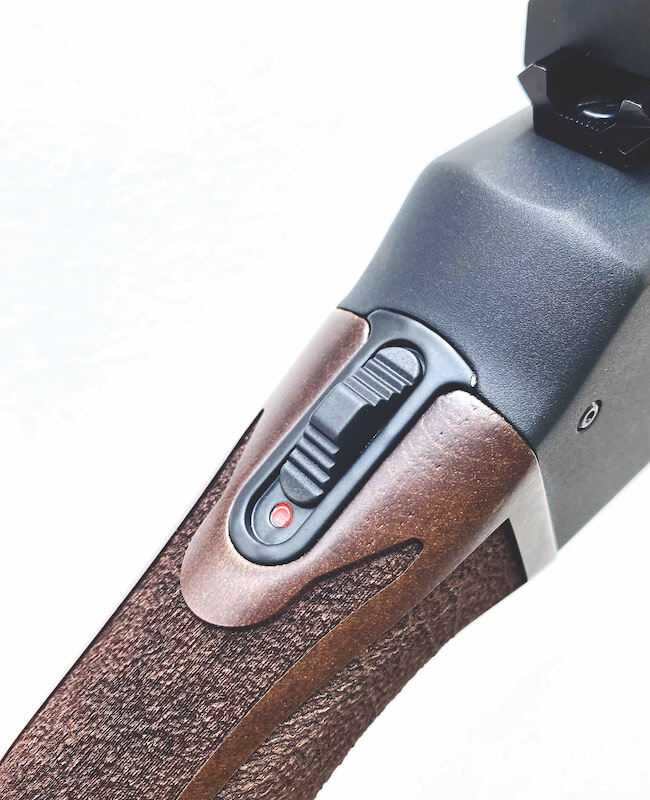
Controls include a bolt hold-open lever pressed from the right or left side of the carbine, a top-mounted thumb safety switch, and a centrally located bottom-mounted magazine release toggle.
Magazine Options
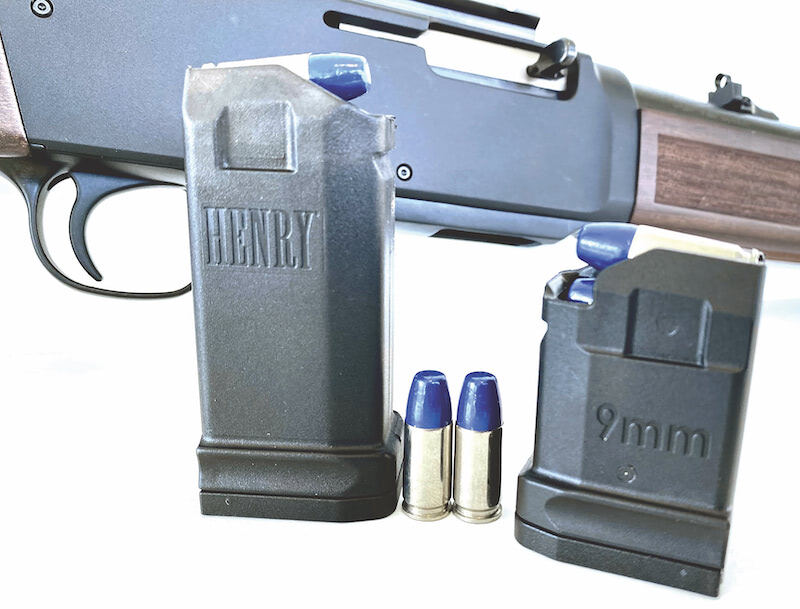
As noted, my Homesteader model included a mag adapter well for Glock 9mm magazine. The Homesteader is also available with a mag adapter for SIG Sauer or Smith & Wesson M&P magazines.
Henry’s instructions for installing the mag adapter start with removing three cross pins from the receiver. Once the pins are tapped out, the trigger group and buttstock assembly pull away from the receiver. The original magazine well pops out and the new mag adapter slides up into place. Cross pins are re-inserted, and the shooter is ready to use his or her Glock, SIG or Smith magazines.
For maximum reliability, Henry recommends the use of double-stack 3rd, 4th, or 5th Gen OEM Glock G17 or G19 magazines, OEM SIG P320 magazines, and OEM M&P double-stack magazines, with the Homesteader’s respective magazine well adapters.
Optic and Mount
The Homesteader arrives from the factory equipped with an adjustable full-aperture rear sight and screw-on front post sight.
Frankly, though, I’m past the age where a peep-sight works for my eyes; evaluating a rifle like the Homesteader with the standard iron sights would actually be a dis-service to the rifle and the manufacturer. As in, my groups with eyes unaided would not tell the truth about the rifle’s accuracy.
But Henry drilled and tapped the carbine’s receiver for a Weaver 63B optics base, which I installed.
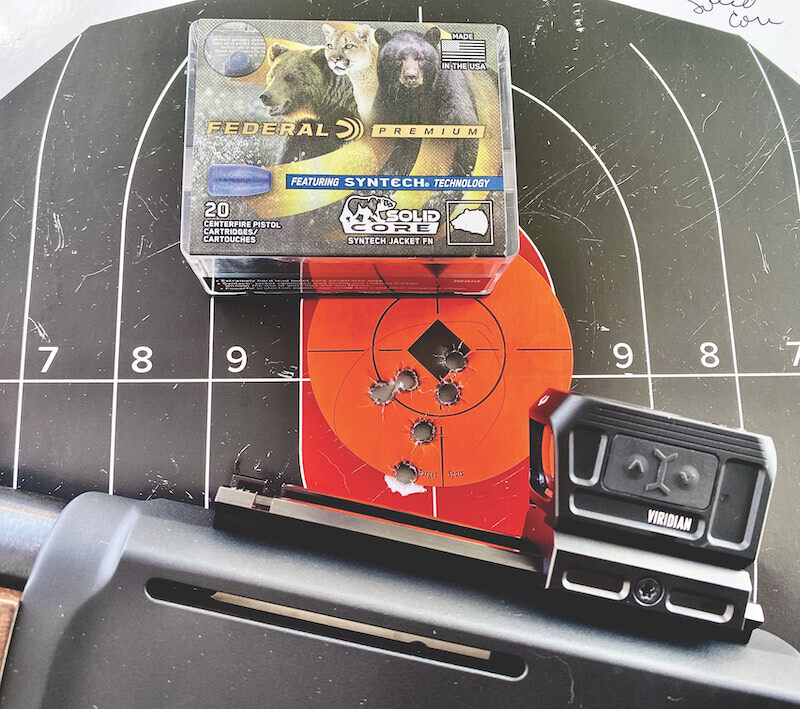
Next, I mounted an RFX 45 closed emitter reflex optic made by Viridian Weapon Technologies, real pros at designing and building reflex optics featuring green dots. Green, by the way, works much better for me and my eyes than standard red.
The RFX 45 sported a 5-MOA green-dot reticle, precise controls and various different mounts. The housing of the RFX 45 was machined from 6061 aluminum. The lenses were fully multi coated and featured Viridian’s INSTANT-ON activation with memory and auto shut off. Viridian rated battery life at 50,000 hours for one CR2032 lithium battery.
Shooting Time
For 9mm ammunition, I used Federal Ammunition Solid Core +P featuring a 147-grain Syntech coated bullet, First Breach Precision range and a 124-grain full metal jacket, and Sierra THD with its 124-grain jacketed hollow point.
I zeroed the Homesteader and RFX 45 at 20 yards using the First Breach, and I was soon punching five shots at 1.0 inches and better.
Still using the First Breach, I jumped to my 50-yard lane. Here, I soon realized the optic’s dot covered up my various bullseyes, making it tough to really place my shots as I would like. I shot a respectable 1.75-inch group with five rounds before I shifted down to the 30 yard lane.
Here, the dot size was a better fit for the targets and distance. I made five-shot groups with the Solid Core at 1.1 and 1.3 inches and a six-shot group at 1.5 inches. The Sierra THD pegged the best groups at .80 and 1.20 inches.
I’d be very interested in trying for even tighter groups with the Homesteader using a small, magnified optic, possibly a prism scope or a red-dot with magnifier. I had some options on hand, but none would fit the Weaver base.
Throughout my shooting, recoil was minimal. I experienced no failures to feed ammunition or to eject spent brass. The tang-mounted safety was an easy reach for my thumb, clicking in and out of SAFE without a hitch. The magazine release button popped out magazines positively.
The trigger pull on my rifle averaged 2-pounds, 14 ounces. The trigger broke cleanly though it did experience a bit of over travel after the break.
One-on-One with Dealers
Henry provides its dealers with a wide array of in-store offerings to help sell its firearms.
“We are always happy to supply our dealers with in-store signage and packs of catalogs on request,” says Dan Clayton-Luce, Henry’s vice president of communications. “If a dealer is interested in a flyer or brochure on a specific product, we're always willing to make that for them, even if we don't already have it designed or printed.
“Providing our dealers with the necessary support to succeed with our products is a top priority for us. Simply get in touch, and we'll be happy to help to the best of our abilities!”
Though it doesn’t have official training or promotional programs in place, Henry can and will help its dealers in each of these areas.
“We've learned that each dealer has unique needs,” Clayton-Luce explains. “We prefer a one-on-one approach to build up a relationship, and we're flexible in terms of what we're willing to do for Henry dealers if they're going to go up to bat for us behind the counter.”
Selling Homesteaders
The Homesteader is a good-looking rifle, but as Clayton-Luce notes, “This is a working gun through and through, meant to be a valuable part of someone’s ‘toolbox.’"
And the toolbox is roomy.
“The beauty of a 9mm carbine is its versatility, meaning it can wear many hats simultaneously,” he adds. “Let's say someone needs a great option for home defense, already owns a 9mm pistol with magazines that the Homesteader accepts and happens to have a varmint problem on their property. The Homesteader 9mm is a perfect fit.”
Sales staff should stress the low recoil, too, and note that this isn’t simply a function of a pistol round in a full-size platform. Explain that Henry designed and built the carbine with a reciprocating mass inside the forearm to further mitigate the already soft recoil.
That soft recoil is also a big plus for selling the Homesteader as a first gun for younger shooters.
One-on-One with Dealers
Henry provides its dealers with a wide array of in-store offerings to help sell its firearms.
“We are always happy to supply our dealers with in-store signage and packs of catalogs on request,” says Dan Clayton-Luce, Henry’s vice president of communications. “If a dealer is interested in a flyer or brochure on a specific product, we're always willing to make that for them, even if we don't already have it designed or printed.
“Providing our dealers with the necessary support to succeed with our products is a top priority for us. Simply get in touch, and we'll be happy to help to the best of our abilities!”
Though it doesn’t have official training or promotional programs in place, Henry can and will help its dealers in each of these areas.
“We've learned that each dealer has unique needs,” Clayton-Luce explains. “We prefer a one-on-one approach to build up a relationship, and we're flexible in terms of what we're willing to do for Henry dealers if they're going to go up to bat for us behind the counter.”
Selling Homesteaders
The Homesteader is a good-looking rifle, but as Clayton-Luce notes, “This is a working gun through and through, meant to be a valuable part of someone’s ‘toolbox.’"
And the toolbox is roomy.
“The beauty of a 9mm carbine is its versatility, meaning it can wear many hats simultaneously,” he adds. “Let's say someone needs a great option for home defense, already owns a 9mm pistol with magazines that the Homesteader accepts and happens to have a varmint problem on their property. The Homesteader 9mm is a perfect fit.”
Sales staff should stress the low recoil, too, and note that this isn’t simply a function of a pistol round in a full-size platform. Explain that Henry designed and built the carbine with a reciprocating mass inside the forearm to further mitigate the already soft recoil.
That soft recoil is also a big plus for selling the Homesteader as a first gun for younger shooters.