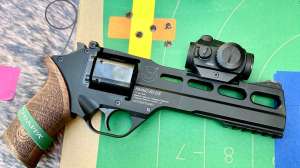

Large, extremely powerful and damned intimidating. That’s the quick take on Chiappa’s newest firearm, the Rhino Revolver L Frame 60 DS chambered in .44 Rem Mag.
When I unboxed the handgun, I immediately thought of the classic detective movie, Dirty Harry, and the scene where the bad guy Scorpio sees Harry’s massive .44 Mag. Revolver. “My! That’s a big one,” Scorpio says.
This was my first time running a Chiappa Rhino. Despite some initial apprehension on my part, I discovered a first-rate revolver for hunting and home defense, as well as one cool and unique-looking magnum to take to the range.
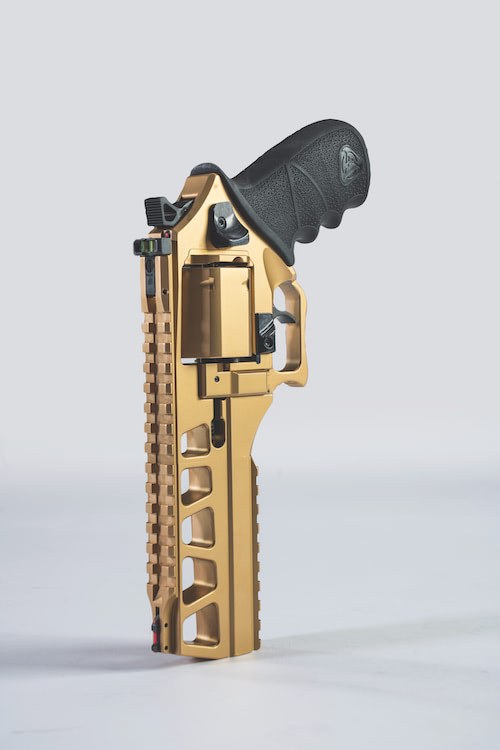
“Unique,” as the 60DS L Frame .44 Magnum features the same bottom cylinder bore axis that made the Chiappa Rhino so well known. Here, the round at the very bottom of the cylinder fires off, with the barrel approximately 1 inch lower than the barrel on a traditional magnum revolver.
Chiappa claims that this low bore results in low recoil and minimal muzzle flip compared to other revolvers chambered in the same rounds. “Low” and “minimal” can be very difficult terms to nail down in a pragmatic sense. Based on the 150 rounds of magnum ammunition I ran through my test Rhino 60DS, however, I believe Chiappa is generally correct.
Of course, magnum loads in a handgun produce recoil and muzzle flip. No way around that. But this low-bore operation did push that recoil back into my hands in a way that other big-bore magnums I’ve fired simply do not. The effect was to spread out the recoil more rearward, giving me more control and, in the process, reducing muzzle flip.
Credit also goes to the hefty, shock-absorbing Houge grip that is standard with this revolver.
Test Specs
Chiappa’s new .44 Magnum 60DS standard lineup is available in four finishes: Black, Gold, Nebula and White Nickel. There is also a Rhino DS60 L-Frame Special Edition limited to 440 revolvers finished in an impressive Navy Cerakote.
I received the White Nickel model for testing and evaluation.
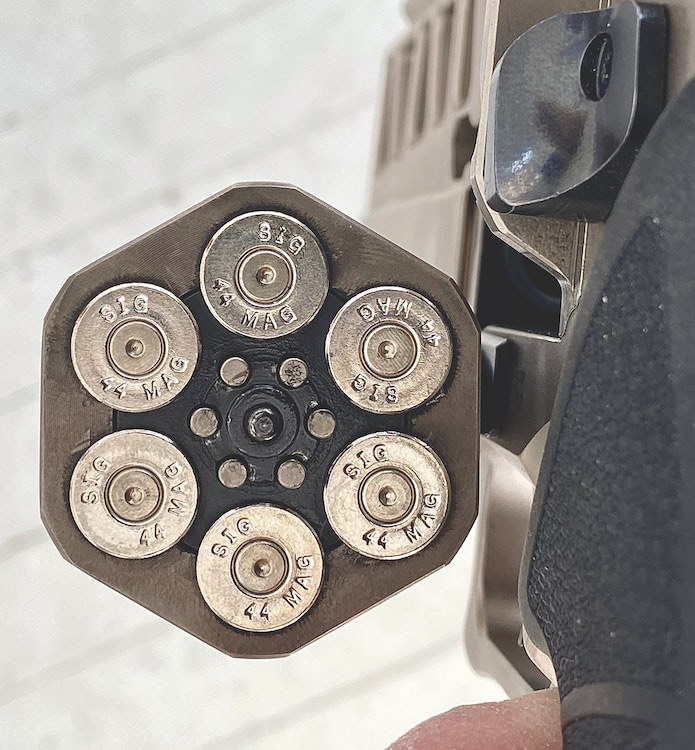
Each 60DS model features a 6-inch barrel and a six-round cylinder, both made of steel. Chiappa fashioned the frame from 7075-T6 aluminum. A fiber-optic fixed front sight and a fully adjustable fiber optic rear sight are standard. A very comprehensive set of safety devices are built in, including a cylinder block safety, a rotation lock safety, and a hammer block safety.
The Rhino operates from both single action and double action. The single action here is a little different than single action in other revolvers I’ve shot. Once the Rhino’s hammer cocks back to initiate single action, that hammer then eases back down. It does not stay back in the cocked position like a traditional revolver. A tiny red indicator pops up to the left of the hammer to indicate the handgun is now in single action.
To handle the .44 Magnum loads, Chiappa enlarged the revolver’s L-Frame over previous L-Frame models. The company also updated the revolver’s ergonomics to include twin finger stops and revised the grip’s placement to improve leverage and to encourage repeatable hand placement.
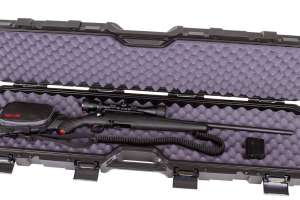
The Rhino 60DS weighs a hefty 2.92 pounds unloaded and measures out a full 11 inches long. Each revolver sells with a Chiappa hard case, owner’s manual and Rhino sticker.
The Black finish model carries a suggested retail of $1,470, my White Nickel at $1,545, while the Gold comes in at $1,745 and the Nebula at $1,835. The Blue Navy Cerakoted Special Edition tops the price list with a suggested retail of $2,145.
Shooting Stock
At my outdoor range, I familiarized myself with the Rhino and determined if the open sights were on. I started shooting at 12 yards from a rest and the sights were in fact positioning the rounds low. I made the needed adjustments to the rear sight and walked the rounds into the bullseye.
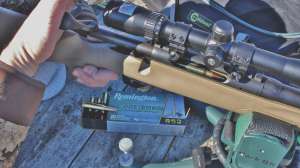
My shooting began with Remington High Terminal Performance .44 Mag. loaded with a 240-grain bullet and they grouped nicely.
I then switched to SIG Sauer’s Elite Performance V-Crown rounds launching a 240-grain jacketed hollowpoint. Once I was sure those rounds and the sights matched up (they did), I shot the Rhino offhand at 8 yards in double-action mode.
Here, I used the Dual Zone Silhouette targets made by Caldwell Shooting Supplies. As the targets themselves noted, the Dual Zones at 5 yards replicate a 6-foot tall target at 10 yards.
My best five-shot group at this distance in double action was 1.8 inches with three of the shots hitting within an inch of each other.
I backed up 2 yards and shot in single action. The best five-round here pegged in at 1.35 inches.
The pair of fiber optic sights came right up to my eye, the two green dots on either side of the rear notch nicely setting off the red dot on the front post.
A Rhino for home- and self-defense? Check.
Hunt Ready
Overall, though, the Rhino DS60 struck me as a hunting revolver. So, the handgun needed an optic; at least it did for my eyes.
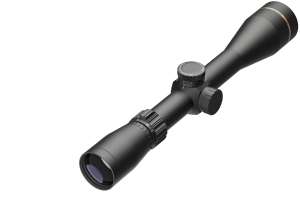
I went with the SIG Sauer ROMEO8T-AMR red-dot featuring a roomy 40mm objective lens, Sig’s Quad Ballistic Circle Dot, and 0.5-MOA elevation and windage adjustments. Very compact at 2.85 inches long and weighing 9.5 ounces, the optic runs on one CR123 battery.
Yes, ROMEO8T-plus-Rhino made for a rather large rig. But I was already deep into the large format with the Rhino, so adding 2.0 inches atop the handgun rail wasn’t a deal breaker.
I first zeroed the ROMEO8T-AMR at 12 yards from a rest, using Federal Power-Shok hunting ammunition and its 240-grain jacketed hollow point. I was on target in six rounds.
Then I moved onto 30 yards, where my first shots were a couple inches high. The elevation control on the optic quickly got me on target.
I shot several five-round groups from a rest with the Federal .44 Mag, and they came in at an average of 1.5 inches. My last three rounds made a 1.25-inch group.
Last, I ran the handgun with Hornady Handgun Hunter ammo, firing a 200-grain Monoflex bullet. Point of impact didn’t change with the new loads, and I fired off four groups of five shots. Average size, 1.30 inches. My very best group with the Hornaday scored an amazing 1.0 inch, and I also made a three-shot cluster at .90 inches.
Throughout my shooting, the Houge grip provided a very solid hold thanks to the rubberized surface and roomy finger grooves.
Trigger pull in single action snapped off at a crisp 1 pound, 5 ounces on average. The double action came in at 4 pounds, 6 ounces, and presented a very smooth and consistent tension throughout.
Empty brass ejected easily with a push of the ejector rod. Last, the under-barrel rail can hold a light or laser or will work fine for attaching to a bi-pod or tripod.

Sales Tactics
The Rhino DS60 begs for a full profile display to show off just how different a look the revolver presents.
Once a customer puts eyes on the handgun, don’t hesitate to explain the revolver’s low bore axis and how that helps control recoil and muzzle flip.
Consider adding a small placard or shelf talker with a simple diagram showing traditional revolver barrel placement versus the Rhino placement. Use concise copy such as, "Fires from the bottom chamber to reduce muzzle rise."
Stress, too, that the Rhino’s double/single-action trigger system allows both deliberate precision shots and smoother double-action pulls. Mention that the integrated safety features (cylinder block, rotation lock, hammer block) are carried over from prior Rhino designs. Go over the multiple finishes available, too.
Dealer Info
Independent FFLs can purchase directly from Chiappa or through distribution.
Chiappa works with most of the major industry distributors, including Bill Hicks & Co., Camfour, Chattanooga Shooting Supplies, Lipsey's, RSR, Sports South, and Zanders.
Retailers interested in becoming a Chiappa dealer need only send an email to info@chiappafirearms.com expressing interest. A Chiappa representative will reach out soon afterwards.
The Rhino DS60 in .44 Mag. received significant media coverage during and immediately following the January 2026 SHOT Show, with more set to appear throughout the year.