
It took roughly 170 years, but Smith & Wesson re-entered the lever-action rifle market with a splash when it introduced the 1854 line in 2024. By now, most hunting retailers are familiar with their features, and so are most of their customers.
Reviews have been good, but there’s more to weigh before adding any gun to inventory. The timing is ideal for the 1854 Stealth Hunter, and the rifle has assets rarely mentioned in its widespread coverage. Mention a few at those at the counter and it gets attention, but in many areas of the country, sportsmen won’t even need the sales pitch.
Straight-Wall Demand
More states have made straight-wall cartridges legal for pursuit of big game than ever before. Smith & Wesson’s 1854 Stealth Hunters fall squarely into that category, attracting the attention of hunters previously limited to slugs and blackpowder — even if just out of curiosity.
The shift has been dramatic, and a breath of fresh air for FFLs is a period of lukewarm firearm sales. One executive at a major manufacturer, who asked to remain anonymous, said the company’s new straight-wall cartridge-chambered rifle grew to become the firm’s top seller at a frightening pace.
The 1854 Stealth Hunter sent for testing was chambered in .357 Mag., suitable for whitetail in practiced hands at moderate distance. The rifle is, however, also available in harder-hitting .45 Colt and .44 Mag. Each arrive with a host of upgrades that add to the lever-action appeal, with the most notable one riding atop.
Modern Rail, With a Twist
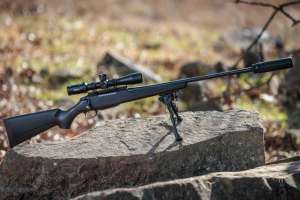
Picatinny rails have claimed receiver summits on virtually every modern bolt-action and modern sporting rifle made today. They are now routinely atop lever actions, including the Smith & Wesson 1854 Stealth Hunter.
It might defy the rifle’s traditional profile, but the upgrade is one many of today’s hunters demand. On the tested 1854, the rail measured 10 ½ inches long. It makes mounting an optic a breeze and eliminates eye-relief challenges that plague shorter versions.
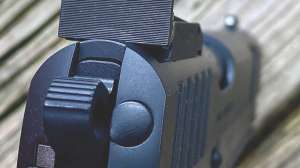
This isn’t your standard Picatinny rail, though. At the rear, a footprint — like those in pistol slides for mounting red-dots — is milled into the aluminum rail. The rear sight nestles inside, held firmly by lugs with a bolt as the final anchor. It’s a rugged design for affixing iron sights on any rifle.
Remove that single bolt and it can be fully removed. Point-of-aim and point-of-impact don’t wander in doing so. Toss those rear sights in a drawer, or in a pocket for a field-expedient backup, remount, and it’s back on target.
The rear sight rides roughly ¼-inch above the rail, so it won’t impede view through a scope after mounting. Some owners might opt to remove it for cosmetic reasons, although even low-mount bases won’t make it mandatory.
Part of the versatility is found in the sights that ship on the 1854 Stealth Hunter. They deserve mentioning at the sales counter as well.
Stock Sight Picture
Smith & Wesson did not cut corners when it comes to sights. The rear sight is a windage- and elevation-adjustable XS Sights Ghost Ring. As shipped, aperture measures 0.191 inch. Constructed from steel, it’s rugged, shuns the elements and can take a beating.
XS also offers different ghost ring diameters that screw right in. To adjust windage, loosen the vertically oriented bolt on one side of the sight, then tighten the bolt on the other until snug. It’s an old-school system, but unfailingly reliable and refreshingly simple.
Changing elevation is akin to doing so on the front post of an A2 sight, except it’s also done at the rear on the XS. Loosen the bolts mentioned above, then screw the ghost ring up or down. Retighten the bolts and that’s it.
There’s more good news up front, where a Hi Viz Litewave H3 sight makes target acquisition fast and intuitive, regardless of lighting conditions. Its green fiber-optic tube glows brightly in broad or low light and, once night falls, a glowing tritium ring provides an accurate sight picture.
Its rugged steel construction ensures reliability and longevity. The main tube is well protected from damage; unlike some lesser models, it’s high enough for use with most suppressors. The fact that the Litewave H3 line is an extremely popular choice for home and self defense speaks volumes about the performance.
Forend
Smith & Wesson didn’t scrimp on design when it came to the forend, either. It piles onto the “takes a beating” theme with T6 aircraft-grade aluminum construction.
It has a total of 15 M-LOK-compatible slots, five each on the 3, 6 and 9 o’clock positions. Most hunters won’t be mounting lights and lasers, but they will find the generous number of locations a big bonus.
Mounting a bipod on a sling swivel stud can be a rickety headache, for example. With the number of companies making versions that lock solidly in M-LOK grooves, there’s no doubt more than a few 1854 Stealth Hunters will be equipped with one on opening day. They go on fast, remove easily and anchor solidly.
Adapters are also available for sling attachment. With the number of slots available, a customer can literally configure the rifle for his or her personal comfort. To anchor the other end, a traditional sling swivel stud is found at the rear of the rifle’s synthetic stock.
Ease of installation and removal makes reconfiguring the gun for home defense after a day afield quick. Add the number of safety features and the firearm is versatile in that role, as well.
Magazine
Smith & Wesson added a wise touch to the rifle’s tube magazine. Reloads are side-loaded through a gate on the side of the receiver, the traditional and field-expedient method.
When it comes time to unload, many lever-action models magazines require the lever must be worked until the magazine is empty. Owners of an 1854 also have the option of turning the magazine tube knob up front to remove the entire magazine, including follower, spring and ammunition that remains — with the exception of anything in the chamber.
Reloading is possible that way, although it be clunky. It’s a deceptively simple change, but it adds another layer of safety those who mentor new hunters can appreciate. The company didn’t stop there, though.
Push Button
The rifle has a crossbolt safety. When it’s engaged, the lever can be operated to remove a chambered round. A bright red ring shows when the gun is ready to fire.
More than a few critics don’t like the looks of a manual safety on the receiver, but this is a modernized lever action. The hammer, which is nicely textured, also has half-notch position to guard against accidental discharges. Smith & Wesson includes a hammer spur extension with the gun.
.357 Mag. or .38 Special
The gun ran flawlessly with both cartridges. Shooting magnum loads was pleasant, and recoil with .38s was barely worthy of mention. The generous recoil pad works well, although there’s not too much energy making its way through a 6.5-pound gun in either chambering.
Muzzle rise was minimal. The rifle’s an ideal choice for both opening day and leisurely afternoons plinking.
Barrel
The .357 Mag. model of the 1854 Stealth Hunter shipped in for testing had a 16.3-inch barrel. Rifling is right hand at a rate of 1 full twist every 14 inches.
It’s threaded 5/8x24 to accept muzzle devices, including suppressors. The gun ships wearing a thread protector.
Trigger and Accuracy
The trigger is single-stage and nicely textured to ensure a positive purchase when wearing gloves or sweating profusely during the 100-degree North Carolina day this one was tested. Let-off weight, measured on a Lyman Digital Trigger Pull Gauge, averaged 4 pounds 2 ounces.
Pistol cartridges are not intended for precision at distance. Accuracy results from the prone position from a sandbagged rest are more than adequate for most of the nation’s whitetail hunters and likely don’t reflect the rifle’s true potential. Blame the heat, but operator error is likely the real culprit.
In .357 Mag., Hornady’s LEVERevolution 140-grain load printed the best five-group average (three shots each) at 100 yards. It came in at 3.16 inches. Federal’s Hammer Down 170-grain printed at 3.49. Both loads are designed for lever actions, and there were no stoppages or malfunctions encountered.
American Eagle .38 Spl. 130-grain FMJ loads were individually loaded for test shooting (lead soft points were not available at the time). Groups swelled to 4.17 inches, and point of impact changed, something easily remedied with the XS Sight.
To ensure proper cycling, the magazine was filled several times with those American Eagle loads. The oversized lever loop was then cycled until it was empty. No stovepipes, failures to extract or other stoppages were encountered during that function test.
Overall
There’s no wood or fine finish to damage when afield. This rifle is all business, right down to the synthetic stock with texturing in all the right places, oversized lever loop and absence of fancy flourishes. It’s black, including the sparse Smith & Wesson names or logos, which only appear on the recoil pad, barrel and bottom of the hand grip.
It’s not going to magically attract diehard Western fans or enthusiasts eager to print braggingly small groups at long distance. What the Smith & Wesson 1854 Stealth Hunter will do is gain the attention of sportsmen who appreciate the lever-action legacy but expect unfailing performance, durability and modern versatility. Smith & Wesson delivers that in this rifle.
The fact new owners will be considering a few aftermarket accessories before they leave your shop is icing on the cake.