
Winchester Supreme Optics launched itself into the shooting sports marketplace in 2024. The line is produced under license, and the Olin Corporation owns the Winchester brand name.
Initially, Winchester Supreme introduced entry-priced lines of daytime optics, including binoculars, rangefinders and scopes. By early 2025, the new company entered the thermal market with three different units: the Supreme THSD 384 Thermal Hunting Scope, and the Supreme THSX 640 50mm and THSX 384 35mm Thermal Hunting Sights.
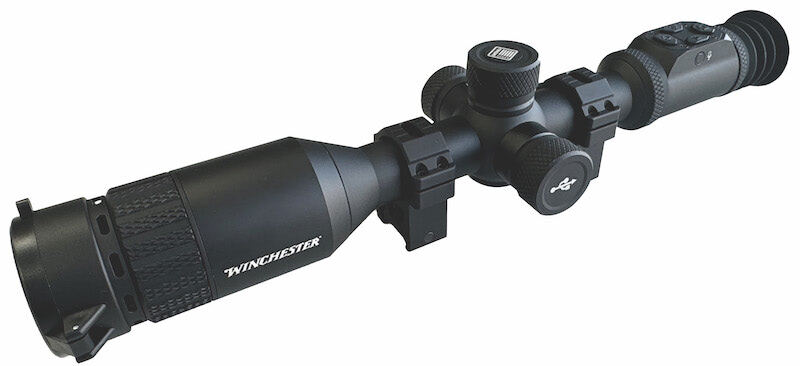
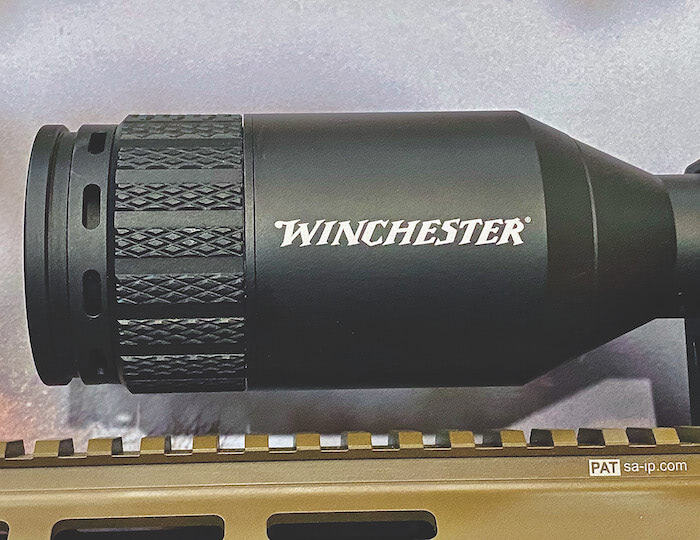
I ran the Supreme THSD 384 Thermal Hunting Scope recently. A mid-price unit built around a 384x2898 thermal sensor, the THSD 384 has all the features thermal hunters expect, including picture-in-picture, hot spot, multiple reticles and multiple color palettes.
In my shooting and scanning with the thermal, images were clean and sharp-edged. The thermal zeroed quickly, and the controls were easy to use and fairly intuitive. In all, the THSD 384 represents a solid value and is a great choice for entry- and mid-level night hunters.
Walkaround
In addition to the aforementioned 384 thermal sensor, the THSD 384 features 12μm pixels, an NETD rating of ≤30mk, and a 50Hz frame rate.
With its 35mm objective lens and a 1 to 8 digital zoom capability, Winchester rates the unit’s detection rate at 1,258 yards.
A single 18650 Li Ion battery, which is included, powers the unit. The battery compartment is located on the right side and center of the tube, with the USB-C port on the opposite side.
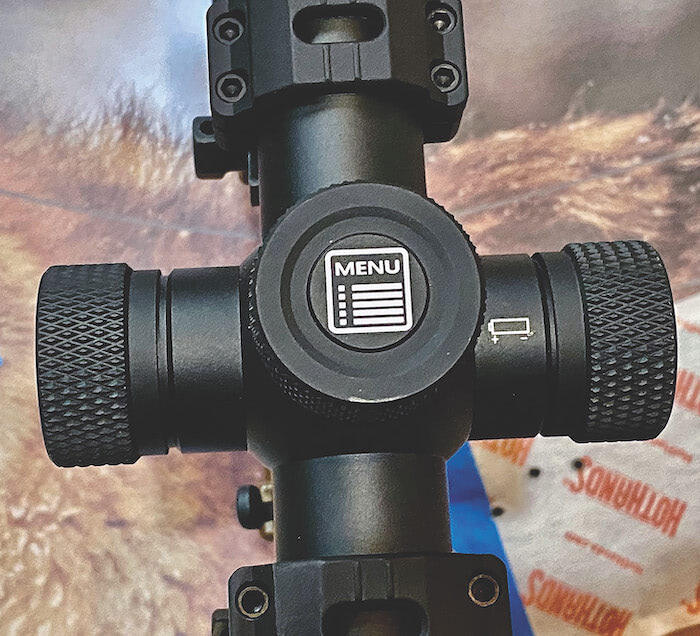
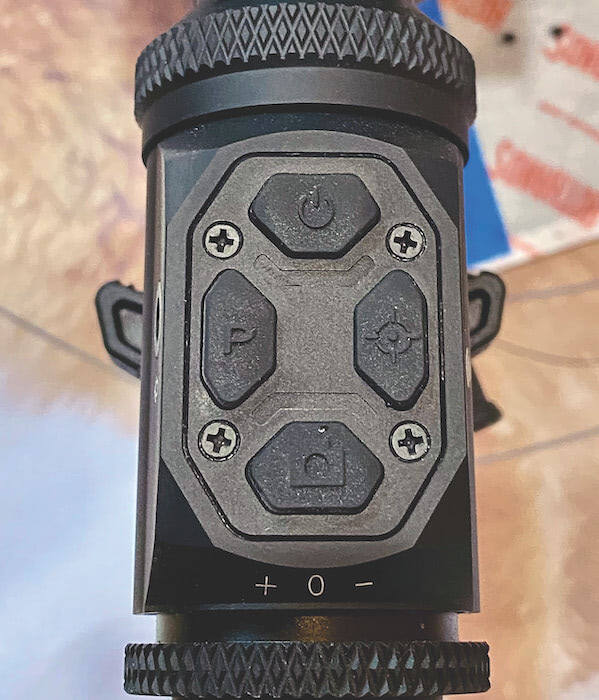
The MENU control is the top, center knob (what would be the elevation knob on a day scope) and the various menus are accessed by simply pressing down on the MENU knob and then selecting the needed menu. A rubberized control pad is also located directly above the diopter and includes the ON/OFF tab, the camera control and the palette selection button, as well as the zeroing button.
For the above media, the unit holds 64 gigabytes of internal memory.
The left side of the tube’s rear contains a tiny microphone; the right side a Wi-Fi antenna and the unit can perform live Wi-Fi streaming.
This thermal does have an internal ballistic calculator, and a hunter can add all the required ballistic information for a specific round. However, the unit does not have an internal or external rangefinder. To me, the lack of a rangefinding capability makes the ballistic calculator of very limited use.
One could, of course, accompany the THSD with a thermal handheld with rangefinding capability and then plug the distances into the ballistic calculator. But that’s many moving parts, at night, for the hunter who needs to make a shot before the animal moves away.
At approximately 16.5 inches long, the THSD 384 weighs in at 28 ounces without the mounting rings.
The thermal package includes mounting rings, a flip-up lens cover for the objective lens, a rubber eye cup that’s easily removable, a USB-C charging/data cord and one 18650 Li Ion battery.
Also included is a lockable, waterproof hard case with a purge valve and customizable foam.
Good Guidance
Of course, there’s a THSD 384 owner’s manual included, and while it might seem like a small thing, this manual is an outstanding guide for the user.
I bring this up because so many of the thermal manuals I’ve used (and tried to use) have been confusing and at times outright contradictory. Many simply list the specs and tell you helpful information like, “Insert the battery and turn on the unit.”
Uh-huh.
But this owner’s manual provides very clear explanations of, for example, how to zero the unit and how to set up hot-spot tracking, enhanced by photos of what the user sees while tooling around within the various menus.
First-rate!
Test Setup
To test out the thermal, I mounted it on a new SAINT Victor 5.56 AR-15 Rifle made by Springfield Armory (reviewed in this issue.)
The rifle sported a Coyote Brown Cerakote finish on the frame, receiver and handguard. The aluminum handguard featured a full-length top Picatinny rail with T-slot markings, and ample M-LOK coverage. The Radian Raptor-LT charging handle worked easily to charge the rifle even with the end of the thermal hanging right above the handle.
The B5 Systems Enhanced SOPMOD stock adjusted back and forth smoothly, while the sandpaper-like texturing on the sides and front of the B5 Type 23 P-Grip pistol grip provided a very firm hold.
I removed the SAINT’s four-pronged muzzle brake and installed an Operator 5.56 suppressor. Made by newcomer Engaged Industries of Elsberry, Missouri, the Operator 5.56 featured the company’s patent pending VLB25 baffles. They utilize Vacuum Expansion technology to restrict the flow of gas and at the same time significantly reduce the reverse flow of gases.
For ammunition, I relied on Federal Premium American Eagle Varmint & Predator .223 Rem. launching a 50-grain jacketed hollow point bullet.
Taking Aim
My shooting began with zeroing the thermal at 50 yards and shooting at HotHands heat packs taped to cardboard sheets. It was 48 degrees Fahrenheit and overcast that day at my outdoor range, though the winds, gusting between 14 and 22 miles per hour, made it feel like the mid-30s.
My initial shots hit the cardboard a bit high and several inches left of the HotHands pack. I accessed the thermal’s ZERO function (which I’d already set for that distance) and pressed the FREEZE application while holding the reticle steady on the HotHands. This froze the reticle in place.
With some units, the FREEZE function then displays a secondary reticle, which the shooter places over his/her first shots, and then saves. Next shots should be on or at least much nearer the target.
But the THSD 384 setup was a little different. Once FREEZE was pressed, a Y-Axis line was displayed to the left of the reticle, the X-Axis line below the reticle. Then, I selected the axis needed and used the MENU control knob to move the Y axis up or down to the impact point of my shots, the X axis to the right or left.
It took a few more times of doing the shoot/FREEZE/adjust process to get me on the heat pack but I was soon placing shots grouped at an inch and better.
At 100 yards, I needed to first adjust my zeroing distance and then took a couple shots which hit, as expected, a little high. A FREEZE and adjustment had me on target quickly.
I shot at a smaller and a larger HotHands taped to a life-sized coyote target made by Delta-McKenzie Targets.
My final five shots at the center mass heat pack came in at 1.3 inches, my last three at the smaller pack taped to the head area at .85 inches. With those gusting winds? Pretty darned good accuracy from the thermal and the rifle.
Images were very clear throughout my shooting. With my eyes and the overcast, I found the unit’s green reticle paired with the red-hot color palette worked best. The 5x zoom I employed during my 100-yard shooting was more than sufficient even with the palm-sized and smaller heat pack as my targets.
A coyote or hog would stand out like a beacon at two to three times the length of a football field.
Name Recognition
“Winchester is offering thermals now?”
This may well be a customer’s reaction to the THSD 384 and other Winchester branded thermals on your shelves. And once you have their attention, what do you tell potential customers to make them actual Winchester thermal buyers?
“Let them know the THSD 384 provides high-contrast thermal imaging that picks up heat signatures through darkness, brush, fog, and smoke,” said Steve Lemenov, senior director of marketing for the Ecentria Enterprise Group, a wholesaler which oversees Winchester Optics and other companies. “Point out and then let the customers run the intuitive controls, let them change color palettes and try out the various reticle options.”
He added that the unit is weather-resistant, an important factor for night predator hunters. With its IP67 rating, the unit is dustproof and can be immersed in 1 meter of water for 30 minutes without water damage occurring. It can take on hard-recoiling rifles, too, up to .300 Win. Mag. And the thermal operates at a temperature range of -22 F to +122F.
Lemenov also suggested that counter staff keep a charged floor model and a heat source ready to show customers the unit in action.
“Have a staff member place a hand on a wall for 10 seconds and then remove it,” he added. “Instruct the customer to scan that spot on the wall. They will be impressed!”
The company also supports and works closely with its dealers.
“We provide a range of marketing materials to help our dealers effectively promote Winchester Supreme Optics products and we’re always open to supporting additional requests that align with sales goals and in-store success,” Lemenov said.
Current materials include counter cards and display signage, and one-page quick reference sheets for staff and customers. Many digital assets are available to Winchester Optics dealers, too, including high-quality product photography, spec sheets, short video clips, and social media content.
Winchester Optics reps can provide sales staff with live Zoom sessions and product walk-throughs. Co-op Advertising is available during promotional periods, subject to approval and brand guidelines.
The company also offers periodic sales incentive programs for staff on qualifying SKUs during key promotional events.
Stock and Start
Retailers can buy units directly from Winchester Optics or through distribution.
“We proudly partner with a select group of established distributors within the optics and shooting sports industry, including Sports South, Zanders, and RSR Group,” Lemenov explained. “For the most up-to-date list of authorized distributors in your region, please contact our Dealer Support or your territory representative.”
He added that direct accounts are offered to qualified dealers and that opening order/minimums apply.
To become a Winchester Supreme Optics dealer, a retailer needs to submit a dealer application directly via the Winchester Optics website at winchesteroptics.com/dealers.
Winchester Supreme Optics is expanding thermal coverage across digital reviews, hunting channels, and category media.
“Additional reviews, field tests, and seasonal content are in the pipeline tied to predator and hog hunting seasons and key retail moments.”