
I screwed my eyes, clicked my heels three times and repeated, “There’s no place like home” — hoping, like Dorothy, in the 1900 classic tale by L. Frank Baum, “The Wonderful Wizard of Oz,” to somehow be magically transported to the Sunflower State. Sixteen hours later, I turned into the driveway of the farmhouse converted to a hunting lodge where my good friend Ted Jaycox, owner of Tall Tine Outfitters, hangs his Kansas shingle. I’ve hunted with Ted many times, so my return to pursue whitetails in the southwestern region of the state was a homecoming of sorts.
If this hunt felt like a do-over, it’s because that’s just what it was, and I felt a slight wave of déjà vu wash over me as Ted helped unload my gear. “Why don’t you check the zero on your rifle and then we’ll take a ride,” he said. “I’m going to have you drop off Dean in the morning and then drive to your blind.” Dean Capuano from Swarovski Optics was one of three long-time buddies joining me on this hunt — Mossberg’s Linda Powell and freelance writer extraordinaire Brad Fenson rounding out our motley crew. We’d all shared camp on several occasions, which added a homey feel to this repeat hunt that I’d been looking forward to for months.
But first and foremost, I was back in Kansas because I had unfinished business — to get the bad taste of my two previous visits there out of my mouth. Ted’s success rate on this hunt is over the top, even though he sets high standards to keep the quality of the deer on his properties at a premium. But, for me, bad luck and bad timing had conspired to result in two eaten tags in as many visits. During my first hunt, I’d played cat and mouse with a tall-tined buck, but ran out of time before I could drop the hammer on him. On the second hunt, a buck that would have easily scored in the 160s leisurely walked by my treestand at 100 yards — but as I eased the rifle to my shoulder, I noticed several broken tines and let him pass. The next day, a pack of seven coyotes ran off another shooter buck before I could get a shot. Get the picture?
I’d spent a lot of windshield time pondering the significance of this hunt on the drive out. Not only was it an opportunity to shoot the buck of a lifetime, it was also my chance at redemption. And as the landscape modulated from Minnesota woodlands to Iowa corn fields to the flat plains of Kansas, my anticipation — and sense of foreboding — increased. There were several plausible outcomes to this hunt, as I saw it: Three strikes and you’re out; Bad things happen in threes; Or maybe, just maybe, the third time’s a charm.
A quick trip around the country block and a couple dropped pins later, and I was ready for the morning hunt. And while Ted fed my optimism by producing trail cam pics of a beasty buck that had been frequenting the area, it was impossible to completely shake the feeling that I might be doomed to a three-peat.
Witchy Wind
It was in the low 30s — calm and foggy — as Dean and I pulled out of camp a full hour before first light, but the wind had kicked up considerably by the time I dropped him off on a fenceline that dropped down into a wooded draw where a hang-on treestand waited for him. I couldn’t help thinking, better you than me, buddy, knowing he was going to have a chilly sit in the exposed stand. I sent him off with a fist pump and continued around the block to my stand — thankfully, an enclosed prefab hay bale ground blind.
As I veered right at a split in the road a quarter mile from the gate where Ted told me to park my FJ Cruiser, I tapped the brakes, as a huge-bodied buck was momentarily illuminated in the headlights — just long enough for me to see his impressive headgear. But as (bad) luck would have it, he was headed in the wrong direction, away from my stand — a harbinger, perhaps, of things to come. No worries, I consoled myself, plenty of other bucks on this deer-rich property.
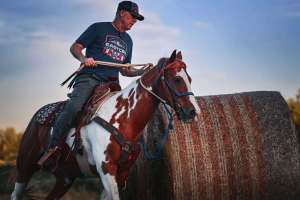
It was a lengthy hike in the dark to my hideout, the faux round hale bale perched on the crest of a hill overlooking a brushy hollow surrounded by CRP and agricultural fields. I quietly slipped into the blind, settled in and waited for shooting light. If it was blustery when I dropped Dean off, it was a full-blown windstorm now, threatening to carry me and the blind off to the Land of Oz with every powerful 35-mph northern gust. The wind apparently had the critters hunkered down, too. All in all, I saw a coyote at first light and then a couple of does and a small buck, but I was somewhat relieved — the blind was shaking so bad in the wind, it would have been difficult to get a steady rest and a true shot.
It was mid-morning when I hiked out and drove over to pick up Dean. It had been a slow morning for him as well — and a cold one, perched in the treestand. I cranked up the FJ’s heater and we headed back to camp to regroup and have lunch.
A Change of Scenery
While the weather had been blustery during the morning, it was the polar opposite by the time Ted drove me to my stand early in the afternoon — mid-50s and calm. He had decided to relocate me for the midday-to-dark sit, in an elevated box blind on the edge of a green field. As I settled in for the final four hours of shooting light, two does and their fawns meandered out onto the field and began feeding, followed shortly by three tom turkeys — perhaps a sign of good things to come. Once again, my anticipation was high because Ted had texted me a trail cam pic of a beautiful buck with skyscraper brow tines that was frequenting the field. “I’ve been getting him on camera about every other day — mostly at night, but sometimes during the day,” he told me on the ride out.
I was watching one of the does and her fawn feed on the opposite edge of the field when I caught movement in the woods behind them. I worked the focus ring on my bino until I had a sharp view of two eyes and the large antler frame of a mature buck. My heartbeat ramped up a notch as I tried to distinguish antler from branches, and when the big-bodied buck stepped out of the cover, I started doing the math. He was a decent buck — a wide, heavy-frame 4x4 — but a year or two away from fulfilling his potential. When hunting in Kansas, or any other destination where trophy bucks are possible (if not the norm) — if my immediate reaction isn’t “Holy Crap!” no amount of modern math is going to produce a shooter. The buck hung around for a short while and then melted back into the safety of the trees.
As the sun arced to the west, more deer poured out onto the field, including a couple young bucks — an 8-pointer and 7-pointer — and I was watching them spar when I caught movement to my left, as a large deer stepped out onto the field. Even at 150 yards, I didn’t need my bino to determine it was a shooter — tall brow tines confirming this was the buck Ted had showed me.
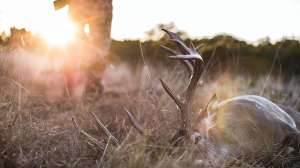
I eased the rifle to my shoulder, but the buck was feeding toward me with his head down and does were milling around in front of him, so I eased off the trigger. I didn’t feel rushed. There was still plenty of daylight, and he seemed content to feed on the green field and mingle with the does. I would simply wait for the right shot opportunity — which didn’t come for about 15 tortuous minutes! Finally, the two does that had been feeding in front of him cleared out and the buck gave me a broadside look. A tug of the trigger ended the drama as a 130-grain Hornady found its way to the promised land.
Mine was the first of four bucks our team killed during the four-day Kansas hunt. Linda and Dean tied their tags to massive, mature 4x4s, and Brad killed a bruiser that gross scored just shy of 164 inches the final evening of the hunt. For me, the curse was finally lifted, and the prize at the end of the rainbow was not only my largest whitetail buck to date, but redemption — the conclusion of a game I’d started several years earlier and finally had the opportunity to finish.
I don’t claim to be the sharpest knife in the drawer, but I believe I have a leg up on the Tin Man when it comes to hunting Great Plains whitetails. “I cannot understand why you should wish to leave this beautiful country and go back to the dry, gray place you call Kansas,” he admonished Dorothy in the closing pages of “The Wonderful Wizard of Oz.”
Dorothy (probably a deer hunter) was quick to set him straight. “That is because you have no brains,” she shot back. “No matter how dreary and gray our homes are, we people of flesh and blood would rather live there than in any other country, be it ever so beautiful. There is no place like home.” And for me, there most definitely is no place like Kansas when it comes to hunting whitetails.

A Perfect Match
The nice thing about hunting with industry folks such as Linda Powell (Mossberg) and Dean Capuano (Swarovski) is that they want you to use their stuff — to get real world feedback from time spent in the field. In this case, it was a marriage of rifle and optics — Mossberg’s Patriot bolt-action rifle and Swarovski riflescope and range-finding bino. And what better proving ground than a Kansas trophy whitetail hunt where these instruments of devastation can be put to the test — a high-octane bino for IDing trophy bucks and determining range, and a riflescope and tack-driving rifle for sending a high-velocity Hornady bullets downrange.
First the rifle (ladies first). It’s probably true that when most people think of Mossberg, they think of shotguns — because the company has been a forerunner in that firearms category for years. The Mossberg 500 alone has sold more than 10 million units since its introduction in 1961 and wears the moniker, “The most prolific and reliable shotgun in the world.” But Powell, who is Media Relations Manager for the firearms company, is quick to point out that the firearms manufacturer is far more than a shotgun company — that it also manufactures an extensive line of rifles and handguns that includes its tried-and-true Patriot.
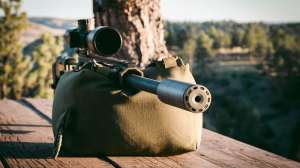
This handsome, traditional bolt-action rifle comes in a wide variety of flavors, including the newest edition to the family — the Patriot Carbine that Powell admits is her favorite because its abbreviated length makes it more maneuverable, especially when equipped with a suppressor. “More and more people are hunting with suppressors,” she said. “And when you add one to a traditional hunting rifle that will typically have a 22-, 24- or even 26-inch barrel, you suddenly have a rifle that’s not very hunting friendly. That’s why I chose the Carbine chambered in .308 Win. with a short 16.25-inch barrel for this hunt. Even with a 6-inch suppressor added, it’s a very manageable rifle, which is key when you’re hunting in heavy brush or out of a blind. It’s very easy to manipulate the gun safely and not have to worry about that extra-long barrel getting in the way.”
The Mossberg Patriot Carbine is equipped with all the features of the Patriot Predator but in a more compact package, sporting a shorter threaded barrel to accommodate a muzzle brake or suppressor and equipped with an 11-degree crown with a protective cap. This petite, easy-to-handle rifle is a great choice for multi-game, multi-season hunting. Attractive, accurate and affordable, the classically styled Patriot Carbine offers premium features at a great value: LBA adjustable trigger (2 to 7 pounds), threaded medium bull barrel, top Picatinny rails/scope bases, spiral fluted bolt, oversized bolt handle and box magazine. It is available in eight chamberings, with 16.25-, 18- and 20-inch barrel options.
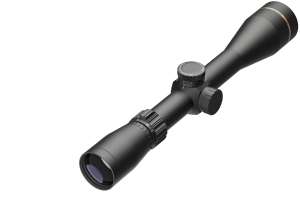
For optics, I went with Swarovski’s new Z5+ 2-10x42mm riflescope and 12x42mm EL Range bino. The scope is equipped with the company’s new Ballistic Turret. I chose this system because I prefer an uncluttered reticle, which is inherent in ballistic calculating systems such as this — simply determine the distance to the target, dial up the corresponding yardage, aim and pull the trigger, easy-peasy. At first blush, the Ballistic Turret System appeared to be a bit complex and maybe even confusing to master. But, as it turned out, zeroing-in and setting the yardage markers was intuitive and easy. For hunters who like to take the guesswork of hold-over out of the equation and simply dial up their shot, this scope/reticle combo is a great option. And in addition to the dial-and-shoot advantage of the Ballistic Turret, they get the quality and durability Swarovski is known for.
Dean Capuano says Swarovski was very excited to bring this new scope to market. “We took all the feedback from U.S. hunters and designed a scope that satisfies their needs in a compact and lightweight package,” he said. “This new 30mm riflescope features 80 MOA of total elevation adjustment and three magnification ranges to cover any hunting situation.”
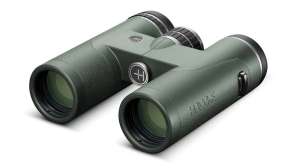
The Swarovski EL Range binocular has been out for seven or eight years, says Capuano, but is now available in a new 12X version. “Five or 10 years ago, it was really tough to go to a hand-held 12X binocular,” he said. “You needed a tripod or something solid to stabilize it. As we’ve progressed through the EL and the EL Range, we designed a binocular that’s so ergonomically correct and so comfortable in your hands, that using a 12X binocular is now viable. With the EL Range, you’ve got the built-in rangefinder, and you’ve got great field of view and great light-gathering capabilities. So, for hunts where a lot of game movement is super early and super late, it’s a great optic.