
Art, science and nuance all play pivotal roles in the sale of handguns. Focus on any one of those factors can result in strong handgun sales. Combine all three, and sales can be great.
Given all the factors in society these days, some folks might suggest that selling handguns is no more challenging than putting them in the display case and allowing customer demand to do the work.
That’s not much of an exaggeration regarding the philosophy of some shops. And those shops are likely missing out on additional initial sales and failing to capitalize on the potential to upsell and cross-sell.
Shooting sports statistics tell a fascinating story for those who want to delve a little more deeply into the subject.
There are an estimated 393 million firearms in civilian hands in the U.S. Of them, there are an estimated 157.5 million handguns, 65 million shotguns and 113 million to 180 million rifles, of which there are 20 million AR-type rifles.
We all know that any such numbers are estimates, and in the case of rifles, rough estimates. When estimates range from 113 million to 180 million, the difference is more than the total number of firearms in many countries. But since there have been firearms in the U.S. since before the Revolutionary War, there have been over 250 years for their numbers to build, even though every year there are a lot of guns that are lost.
For a contemporary reality check, there are an estimated 7.65 million handguns sold each year in the U.S., which represents 40% of all firearm sales yearly. Break those numbers down a bit, and in the overall comparison, there are an estimated 40 million to 50 million semi-auto handguns in the U.S. vs. 43 million revolvers.
Although the fact that all of these statistics are estimates and that there can be overlaps that seem to cloud some numbers, the overall story they tell is fascinating. For example, some folks might balk at the suggestion that there are as many or nearly as many revolvers in the country as there are semi-auto pistols. To answer that, revolvers had a huge jump in that they were widely popular a long time before semi-autos were invented.
Whether one considers the yearly sales or the total number extant, handguns represent a commanding element of the shooting sports industry. At 40% of total annual sales, handguns can’t be ignored. And given the fact that revolvers represent roughly 30 to 50% of the total number of handguns, it makes sense to have them in the inventory mix.
Local clientele always dictates inventory strategies, but when it comes to handguns, it is a no-brainer anywhere in the land to focus on 9mm. For example, in 2019, of the 2.25 million pistols produced, 1.73 million of them were 9mm. That means there were more 9mm pistols made than all other calibers combined – and that overall trend continues.
For revolvers, it is estimated that about a third handle the .38 Special cartridge (many also shoot the .357 Magnum). This makes sense because the 9mm and .38 Special are similar in size and recoil – they will fit in handy guns and don’t kick a bunch, which means a wider variety of shooters can handle them.
People buy handguns for all kinds of reasons like defense, plinking for fun, hunting, etc. Regardless of the primary motivation, defense is always in the backs of their minds.
Considering that, familiarity and practice separate many buyers from one another. Most handgun owners don’t practice regularly and some practice rarely, if ever. That’s not good, but it is a reality.
With that in mind, it is simpler to operate a double-action revolver than it is to operate a semi-auto. Something to keep in mind when discussing what type of handgun might fit customers’ needs best.
All the factors above address the science of handgun sales. Next in importance is the art of the sale, which includes the traditional art of sales as well as the visual appeal of different handguns.
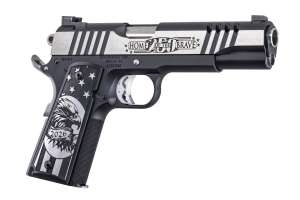
For example, different colors or shades of finish on handguns are important to some buyers, where basic black is what attracts others. It may not be intuitive, but the size and shape of a handgun fall into the art category, if for no other reason than form follows function. And here lies a critical element of selling the right handgun to a customer.
The very term ‘handgun’ insists that ‘hand’ is a commanding part of the equation. The size and strength of a customer’s hand can determine what makes and models they can handle best, and more importantly, which models they likely won’t be able to handle effectively. Shooters with very small and relatively weak hands have problems handling huge handguns, while those with really big hands can’t handle mouse guns well at all.
That brings us to the conundrum of concealed carry, and concealed carry is a huge factor in the handgun world. The conundrum involves the tradeoffs between power and concealability.
Typically, it is assumed by many that a concealed handgun has to be very small, which means it likely won’t be able to handle powerful cartridges. That may be true when it comes to pocket pistols, but not necessarily so when talking about purse/pouch carry or even belt carry. Purses and pouches can carry big handguns if the carrier wants to lug the added weight. And belt carry represents a counterintuitive reality.
The more rotund the person, the smaller the belt carry handgun must be for effective concealment. This is because the waist area of a larger person is convex, while the profile of a thin person is concave (hour glass between hips and shoulders).
In addition to all these factors, consider that a handgun sale needs to include sales of ammo, holster and other accessories that can include everything from red-dot sights to cleaning kits. These sales represent the nuance of the sale.
Regardless how it is viewed, handgun sales not only need to be a significant factor for the shop, but can be a defining factor.