
Archery consumers are a diverse lot. Styles, physique, preferences, applications and budgets — all highly varied from person to person — unquestionably influence bow-buying habits. Thus, archery dealers must stock various options so that most customers who walk through the door can leave with a bow they love.
However, far more bow brands exist than what any single archery shop should stock. And within those brands are different prices, finishes, etc. So, how can a dealer, especially one with little to no archery business experience, consolidate the myriad options into a reasonable selection for his or her store?
Well, I discussed the all-pertinent points of bow sales with Wade Grinager, who manages Archery Country’s Rogers, Minnesota, store. Archery Country is a large archery dealership with four locations — one in Wisconsin and three in Minnesota. For another perspective, I also spoke with Paul Finch of R&E Sporting and Avon Shoppe in Tomah, Wisconsin. It’s a small, family owned shop that’s been open since 1988. As a side note, I also served a tenure in archery retail and have been in the archery industry for 23 consecutive years. I suppose that counts for something.
Without further ado, let’s land the plane on some principles that will guide you in creating the ultimate bow pyramid for your store.
Don’t Get Buried by Brands
Almost every archery dealer I’ve ever spoken with has gone through some trial and error in stocking a healthy number of bow brands.
“I’ve been with Archery Country for nine years,” Grinager began. “We used to carry about 12 different bow brands. It’s cool to be the shop that has everything, but it’s overwhelming. Plus, if you’re selling only one or two bows from a given brand each year, is it really worth your trouble and the confusion it imposes on your customers? No.
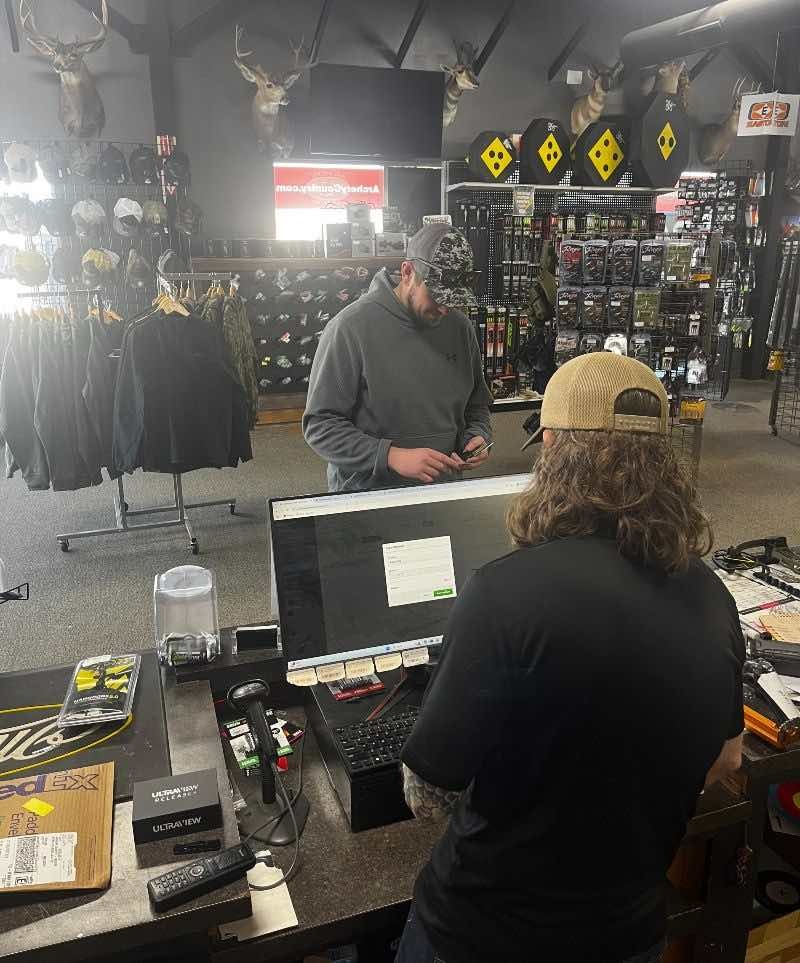
“That said, we take a lot of pride in telling our customers that we stock the ‘Big 7.’ Those are Mathews/Mission, Hoyt, Bowtech, PSE, Prime, Elite and Bear. It’s a healthy selection for our market. It’s not too much to manage from an inventory standpoint, but it gives our customers plenty of options. Further, virtually everyone knows or has at least heard of these brands through TV, magazines, social media or word of mouth. Brand recognition is important.
“I know your article isn’t about crossbows, but we’ve reduced our crossbow brands, too. We used to carry five brands; now we’re down to three. In summary, we stock seven compound brands and three crossbow brands. It’s manageable but gives our customers options.”
Even a smaller family owned shop such as R&E Sporting can get caught up in offering too many bow brands. “We’ve had as many as eight brands in our store,” Finch said. “Today, we mainly stock Mathews, Mission and PSE. We can get others, but those are primarily special orders.”
Another small dealer whom I spoke with from Louisiana who’s been in archery retail for 35 years has whittled his offerings down even further. His high-end line is Mathews, and his low-end offerings are from Mission. It works for him, and it doesn’t get any simpler from a merchandise-management standpoint. I’ll bet he misses out on a sale here and there, but when you’ve been in business for 35 years, you typically have a following, and most customers will buy what you personally use and sell.
Know Your Price Categories
Consumer budgets vary greatly, and buying tendencies can fluctuate based on your store’s proximity to competitors and your region’s median income, among other factors.
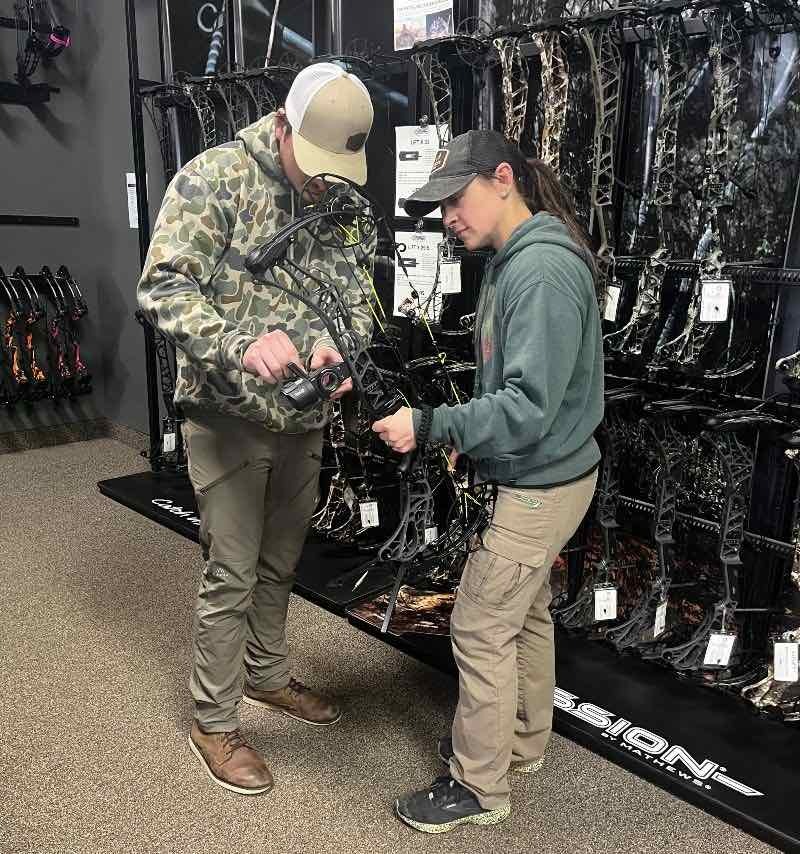
“Based on Archery Country’s clientele, flagship bows sell the best here,” Grinager said. “I’d say it’s about a 70/30 split for flagship bows and budget bows, respectively. During the Christmas season, it might swing to 60/40, but the fact is that we sell a lot of high-end bows. Mathews, Hoyt, PSE and Bowtech are our top sellers, and the carbon bows are highly popular.
“In what we call our ‘price-point’ category, we sell a fair number of Elite’s Basin. It’s a complete package with a sight, arrow rest, quiver and stabilizer that’s ready to go for $750. It sells very well to customers who’re looking for a high-quality bow that’s priced right. Bowtech’s Carbon Zion is the next closest option, and it goes for about $700, un-accessorized.”
Grinager said that, aside from grow-as-you-go bows with infinite adjustability, “We’re working on reducing SKUs in the low-end category. We carry some inexpensive bows from Diamond, Mission and Bear, and we also have Hoyt’s Kobalt. We’re kind of simplifying back to stocking primarily Mission’s Radik, Hammr and Switch. They’re in the $300-400 range, and customers can get a full-accessory package for about $150. We’ll still order the other low-end bows as needed, but our sales numbers are down in the low-end category, so it's time to simplify.”
What’s the reason for the decline? Grinager believes that low-end bow buyers aren’t always loyal to one store or even a brick-and-mortar store at all. “We are located near larger chain retailers, and, of course, online retailers are huge competitors for low-priced bows. The bulk of our clientele consists of folks looking for pro-shop-grade equipment and service, which we deliver.”
Finch explained that R&E Sporting’s bow sales are well distributed across the low-, mid- and high-priced categories. “We sell pretty even amounts of bows in all categories,” he shared. “During some months we might sell more of one category than another, but for the most part, it is pretty even. That’s why we keep a good mix of bows in stock in all price ranges.”
Wading Through All of the Finishes
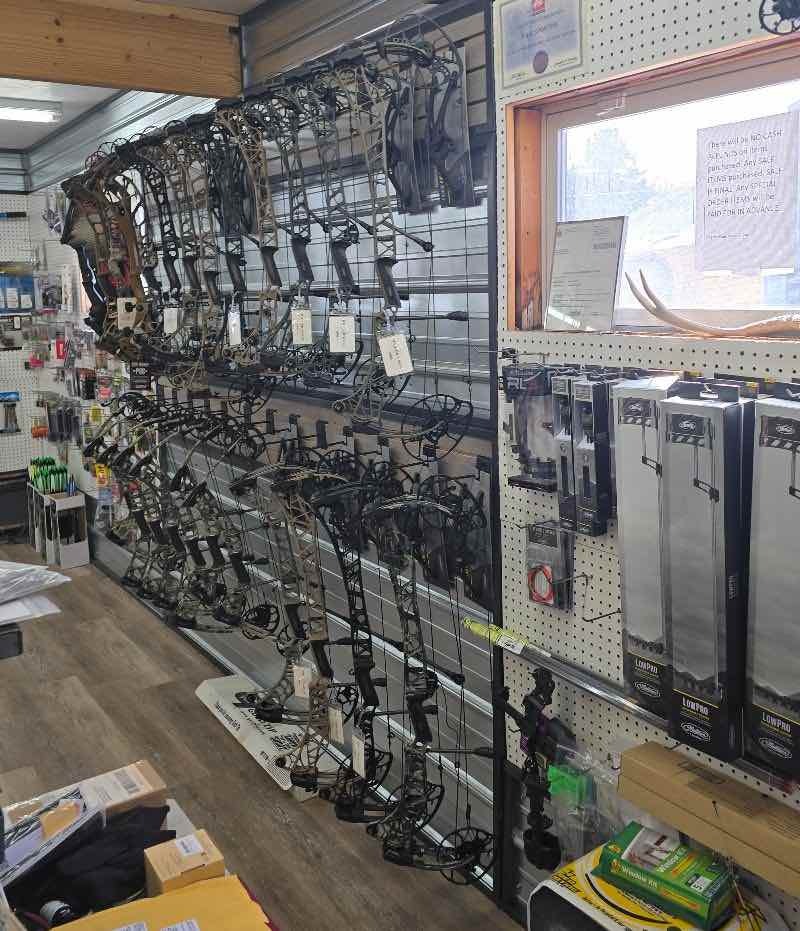
Finishes are becoming like drink flavors; there are more than ever. Should you bring in bows finished in this camo or that? Which solid color will your customers gravitate towards the most? Those are good questions.
“We’re attentive to trends, but we also lean heavily on the manufacturers for insights,” Grinager detailed. “For example, Mathews recently eliminated two camo finishes. They were the least-ordered finishes, and eliminating them also made room for new finishes. Knowing details like these is super-helpful to dealers.
“If you successfully sell apparel in your store, it pays to offer bows in that camo pattern. We recently stopped selling Sitka Gear, but we’re now First Lite dealers, so we went a little heavier on ordering bows finished in First Lite camo to match things up a little bit. Plus, First Lite is hot now.
“We sell a ton of solid-color bows, and custom builds are pretty popular, too. Whether it’s a bow with custom-color strings or a solid-color riser with black limbs, people like to personalize their new bow to some extent since they’re already spending so much money. That said, we don’t get too crazy with pre-ordering custom bows, but customization is pretty popular and something to factor in.
“To bring the bow finish topic full circle, I’ll summarize it this way: For standard-price finishes, we sell approximately 70 percent solid bows and 30 percent camo bows. For camo, a lot of customers who are loyal to a certain camo, such as Sitka, First Lite, or Mossy Oak’s Bottomland, often want a matching bow, but some people don’t care what camo they wear, or what camo is on their bow as long as it is camo. In general, though, a solid bow works for most bow buyers, so we stock heavier on that end.”
According to Finch, R&E Sporting’s customers generally show interest in new finishes. “Lots of customers want something new and different, so when the larger bow companies offer a new finish, it usually goes over really well. Another trend I see is that some customers who have camo or solid-color accessories (besides black) on their existing bow will typically buy a new bow of the same finish so that they can swap their existing accessories over. Then, their new bow and accessories will match.
“Unless there is something new and exciting, we identify what has been the most popular with our customers and stick with those finishes. On our Mathews bows, Granite and Ambush Green seem to be the most popular. Over the last four to five years, solid colors have become more popular than camo finishes.”
What’s the Left-Handed Secret Sauce?
Left-handed customers are just as important as right-handed customers, but there just aren’t as many in the marketplace. (FYI: About 10 percent of the human population is left-handed.) Ordering too deep in left-handed bows can spell big trouble, so go conservative . . . very conservative.
“We always have a demo bow for each of the popular models,” Grinager said. “From Mathews, we have a left-handed LIFT X 29.5, LIFT X 33, and LIFT RS. For Hoyt and PSE, we usually have a demo carbon model and a demo aluminum model. We don’t over-stock left-handed bows. We can always special-order something we don’t have, and most left-handed customers understand that they’ll have to special-order.”
R&E Sporting is even more conservative. “We currently have only one left-handed bow in stock just so people have something to try,” Finch admitted. “We’ve made the decision not to stock high-end left-handed bows simply because there aren’t many left-handed shooters out there. For us, bringing in several $1,200-1,500 left-handed bows is risky. Most likely, they won’t sell, especially if they’re the wrong color, draw length or draw weight. If we have unsold left-handed bows on the shelf that are two years old, we obviously cannot sell them at MSRP and will have to take a hit by marking them down.”
What About Target Bows?
In my target-bow discussions with dealers around the country, I’ve learned that most dealers don’t stock them, or they might have just one so the few folks who’re interested have something to see and test. The exceptions are dealers located in areas that coincide with competitive archery. Even then, there are some safeguards to reduce the odds of being stuck with bows that don’t sell.
When chatting with Scott Aase of Dakota Archery in Yankton, South Dakota, back in 2018, he said, “When customers are contemplating target bow color choices, I carefully remind them that color influences resale or trade-in value down the road. Obviously, a black-finished bow holds better value than a hot-pink bow, because you could potentially resell it to a bowhunter. Neutral colors are by far the most popular target-bow finishes in our area. Folks can build a pretty sexy target rig starting with a tan, black or brown bow. Not everyone has the funds to own a target bow and hunting bow, so a neutral color also gives them a bow that stands out on the range but blends in out in the field.”
If you read between the lines, it’s safer to stock more neutral options rather than loud colors.
Final Thoughts
Grinager said that Archery Country is attentive to year-to-year technology advancements. “Aside from our top-selling bow brands,” he said, “if a manufacturer makes only a subtle change to an existing bow and slaps a different name on it, we order light. If it’s not really something new or that will knock your socks off, we order fewer than we would if it was a completely new design.”
The points we’ve covered here have given you both large- and small-dealer perspectives to land your plane on, depending on your shop’s size and customer base. The rest you’ll have to figure out on your own through trial and error, but these principles should help you avoid some costly mistakes and create the ultimate bow pyramid.
Sidebar: Traditional Bows — Should You Stock Them?
When I queried Grinager if stocking traditional bows and equipment is worth it, he said, “Yes, as long as you have employees who know it and shoot it themselves. We’re blessed to have at least one to two guys at each store location who do and can talk the talk.
“Just like left-handed compounds, we don’t over-stock traditional bows. We carry two to three of Bear’s Grizzly, and we have a handful of $150 October Mountain Products recurves for introductory customers. We’ve special-ordered a few Elite Flex recurves, but those are $1,100. Most of our customers who’re spending that much money would rather be able to shoot 40-50 yards with a compound, so the demand for high-end recurves is slim. Overall, traditional bows make up less than 5 percent of our bow sales.”
Finch said that R&E Sporting doesn’t stock any traditional archery equipment. “In our experience,” he said, “it takes a special customer to come in for a recurve or longbow. We see minimal interest, and if we were to stock several of them, we’d be stuck with them for a long time. At the most, we special-order one or two traditional bows a year. That’s about the extent of the demand in our location.”