
If your sense of the thermal market is that it’s already crowded and getting more so by the month, you and I are in complete agreement.
So many new companies, various and ever changing product lines, and an avalanche of technical specs thrown around in the marketing of these thermals. It’s tough to know what’s actually good and functional and what is sub-par junk rolled out to snag some quick sales.
There is, however, a real plus-side generated by this crowded market. With so much competition, some of today’s thermal manufacturers keep pushing to make their units better and less expensive. The result: New thermals offered in the $2,500 MSRP range that are equal to and often superior to $5K thermals from five years ago.
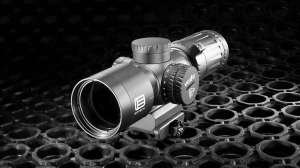
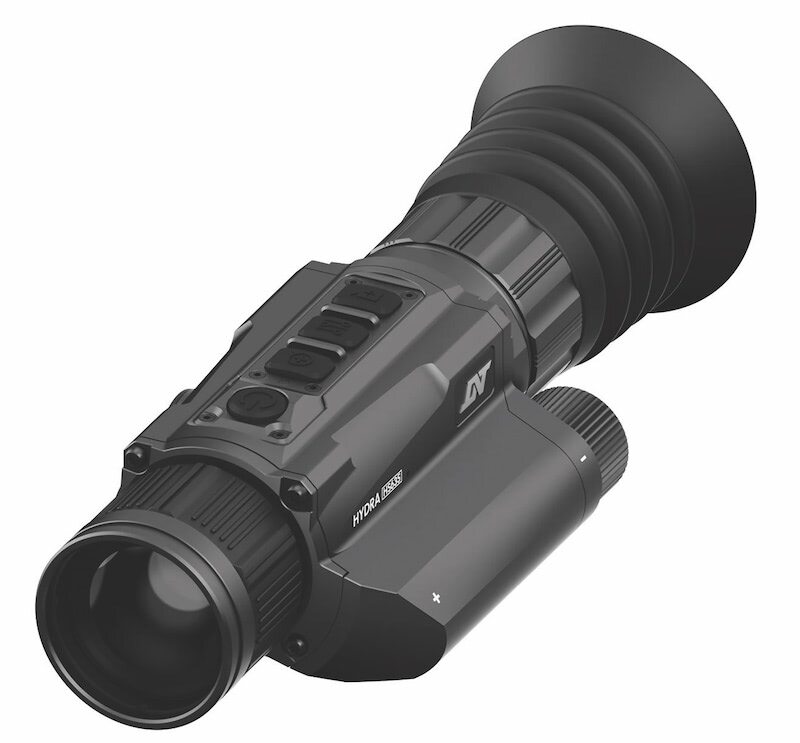
One recent entrant to this category is the new Hydra 640x512 35mm Multi-Function Thermal Scope from DNT Optics.
The Hydra 640 features 640x512 resolution, 12x12um pixel size, 50 frames per second refresh rate, an NETD rating of <18mk, and, in my time with the unit, very sharp images and precise controls. The unit can operate as a stand-alone thermal scope, a clip-on or a handheld unit.
All for just over $2,500.
Getting Familiar
The Hydra housing is CNC machined from an entire block of aircraft-grade aluminum. That’s a real plus. Aluminum transfers heat generated by the infrared detector and the image processor much better and faster than a poly housing. Quicker heat dissipation means a longer life for the unit.
With a 1024x768 micro-OLED display and a rapid-adjust eyepiece, the Hydra features eye relief of approximately 2.5 inches. In my time running the unit, this display window and the overall ergonomics made it feel much like a daytime scope.
A single flat-top 18650 battery powers the Hydra and loads into a compartment on the left side of the tube. DNT includes two batteries and a charging station plus cord with the unit. With an operating time rated at 4.5 hours, a hunter can carry the extra, charged battery in his or her pocket and essentially hunt all night, exchanging batteries needed.
The Hydra can also operate on external power packs as the unit is USB-C Compatible for 5-volt charging.
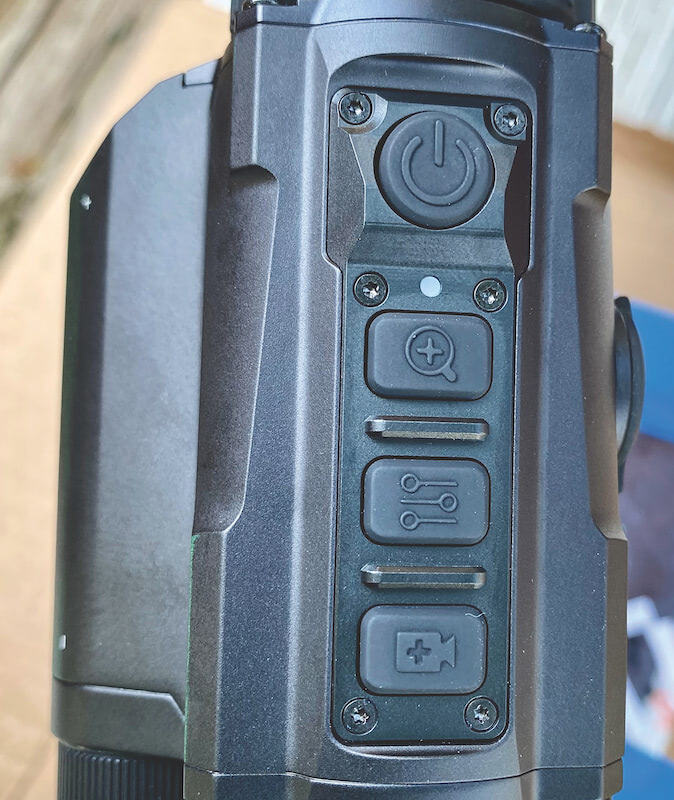
Controls are located along the top of the unit. They are intuitive and easy to operate, even at night when it counts most. Menus came up quickly and were simple to access and move around within. Menu instructions found in the owner’s manual were clear and straightforward — not always the case with other thermals as their menu instructions often seem the work of scientists who haven’t actually run the units themselves.
As a clip-on, the Hydra works best with LPVO day optics, and DNT recommends staying at the lower half of the LPVO’s magnification range for best image quality. The unit will also work with low-magnification prism optics.
Zeroing In
I mounted my test and evaluation Hydra 640 onto a Mossberg MMR, my “workhorse” AR-15 that I’ve had for many years and always functions reliably. Chambered in 5.56 NATO, the MMR is a gas-impingement carbine featuring a 16.25-inch barrel, a six-position adjustable stock, and a MagPul MOE+ pistol grip and an MOE polymer trigger guard.
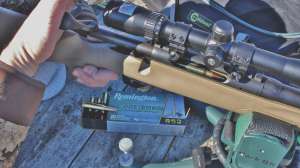
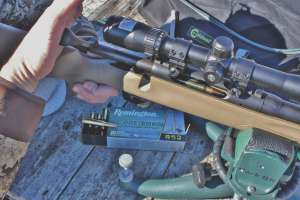
For ammunition, I ran Remington UMC .223 Rem. firing a 55-grain full metal jacket bullet.
The Hydra’s instruction manual advised zeroing the unit at 50 yards and that is where I started.
Using a large HotHands heat pack as my target, I fired off two rounds. They hit approximately 7 inches high and right of the heat pack’s center.
I accessed the Hydra’s One-Shot Zero function, “froze” the reticle, moved the zeroing reticle to the area of the first shots, and saved those adjustments. I shot three more times, the rounds hitting the top right of the heat pack.
Another One-Shot adjustment and my next five rounds drilled into the center of my target.
For this zeroing, the thermal color palette was set on White Hot, my zoom magnification at 4.5x.
Longer Range
No big surprise that the Hydra and the MMR placed bullets high at 100 yards, given the original 50-yard zero. I did the zeroing adjustment and my next rounds hit lower. But then I realized I was nearly out of ammunition.
So, I taped a new large HotHands onto the cardboard backing, let the rifle cool for a bit and then shot off my last five rounds of Remington UMC. They grouped high and right on the heat pack. I needed to make another zeroing adjustment to hit into the center of the HotHands, and would have done so with more ammo.
Yet, as it was, those last five shots grouped at 1.1 inches.
Impressive accuracy, and exactly what the thermal hunter requires.
In the Hand
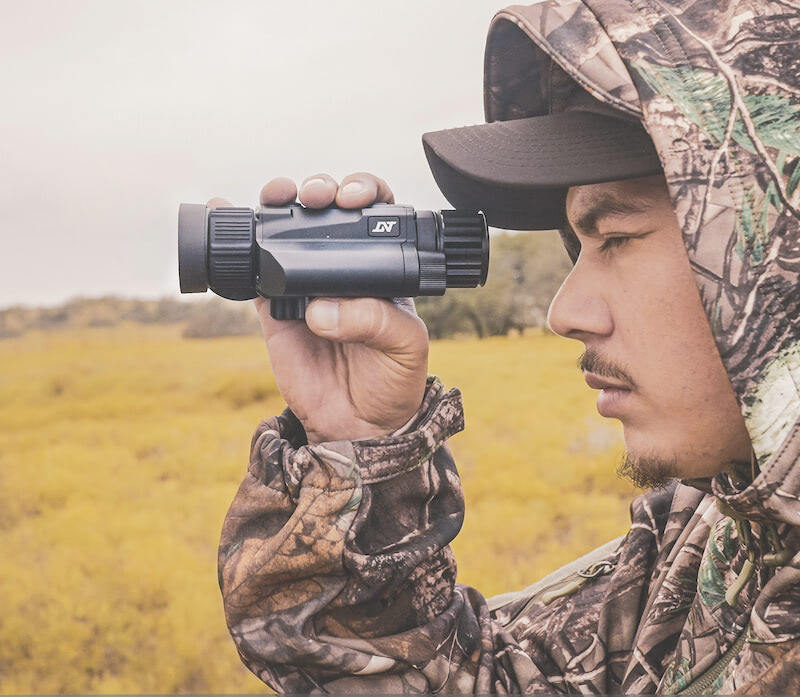
Last, I ran the Hydra as a handheld at night at a couple different locations where I knew the distances of various objects and landmarks.
I varied between 1.5x to 6x and used the White Hot and Iron Hot palettes. I also videoed and took photos. Photos came out clearly, and the videos were first rate, and even supplied sound. While recording geese and ducks on a pond, for example, the videos included lots of quacking.
The Hydra’s 35mm objective lens might look a bit smallish out of the box, especially compared to thermals sporting 50mm and larger objectives. But I have to note that while shooting or running it as a handheld, the 35mm lens matched up well with the 640 sensor and provided a wide field of view and sharp-edged images.
With the scanning I accomplished and the quality of the images, plus some picture-in-picture testing, I believe one can easily make accurate shots on hogs and coyotes out to 250 yards with this thermal. And maybe farther.
Customer Appeal
Given the Hydra’s many uses, the customer base for this thermal is large and varied.
“The Hydra was built specifically for our most demanding customers and for the uncertain ones as well,” said Schuyler Pedroza, DNT’s director of marketing. “This unit should appeal to users who insist on versatility or those uncertain ones who haven't decided if a dedicated thermal or clip-on thermal with their favorite LPVO is the route they want to take for night hunting.”
Let your customers know, too, that the entry-level price actually includes some cutting edge high-tech.
“Mention our proprietary AI ‘Image Super Resolution’ algorithm to customers,” Pedroza urged. “This feature tackles one of the biggest issues in thermals: digital magnification clarity loss. When activated, this advanced feature significantly enhances image quality at higher magnifications, ensuring the thermal image remains sharp, detailed, and closer to the thermal core's full potential than ever before.”
Consider these display ideas for the Hydra to highlight its many uses.
“Showing the versatility of this specific unit is one of its strongest selling points,” Pedroza added. “Have one standing alone on a pic rail and another mounted in front of an LPVO. Attach it to a chest pack as a handheld for a visual of how versatile and compact it truly is.” Point out, too, that by downloading the DNT Optics app onto a cell or tablet, night hunters can live stream the scope's sight picture while also video recording the hunt.
Sales Assistance
In store, DNT supports dealers beyond just the standard spec and sell sheets, Pedroza noted. “We provide engaging, high-quality visual content that showcases the exceptional image clarity. Additionally, we offer dealers access to an extensive library of user-friendly setup, instructional, and best-practice videos, ensuring customers feel confident, supported, and satisfied long after the sale.”
New DNT dealers can schedule a 30- to 60-minute product training sessions with a DNT training manager. Even after the initial training, DNT trainers are available Monday through Friday to assist dealers and staff with any questions.
Currently, independent FFLs purchase directly from DNT as the company’s products are not available through distribution. FFL’s can purchase a single unit at a time or dozens.
To inquire about becoming a dealer, access the company website at us.dntoptics.com. Click on the "DNT Programs" tab on the top right of the screen and scroll down to the "Become a Dealer" link. Fill out the requested information and a DNT rep will reach out, usually within 24 hours.