
The reloading market has evolved in recent years. It’s no longer so much about saving a few pennies per round as it is about getting the very most out of firearms and ammo.
Liz Friedmann has been the marketing services manager at Lyman Products since 2007. She is responsible for much of the consumer-facing aspects of the company, from print and digital advertising, to the websites, catalogs, and product packaging. In her 18 years at Lyman, she has seen many changes and growth, both within the company and in the shooting sports industry as a whole. Shooting Sports Retailer recently caught up with Friedmann to talk about the reloading market and the Lyman family of products.
SSR: Can you give me an overview of the brands under the Lyman umbrella and how they all fit together?
Friedmann: Lyman is made up of a family of eight individual brands, each with a focus on a specific aspect of shooting. Our goal is to serve the many various sectors of the industry and provide growth avenues in different segments. The only exception is our Raytech Brand, which markets metal finishing products to industrial manufacturers.
In 1996, Lyman purchased the Pachmayr brand, which brought with it a full complement of recoil pads, handgun grips, and the gunsmithing tools that the Pachmayr name was known for. Pachmayr served a different market from our reloading product lines including hunters, trap and skeet shooters, gunsmiths and firearms manufacturers. This was followed in 1997 by the addition of the TacStar line of tactical accessories for law enforcement and the shotgun market. In 1999, benchrest shooter Butch Fisher introduced “Butch’s Bore Shine.” Demand for his product became so great that he partnered with Lyman to produce and distribute that and his other innovative gun care products.
In 2000, A-Zoom Snap Caps and training rounds were introduced to the market, at a time when there was a growing demand for greater safety and training within the consumer and law enforcement markets. Trius clay target throwers were acquired in 2003 and were one of the strongest quality brands in that market.
Seeking deeper penetration and greater innovation in our core reloading business in 2019, Lyman purchased Mark 7 Reloading. Mark 7 was originally started in 2015 by a competitive shooter and a talented engineering team. Mark 7 had introduced their ground-breaking Autodrive which automated a Dillon progressive reloading press. This was followed by their own fully automated press, the Revolution, which allowed users to reload over 3,000 rounds per hour. Mark 7 was a good fit for Lyman as their high tolerance steel and aluminum parts were phased into Lyman’s manufacturing facility in Connecticut at greater precision and lower costs than outside suppliers. The collaboration between Lyman and Mark 7 engineering led to the introduction of the APEX 10, the most advanced progressive reloading press in the world, which could also be automated with a Mark 7 Autodrive. Since that time Mark 7 has expanded its share of the commercial loading machine market with the Revolution and new Titan, which loads calibers up to.338 in both single- and double-feed configurations.

SSR: Has the influx of new gun owners made an impact on your brands?
Friedmann: With the exception of blackpowder rifles and one centerfire rifle in commemoration of its 140th year in business, Lyman has never been a “gun manufacturer,” so we are less directly affected by new audiences buying guns, although an influx of gun owners does of course mean more people looking to buy grips, gunsmithing tools, snap caps, cleaning products, and all of the other accessories that our brands offer. However, over the course of the past 15 years, the industry has experienced several ammo “shortages,” when factory ammunition was not easily found at many stores or was prohibitively expensive if it was available. This has made a much wider audience interested in being able to make their own ammunition by reloading. We have seen a slight shift in the age demographics of our reloading customers to younger shooters taking up reloading. This is especially true with the Mark 7 line, as the younger reloaders are interested in not only the high quality of their reloaded rounds, but also how high a quantity they can produce in a shorter amount of time.
SSR: The reloading market seems to have shifted away from frugal shooters looking to save a few bucks. Where do you see that market heading?
Friedmann: Cost savings are certainly still a driver for reloading, especially if you shoot less common calibers such as 6.5 Grendel of 50 Beowulf. However, we have many reloaders who are more interested in the customization aspect. Long-range precision shooters almost always load their own ammunition so they can tailor the round to achieve their precise goals. Competition shooters are another audience that reloads specifically for the ability to customize their ammunition, and for this audience, the automation factor that Mark 7 provides is another key driver, since they tend to go through thousands of rounds of ammo for practice and matches.
SSR: How has the broader accessories market changed over the past decade?
Friedmann: There are always new styles and new technology evolving that influence what the next handgun grip or recoil pad, or reloading scale, or even the reloading press itself will look like, but it is rare for an entirely new product that hasn’t been seen before to be introduced into this sport. In 17 years of attending SHOT Show, I’ve seen many shifts in focus – from traditional rifles to ARs, for example, and then more recently to lever guns, and so of course, the accessories change accordingly – from hunting-themed to tactical to the current emphasis on customization.
SSR: What’s new for 2025?
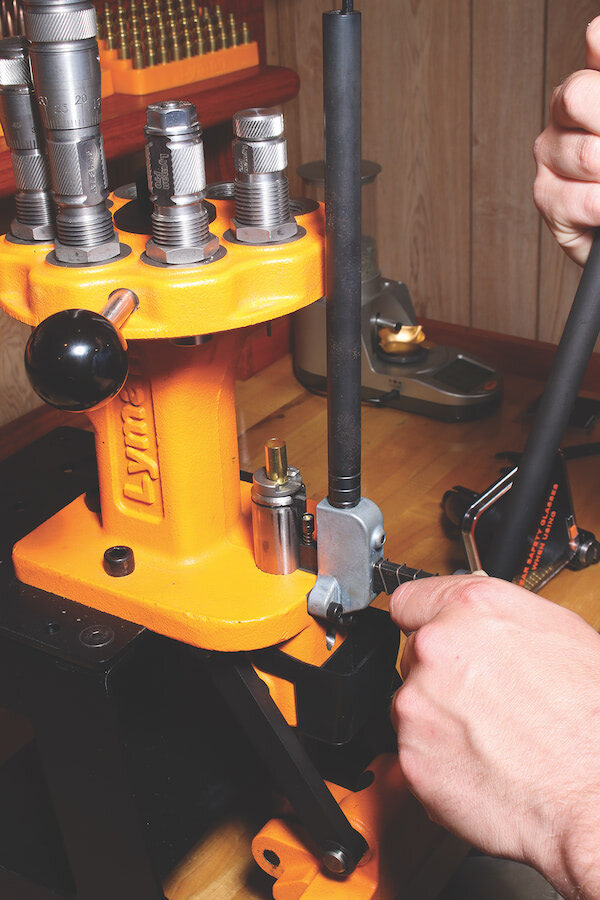
Friedmann: Lyman was very excited to introduce 28 new products this year! Some key items are the 1500 Turbo Pro Tumbler, the Revolution HD Heavy Duty Gun Vise, new TacStar American Made Modular Shotgun Extension Sets, and our long-awaited 6th Edition Shotshell Reloading Handbook, but possibly our most exciting new products are the patented Accu-Primes. These innovative priming tools truly change how hand priming is done, as well as the level of accuracy that can be achieved. By using the bottom surface of the cartridge case instead of the top surface of the rim, the Accu-Prime can control the exact amount of primer depth. In addition, the unique side lever provides much smoother operation, not to mention much less hand fatigue than squeezing a handle over and over. The Accu-Prime Auto Load adds the convenience of a linear rail system that loads a new primer from a primer feed tube with each pull of the handle.
SSR: What’s in demand, and where do you see opportunity?
Friedmann: Well, the Accu-Primes sold out almost immediately after they were announced on our website, but luckily these are made right here in our factory in Middletown, Connecticut, so we promptly got the next round of production underway and are now back in stock.
As for opportunity, we are working on ways to leverage our 147 years of reloading knowledge and expertise to help introduce new gun owners to the joys and satisfaction of reloading their own ammunition. We also see automation as a growing segment of the reloading market as consumers seek higher performance while saving time.
SSR: What mistakes do you see retailers making when it comes to helping people get started in reloading?
Friedmann: I think that emphasizing the idea of reloading being “money-saving” is probably somewhat confusing to customers. Sure, they may eventually save money, but the truth is they will need to spend quite a bit first to acquire all the equipment they’ll need. Reloading is a hobby, some might even consider it an art. It takes some time and practice, but eventually you can produce something that outperforms factory ammo. Few people take up knitting because you can make less expensive scarves or mittens. You are creating something that you can use and that you can take pride in, as well as something that makes you a little less dependent on outside sources for something you need.
SSR: What’s the one Lyman product no reloader should ever be without?
Friedmann: A Lyman Reloading Manual. Preferably one that comes as part of a whole Lyman Reloading Kit so the customer can be certain they are working with quality reloading equipment.
SSR: What does the future look like for Lyman? Are you looking to expand your product lines or brand portfolio?
Friedmann: With changing markets, it is extremely important to focus on innovation and diversification. In late 2025 and 2026 Lyman will be making some major announcements along these lines so stay tuned. We are also very open to partnering with other companies where we have mutual interests. This past year we partnered with Vantage Point Armory to help them distribute their new line of compensators. Many of our employees are hunters and/or shooters themselves, so we are on the lookout for new and innovative products to improve or expand the experience for other hunters and shooters.
SSR: If they’re not already, what does a retailer need to do to begin carrying the Lyman family of products in their stores? Are there any dealer incentives or programs for new partners?
Friedmann: Our sales team would love to talk to any retailer interested in carrying any or all of the Lyman brands. Simply contact our sales team at 860-632-2020, or toll free at 800-225-9626, or email us at lymansales@lymanproducts.com
SSR: Anything else you’d like to add?
Friedmann: Just a thank you to Shooting Sports Retailer for continuing to help us reach not just our individual customers, but probably our most important audience, the dealers and distributors that carry the Lyman Brands.