
As a kid, I hated standing out. But I’m a redhead, and my name is spelled differently than the other Darrens, Darins, and Darrins. Oh, and I was homeschooled. Thus, every lady over 50 couldn’t resist saying, “Look at the cute little redhead,” and people constantly misspelled my name. Further, anytime my mother and/or father took my siblings and me out in public during school hours, the nosy types asked, “Why aren’t they in school?” Or, “No school today?” I hated it and wished I were more normal (whatever that means).
When I became an adult nearly 20 years ago, I pulled a 180 and embraced my differences. No, I don’t intentionally draw attention to myself, but I’m now comfortable with standing out. I rarely go with the flow, and I usually avoid the easy route. And that has gotten me somewhere (with the Lord’s provision, of course). That makes me think of Xpedition Archery.
Starting a new bow company a little over a decade ago, when compound bow technology was rapidly advancing, had to be immensely challenging. I’m not an Xpedition Archery expert, but I believe it’s safe to say that Xpedition faced rocky roads as it fought to gain a following in this competitive product category. From the beginning, it has built nice-shooting bows that didn’t copycat the few biggest bow brands. In the compound bow space, you must stand out or you’ll probably become shark bait. Yes, Xpedition Archery stands out, and it has survived the tests of competition.
Previously, I hadn’t taken an Xpedition bow beyond the brand’s shooting lane at the ATA Show until this May, when I was assigned to test, evaluate, and report on the Xlite 32. This latest Xlite model was rated the “Best New Bow Introduced at the 2025 ATA Trade Show” and also took first place in the “New Product Introduced at the 2025 ATA Trade Show” category. After running it through its paces, I see why.
The Xlite 32 not only stands out from a design perspective, but it isn’t all just smoke and mirrors. It is one of the market’s best-performing compound bows, and as someone with two decades of archery industry experience, I don’t say that flippantly. Folks, there are a lot of cool new bows this year, but this one is high on the list, and checks nearly every box a bowhunter can think of. Let’s have a closer look at a bow that truly stands out.
Test Bow Specs
- Axle-to-Axle Length: 32 inches
- Brace Height: 6.125 inches
- Draw Length: 28 inches
- Draw Weight: 73.6 pounds
- Let-off: 80%
- Bow-only Weight: 3.8 pounds
- Accessorized Total Weight: 5.1 pounds (including sight, rest, and front stabilizer)
- Velocity: 276 fps (with 468-grain Easton 6.5mm Acu-Carbon 340 arrow); 279 fps (with 456-grain CX Maxima Triad 350 arrow); 282 fps (with 441-grain Victory VAP SS 350 arrow); 300 fps (with 388-grain CX Predator 350 arrow)
- Kinetic Energy: 79.18 foot-pounds (Easton); 78.84 foot-pounds (CX Triad); 77.89 foot-pounds (Victory); 77.56 foot-pounds (CX Predator)
- Test-Bow Finish: Highland Green (riser and limbs); Flat Dark Earth (ancillary parts)
- MSRP: Starting at $1,899
- Contact: xpeditionarchery.com
The Unboxing
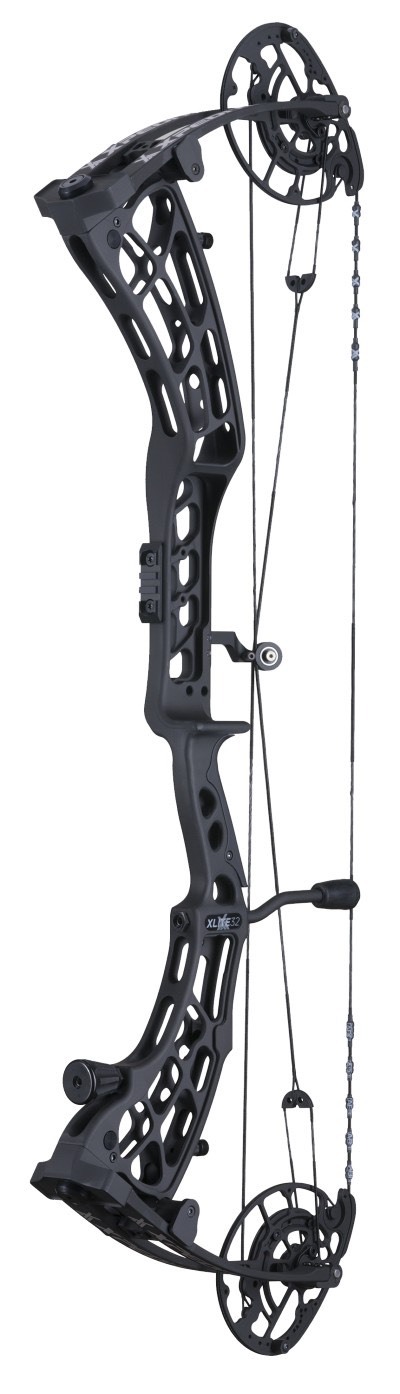
The Xlite 32’s aesthetic appearance is immediately eye-catching, to say the least. Its riser geometry resembles nothing else on the market, and the Highland Green riser and limbs combined with the Flat Dark Earth ancillary parts on my test bow are striking. Even better, the parts feature a Cerakote finish (except for camo-finished risers and limbs). Cerakote is a specialized ceramic coating that has long been proven in the gun world. It is durable, corrosion-resistant, and wear-resistant; basically, it’s tailor-made for wild places and pushes beyond industry-standard finishes. It feels and looks awesome, and it will last. Between the finish and the overall appearance, the Xlite 32 screams quality and craftsmanship.
The Anatomy
The Xlite 32’s most important attribute is its Magnite riser. Remember in the intro when I said that Xpedition stands out? Today, this is the No. 1 reason it does. While most other manufacturers chase the carbon market or have found ways to lighten up machined aluminum, Xpedition rolled out the proprietary Magnite riser. The material is new to archery but has previously been used and proven in the defense and aerospace industries.

Shockingly, Magnite is lighter than carbon but has tighter tolerances, and it is stiffer than aluminum to reduce flexing while drawing and shooting to move the downrange-accuracy needle forward. It also doesn’t foster the hand shock often associated with carbon-riser bows. The overall gist of Magnite is it is ultra-lightweight without compromising durability or dependability, and you’ll feel the difference — I did the moment I put my hands on it.
As with previous Xlite models, the 32’s grip is integrated into the riser, but for additional comfort and customization, Xpedition includes two grip modules with different degrees of angle for individual preferences. I tried and loved both grip modules, but ultimately settled on the less angled one. Both fit very naturally, and the slim design makes it difficult to torque the bow.

Other riser attributes are the Picatinny sight mount, Integrate dovetail, upper and lower front stabilizer mounts, rear stabilizer mount, and triangular quiver mounts. For bowhunters who use a conventional arrow rest, the riser is rigged with two mounting holes so the rest can be double bolted to eradicate movement. A minimal and silky-smooth ball-bearing roller guard designed to reduce friction also adapts to the riser almost as if it were a part of it.
Although Magnite is extremely vibration-void, the Xlite 32 has vibration-dampening details that further enhance stealth. The adjustable string cushion kills the bowstring’s buzz on contact and reduces bowstring oscillation. A weight/rubber combo located just above the bottom limb pocket on the front of the riser intercepts vibrations and improves the balance. Miniature weight/rubber combos are located on the back of the riser near the ends, minimizing weight while stopping vibrations.
The Xlite 32’s limbs and pockets are nice and wide to make the bow more laterally stable while also maximizing durability and dependability. Despite its width and robustness, the minimal pocket is lightweight.
Xpedition rigs the Xlite 32 with the XB32 Dual Cam System. The bow comes standard with two module sets to cover all draw lengths and optimize efficiency at short and long draw lengths alike. The XB32 is also outfitted with two cable stops per cam, totaling four stops and redefining a solid back wall. This cam also brings the heat. With a 342 fps IBO rating, this is the fastest Xlite model yet. Xpedition also includes spacer sets with the Xlite 32, which allow a bow technician to address cam lean by repositioning the cam on the axle. This is highly effective, but the downside is a bow press and pulling the axle are required to swap out spacers — not a big deal, but there are more DIY-friendly tuning features on other bows.

This brings us to one final detail that I’m a huge advocate for: a high-end bowstring and cable set. A bow is only as good as its string and cables, and the Xlite 32’s ABB set boasts tight tolerances with no creep, peep twist or serving separations, enhancing the bow’s performance and giving your customers quality and dependability.
The Test
Technology is great, but where the rubber meets the road and what your customers care about most is performance. Believe me, the Xlite 32 checks that box, too.
I drew it back a couple of times before setting it up just to get acquainted. Not only is the XB32 Cam System nice and smooth all the way through, but it transitions beautifully from peak to valley and hits a dead stop at full draw, thanks to the four cable stops I noted earlier. Some bows have draw cycles that require some acclimation, but the Xlite 32’s draw cycle is natural and feels incredible. It also lets down more easily than most bows.
Despite technological advancements, some bows still have vibrations and associated noises, and with bows featuring integrated riser grips, you feel everything. That isn’t an issue with the Xlite 32; it’s whisper-quiet and vibration-free. Some of that can be attributed to the dampening details and parallel limbs, but the Xlite’s secret sauce is the Magnite riser. It is tested to be 20 times more vibration-free than carbon and three times more vibration-free than 6061 aluminum.
While sighting in the Xlite 32, acquiring my anchor point was effortless; aiming was also shockingly easy and uber-comfortable. This is due to the string angle and the Magnite riser’s superior geometry. Look up and down the riser, and you’ll notice a very purposeful design with strategic bridging to not only enhance balance and stability, but also strength so that worry is the last thing on a bowhunter’s mind during a grueling hunt.
Is the Xlite 32 accurate? You bet it is! My very first groups at 40 and 50 yards while shooting in a crosswind were stupendous. I can’t quite articulate how comfortably this bow holds and shoots. I felt so relaxed and comfortable while executing each shot. It also falls perfectly during my follow-through. Based on my experience, put the Xlite 32 in skilled hands, and it will shoot as accurately as any other bow out there. I truly believe that.

Final Thoughts
The only downside I’ve noted so far is the cam spacers require a bow press and pulling the axle. The only other one I came up with is that the MSRP is up there at $1,899. A few other bows out there are in that ballpark, but because compound bows depreciate somewhat quickly once driven off the lot, that is a lot of money just to go bowhunting. But the quality, craftsmanship, and performance that your customer gets will soften the blow. Again, Magnite is proprietary, and its merits come at a price. I think most of your high-end customers can live with that, especially if they are looking to buy a bow that stands out.
Additional Notes: The Xpedition Xlite 32 was set up using a Last Chance Archery EZ Green Bow Press and EZ Green Bow Vise, and the draw weight was calculated using Last Chance Archery’s Digital Bow Scale. A Caldwell Ballistic Precision Chronograph measured the arrow velocities. Other products used were Easton’s Nock and D-Loop Pliers and Pro Hex Fold-Up Allen Set. Arrows were weighed on Last Chance Archery’s Pro Grain Scale.
In-the-field photos by Becca and Darron McDougal