
I’m blessed to call tinkering around with archery equipment “work.” The challenge, though, comes when I sit down to write. Why? Every name-brand bow manufacturer makes great bows, and it’s difficult to word each bow report uniquely, though I manage. The adjectives we’ve long used to describe bows— words such as fast, smooth, quiet and accurate — are tough to avoid and basically interchangeable from one flagship bow to another.
Albeit, I believe in honest, authentic journalism, so I won’t copy and paste a previous report into a new Word document, rework it slightly, and e-mail it over to Archery Business Editor Dave Maas. You deserve better, so I always aim to deliver original content. Whether it takes two hours or two days to write 1,000-1,400 compelling words, I’m committed to authenticity. That said, writing this bow report was easier than some because Bowtech bows are very unique and teeming with purposeful features. Additionally, the 2025 Bowtech Virtue unveils new noteworthy technologies that require a handful of other adjectives.
Having test-fired the Virtue at the 2025 ATA Show, Maas teased about it in Archery Business’ March/April issue, promising that I would conduct a thorough test and evaluation in an upcoming issue. Here you go.
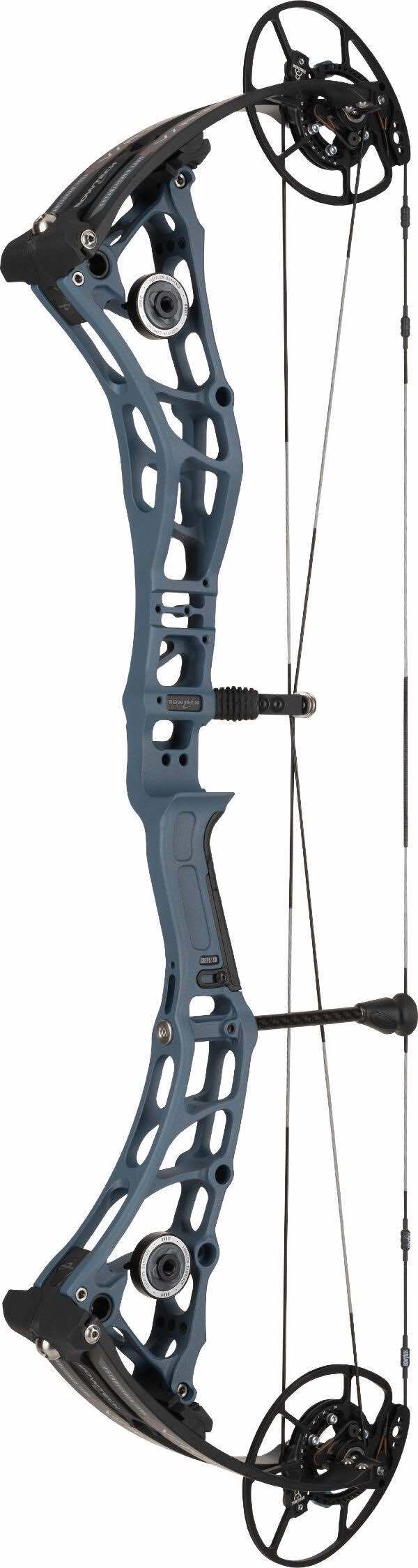
Test Bow Specs
- Axle-to-Axle Length: 32 inches
- Brace Height: 6.19 inches
- Draw Length: 28 inches
- Draw Weight: 71.8 pounds
- Let-off: 85% (Performance); 87% (Comfort)
- Bow-only Weight: 3.7 pounds
- Accessorized Total Weight: 5.5 pounds (including sight, rest and front stabilizer)
- Velocity: 281 fps (with 468-grain Easton 6.5mm Acu-Carbon 340 arrow); 284 fps (with 456-grain CX Maxima Triad 350 arrow); 288 fps (with 441-grain Victory VAP SS 350 arrow); 306 fps (with 388-grain CX Predator 350 arrow)
- Kinetic Energy: 82.08 foot-pounds (Easton); 81.69 foot-pounds (CX Triad); 81.24 foot-pounds (Victory); 80.69 foot-pounds (CX Predator)
- Test-Bow Finish: Tac Black
- MSRP: Starting at $1,999
- Contact: bowtecharchery.com
Tough as Nails, Light as a Feather
Every Bowtech bow I’ve ever tested has looked and felt tough. The risers are always robust, the limbs wide, and the connection between the two solid. Bowtech bows always trigger this thought: Man, this thing is built to withstand virtually anything. With a Bowtech in my hand, durability and dependability are my last concerns.
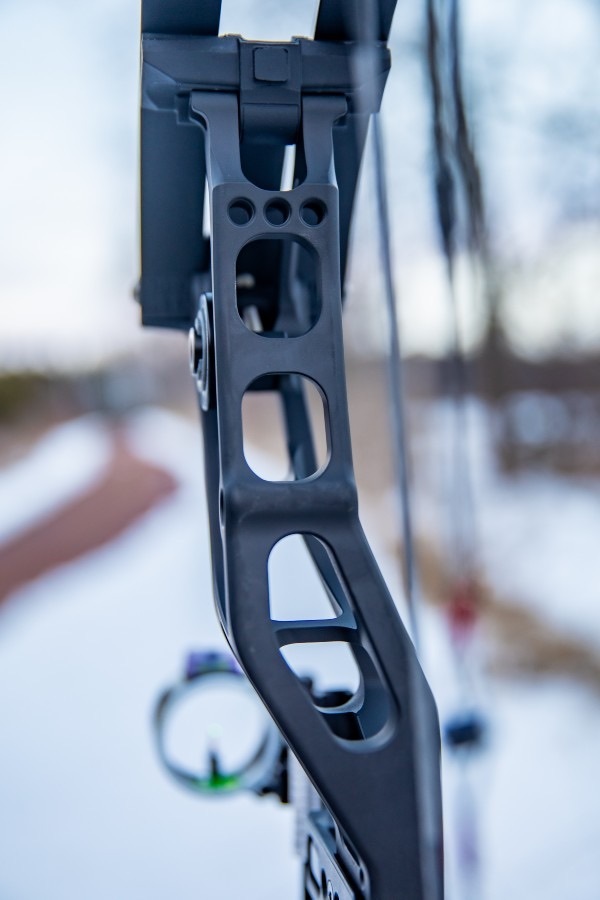
Remarkably, Bowtech’s engineers eliminated .7 pounds with the Virtue (compared to the Core SR). It’s no surprise, then, that I was shocked as I pulled the Virtue from its shipping box; I immediately noted that the Virtue feels substantially lighter than its predecessors. The Virtue weighs only 3.7 pounds; I know of no other non-carbon high-end bow that is so light.
What’s the secret sauce? Bowtech’s AeroMag Magnesium Riser achieves weight savings while enhancing durability, strength and stiffness. From hopping over deadfalls in Colorado’s high country to holding a tune through hundreds of shots, this new riser construction combines the best of durability and light mass weight so you can have your cake and eat it, too.
While we’re discussing durability, coatings are a big deal. The Virtue harnesses the rigidity, scratch-resistance and resilience of a protective Cerakote coating. Cerakote is an undeniable leader in the coating business. With that, the Virtue is available only in solid colors. Based on my bow-finish discussions with dealers, solid colors seem to be more popular than camo finishes anyway, so I don’t believe it’s a make-or-break issue for most bow buyers.
Another noteworthy durability attribute is the Virtue’s titanium hardware. I can’t count how many stubborn screw and bolt heads I’ve stripped out in my archery career, so I appreciate the attention to detail here along with the rust- and corrosion-resistance.

DIY Customization and Tuning
Bowtech was one of the first, if not the first, to offer lateral cam adjustment to address cam lean, no bow press required. DeadLock Technology has proven itself across multiple bow models, and it saves you, the dealer, time in tuning bows for your customers. It also puts tuning within your customer’s reach. Each cam can be adjusted left or right on the axle in minute increments, and adjustments take seconds with a small hex wrench. It’s outrageously easy and ultra-effective.
GripLock Technology was introduced on last year’s Core bows, and it’s back on the Virtue. Adjust the grip angle from low-wrist to high-wrist and every position in between. Simply loosen the screw on either side of the rotating grip module, then insert a hex wrench into the circular hole below the grip on the front of the riser and micro-adjust the grip angle to preference. It’s like having multiple custom grips but without the expense.

Synchronizing cams has long been finicky, especially for consumers who want to do some of their own bow work. The avenue has always been to twist or untwist a cable to get both cams to roll over simultaneously. TimeLock is a novel, bow-press-free timing solution, and like DeadLock, it has a locking screw and an adjustment screw. Users can tighten or loosen the cables in finite amounts until both cam stops hit at the same time.
Another outstanding customization feature that Bowtech fans have enjoyed for years is the FlipDisc. In addition to bow-press-free draw-length adjustability, it has two unique draw cycles. One side of the Flip Disc gives you the Comfort draw cycle (easier and smoother), while the other side gives you the Performance draw cycle (slightly more difficult with a shorter, more abrupt valley but more velocity). I prefer the Comfort cycle, but I found that the Virtue achieves the same velocity at a 28-inch draw length in the Performance cycle as a 29-inch draw length in the Comfort cycle. For bowhunters with shorter draw lengths, this is a good avenue to gain some extra power.

CenterMass and Integrate
On the 2024 Core SR and SS, Bowtech’s CenterMass Sight System accepts the sight bar through the riser and bolts down with a single bolt. The Virtue features the second generation CenterMass Sight System. It’s now located on the inside edge of the Virtue’s riser (above the shelf), which moves the sight’s mass weight even farther toward the center of the bow, optimizing the accessorized balance. Also, this improved system uses two bolts to lock the sight directly onto the riser (no mounting bracket) instead of one.
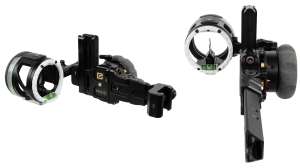
For the test, I installed Bowtech’s CenterMass Dual Trac sight, which is manufactured by Black Gold in the USA. This slider sight has two pins and two yardage pointers. The pins are independently micro-adjustable. The Dual Trac has 1st-, 2nd-, and 3rd-axis adjustability, and the 3rd axis is micro-adjustable. Black Gold’s long-proven PhotoChromatic Shell intuitively adjusts pin brightness to the setting. It comes with multiple yardage tapes for different arrow velocities, delivering to-the-yard precision out to long ranges.
I also tested out Ripcord’s Ratchet Cable Driven rest. It attaches directly to the riser via the IMS mounting system. It features micro-windage and -elevation adjustments, and it has an arrow containment bar so that you never have to worry about your arrow falling off. The launcher also locks in the up position until the bow is fired. Both the launcher and the containment bar are padded to mute arrow contact. The anti-bounce-back launcher yields true vane clearance. SpeedSet Technology allows users to seamlessly fine-tune the cord length. It’s a rock-solid rest that is ultra-lightweight and super-dependable.

Test and Evaluation
Besides the Virtue being lightweight, I immediately noted the steadiness I felt when I drew it right out of the box. It holds almost effortlessly. Besides its optimal balance, I attribute the steadiness to the riser’s wideness and bridging above the sight and below the grip, as well as the wide limbs. The bow naturally holds level with no tendency to tip left or right.
Reaching full draw is also easy. Bowtech’s flexible FLX-Guard reduces friction-causing lateral torque on the cables during the draw cycle. Again, the Performance draw cycle is a bit more strenuous, but the Comfort draw cycle is one of the smoothest available. Regardless of the FlipDisc setting, the draw cycle ends with a solid back wall via draw stops that contact the cables.
Like last year’s Core SR, the Virtue is a grouper. I shot it out to 60 yards and experienced immediate accuracy. Shooting groups at 40 yards felt easy. Accuracy-wise, I believe this bow will perform right next to any other flagship out there.
If I can complain about one thing, it’s that the Virtue lacks vibration-dampening products. Yes, the Orbit Dampeners arrest most vibrations, but for a $1,999 bow, I’d like to see some limb and bowstring dampeners to smooth and silence the shot even more. I’m not calling the Virtue loud; I just think it should come with limb and bowstring dampeners.
Final Thoughts
With all of the market’s new bows, what makes one more desirable or attractive than another? The Virtue makes that easy to answer. I believe Bowtech has achieved the most customizable and DIY-tuning-friendly bow there is with integrated features. Pair that with the monumental weight reduction due to the AeroMag Magnesium Riser, the refined CenterMass Sight System, and the Cerakote finish, and the Virtue is a bow your customers just have to test out. It’s so awesome that it made my writing duties for this bow report a walk in the park.
Additional Notes: The Bowtech Virtue was set up using a Last Chance Archery EZ Green Bow Press and EZ Green Bow Vise, and the draw weight was calculated using Last Chance Archery’s Digital Bow Scale. A Caldwell Ballistic Precision Chronograph measured the arrow velocities. Other products used were Easton’s Nock and D-Loop Pliers and Pro Hex Fold-Up Allen Set. Arrows were weighed on Last Chance Archery’s Pro Grain Scale.
In-the-field photos by Becca McDougal