
It was 1967 when the first commercially available Howa firearm was offered on the U.S. market. That Golden Bear rifle was unveiled at a trade show in Chicago a dozen years before the inaugural Shooting, Hunting and Outdoor Trade (SHOT) Show.
Since that early introduction, the Japan-based company’s guns have earned an enviable reputation for performance and reliability. The firm’s famed 1500s are well known as budget-friendly rifles capable of podium finishes in long-distance competition — with a skilled shooter behind the trigger, of course.
Despite nearly six decades on U.S. shores and Howa quality, the firm has yet to gain household-name fame. Many shooters don’t realize the precision rifles they build. Those who do will ask for it by name or immediately recognize the brand. Thankfully, this traditionally profiled rifle has looks that stand out from the run-of-the-mill competition and draw attention from both crowds.
Yote Camo
Getting customers to stop, look and ask is part of the battle, and this rifle wears a distinctive camo pattern capable of doing just that. Displayed in today’s sea of monotones or lookalike camouflage bolt actions, it draws attention faster than U.S. Open tennis players exchanging post-match insults.
The pattern is called Yote. It wasn’t tailored to maximize store sell-through, however.
The design was a collaboration between Predator Quest’s Les Johnson and Thunder Mountain Camo’s Jessica Oster. High-resolution images of coyote fur were employed to emulate a song dog hide’s uncanny ability to blend into the landscape and seemingly vanish. It hit the market in 2019. Howa rifles were the first to wear it.
The look is distinctive, and it’s equally adept at blending into other less-arid environs. It grabs attention, but this rifle has much more than history, reputation, price and Yote going for it. Here a few of the other things to point out at the counter to help close the deal.
Mini Action Receiver
Howa introduced its Mini Action rifles in 2015. Like their older siblings, the 1500s, they have been a huge success.
Initial chamberings included .204 Ruger, .222 Rem. and .223 Rem. The line today includes models in 6 mm ARC, .223 Rem. 6.5 Grendel, .300 Blackout, 7.62x39 mm, and .350 Legend, and early this year, the company added .22 ARC to the lineup.
These bolt-actions come with significant weight savings when compared to their big brother. The machined receiver has been trimmed in all the right places to maximize short-action benefits without sacrificing performance.
The rifle sent for review, unloaded and without the Vortex Diamondback Tactical 4-12x-40 mm riflescope it shipped with, weighs 6 pounds even. That lack of undue heft is a big benefit for varmint hunters on the move.
The forged bolt is 1.4 inches shorter than those used in most long-action receivers and nearly an inch shorter than many short actions. Its abbreviated length shortens travel required to eject spent brass, pick up a fresh cartridge and return the gun to battery. With the modest recoil generated by the .22 ARC, this rifle was back on target almost immediately. Follow-up shots were fast.
No tools are required to remove the firing pin and spring from the bolt, too. It’s a nice advantage when it comes time for cleanup and routine maintenance.
No stoppages or hiccups were encountered during testing. Working the one-piece, push-feed bolt was buttery-smooth. The M16-style extractor performed flawlessly, the two opposing lugs made lockup solid, and cartridges fed from the magazine without stovepipes or problems.
A three-position safety is on the right of the receiver toward the rear, the most traditional position in bolt actions. The bolt-release lever is on the left side.
Magazine
Its detachable polymer magazine wears the Howa name on the bottom and has a five-cartridge capacity. It’s clearly labeled as being compatible with 6 mm ARC, 7.62x39 mm and 6.5 Grendel cartridges. Spares are available from Legacy Sports International — the U.S. distributor of Howa rifles — and several aftermarket companies.
The firearm’s magazine release is directly in front of the mag well. It’s spring loaded and easily worked by a squeeze to the rear with the shooter’s index finger. It’s a nice setup, and removing the reloads is a smooth operation when gripping the magazine with your hand.
On the right and left of the mechanism are flush-height polymer barriers to minimize chances of accidental releases of the magazine. No one wants reloads mysteriously vanishing, after all.
Gravity wasn’t quite enough for the magazine to drop free in the test rifle. A modest amount of downward pressure was required for removal. That isn’t necessarily bad. It may even be a deliberate design feature, but worth noting before demonstration at the sales counter.
Trigger
One rifle feature that’s sure to impress is the trigger. It’s a match-grade, two-stage version so pleasantly crisp that the odds are good most shoppers will give it a try several times.
That Howa Actuator Controlled Trigger (HACT), introduced by the company in 2011, is smooth and creep free and provides a consistency that shrinks groups for many shooters. That, of course, depends on their experience and their current rifle’s maintenance schedule, but don’t be surprised to get glowing reports back from many new owners.
Using a Lyman Electronic Trigger Pull Gauge, let-off weight hovered just above 3 pounds, rarely varying by more than 3 ounces. Over the 10-pull test, it averaged 3 pounds, 1 ounce.
There is no external mechanism for owners to easily adjust let-off weight on the trigger. On the rifle sent for this review, there isn’t much reason for doing so, obviously.
Barrel
The .22 ARC-chambered rifle sent for review had a 20-inch light varmint barrel. It’s also available with a 20-inch carbon-fiber barrel and a 22-inch steel version.
Rate of rifling is 1 full twist every 7 inches. The gun ships wearing a thread protector to shield the 1/2-28 LPI threading at the muzzle. The feature allows owners to mount their preference of muzzle devices, including brakes, flash hiders or suppressors.
Other Features
The stock’s textured at the wrist and forend to ensure a positive grip in inclement weather or when wearing gloves. There are also sling swivel studs fore and aft. Overall, the finish is nice — attractive enough to draw attention.
The trigger is grooved for those times Mother Nature gets nasty. At the rear is a thick recoil pad. The reviewed rifle’s chambering didn’t really make it necessary, although it’s a reassuring touch for customers who are recoil sensitive.
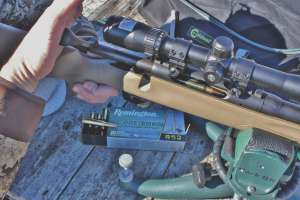
There is no Picatinny rail on the receiver for mounting optics. Instead, it is drilled and tapped. There are plenty of bases and rings on the market for Howa’s. Talley’s were mounted for firing-line sessions.
The riflescope-mounting surface is common today, but retailers who keep a set of bases and rings and a modest stock of .22 ARC loads on hand might ring up a few add-on sales. Consider inventorying a spare mag or two as well.
Behind the Trigger
Two loads were used for testing accuracy and reliability. Range sessions were conducted from a prone, sandbagged rest at 100 yards. It was a comfortable day with a temperature of 84 degrees. Five three-shot groups were sent and group spreads were averaged.
A full-value, right-to-left breeze of maybe 5 mph occasionally crossed the range. It was an ideal day to witness the accuracy of this rifle. Two bullet holes nearly always touched, but a second or third shot painfully reminded me I don’t practice enough. Regardless, I haven’t had this much fun behind a rifle in a long time.
Hornady’s 88-grain ELD Match load turned in the tightest group. It measured .26 inch and came late in the session — barrel heating’s not much of a factor, apparently, and it was hot. I ran out of ammo trying to duplicate the feat. The company’s 80-grain ELD-X Precision Hunter’s tightest group came in at .48. Average for the five-shot groups came in at .46 and .58 inches, respectively.
Overall
The Howa Mini Action Yote in .22 ARC is designed for varmint hunters on the move, but the rifle has everything for other shooters — including enviable accuracy right out of the box. Customers who own an AR-15 chambered for the cartridge will likely be interested in adding a reliable, budget-friendly track-driver that uses the same ammo. Icing on the cake is the fact that Legacy Sports International stands behind Howa rifles with a lifetime warrantee and sub-MOA guarantee. This rifle has the performance, reliability and looks to make it a winner with hunting retailers. And once word of its accuracy gets out, don’t be surprised if they don’t last long in inventory.