
High-tech metal stocks, adjustable cheek rests, interchangeable pistol grips and other cutting-edge firearm features attract tire-kickers to the counter. Praise oozes, rightfully so, as the gun comes down from the wall for a closer look. It’s good to have at least a few in inventory and on display. They always launch conversation, but that MSRP is out of reach for many, and if a retail business is to survive, its inventory must move — not collect dust.
CVA’s Cascade bolt-action rifles, the company’s first, were introduced in 2019 at the SHOT Show. Their value pricing and performance quickly made them a popular choice among hunters, despite lack of internet fame.
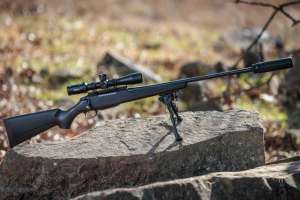
The company’s upgraded XT (X-Treme) models appeared three years later. Like the original, each comes with a Bergara barrel — renowned for accuracy — but it’s been upgraded to a heavier No. 5 taper. They are also fluted to maximize heat transfer and keep things cool, ensuring shot-to-shot consistency, even during lengthy range sessions.
XTs also come with a radial muzzle brake to minimize perceived recoil and reduce muzzle rise. The oversized bolt knob eliminates any concern that gloved operation in foul weather will be a challenge.
The upgrades are welcome additions. They improve handling and are tailored for enthusiasts who anticipate they may need to deliver an accurate long-distance shot when afield.
None of the new assets turn heads when the gun is hanging on a distant shelf, however. You’ll get their attention once you give them a chance to handle the rifle, while explaining its features and performance. Here are a few elements worth mentioning.
Adjustable Length of Pull
Length of pull on the Cascade XT, as it comes from the factory, is 14 inches. Owners can adjust it down to 13 inches easily, however.
The process is as simple as backing out the pair of screws that affix the recoil pad and removing the spacer. You may need to use an exacto blade during the process to prevent the camouflage coating from tearing.
It’s not a field-expedient process by any means, but the approach eliminates potential problems afield. For one thing, there’s no external knob or lever to hang up on brush when you’re trying to put a sneak on that trophy elk. It also means fewer exposed parts to work loose and permanently disappear.
The only drawback for a retailer is the fact that the spacer is hard to detect without up-close inspection. The feature improves trigger finger placement for younger hunters and those with different physiques and is worth pointing out at the counter.
Trigger
Every customer, regardless of arm length, who gives the trigger a try will be impressed. There was no creep, take-up or gritty feel on the rifle sent for testing. Even after a lengthy range session, the single-stage trigger was crisp and pleasant.
That’s been my experience with every CVA, though. Let-off weight was tested after the range session. Doing so before would only reflect factory-fresh numbers.
Let-off weight averaged 2.44 pounds over the course of 10 pulls, as measured by a Lyman Electronic Digital Trigger Pull Gauge. Results varied a couple times by two ounces but, overall, it was very consistent.
Most new owners won’t be in a hurry to change the factory setting, but they can. Doing so only requires removing the barreled action from the stock and adjusting a screw in front of the trigger housing. That feature is rarely mentioned about this Cascade, but it’s something customers have come to expect from manufacturers. In this case, the mechanism is hidden, wisely protected from conditions afield.
The trigger guard is large enough that it will not encumber gloved use. The trigger shoe, however, is smooth instead of wearing any sort of purchase-enhancing texture.
Bolt and Receiver
The three-lug, push-feed bolt operated glassy smooth during testing. It locked up solidly and picked up cartridges from the magazine without a single stoppage or failure.
Its handle has a 70-degree throw to speed reloads. The angle also increases distance from mounted optics.
A red tab appears low and behind the bolt when the firing pin is “cocked” — regardless of safety position. It retracts after a shot. The safety enhancement is clearly visible from the shooting position.
The receiver is constructed from 4140 carbon steel. A non-integral, Picatinny rail rides across the top, which makes mounting an optic the effortless chore today’s hunters expect. Earlier versions of CVA Cascade XT wore two smaller sections of rail. The company phased that out late in 2024 to provide more real estate for riflescope placement. Owners of earlier models can pick up a single-piece DuraSight rail — either 20 or 0 MOA versions — on the company website if they wish to replace their two-piece set. They go right on with a few turns of a wrench.
A two-position safety is at the traditional location, right rear of the receiver. The bolt can be removed regardless of its setting.
On the left side, again at the rear, is the bolt-release bar. It also worked smoothly and without fail. It’s refreshing not to go through multiple steps to remove it at the range or when traveling.
Magazine
The rifle’s flush-fitting polymer magazine was reliably and easily removed during the firing line session. Pulling back the release bar, which is in front of the magazine well, unlocks the spring-loaded mechanism. That motion also makes grasping the magazine intuitive, minimizing chances of a noisy drop to the ground.
Small polymer barriers surround the left and right sides of the release bar to prevent inadvertent activation. The groove it rests in, however, is large enough to easily locate with an index finger without looking, even when wearing thick gloves.
Short-action CVA Cascade XTs have a magazine capacity of four cartridges. The count drops to three with long-action chamberings.
The 7mm PRC is the outlier, however, despite falling into the latter’s length category. The magazine holds only two rounds. It’s not a deal breaker, but it’s worth noting by retailers who have yet to experience demand for this particular cartridge or firearms in the chambering.
Stock and Looks
The test rifle arrived wearing Realtree Hillside camouflage, a highly effective pattern in many areas of the nation. It is designed for field use and shuns any jump-off-the-shelf gaudiness that drives impulse gift buys. It’s a solid choice for hunters looking for performance, not fluff. It’s particularly suitable on this rifle.
Checkering at the wrist and forend ensure a solid grip in nasty conditions. One of the big advantages of letting a customer handle any CVA is giving them a first-hand feel of the company’s SoftTouch finish. It’s not tacky. It’s instead confidence-building and conveys a wood-like warmth — rare assets for a synthetic stock.
There are three sling swivel attachment points on the stock. Two up front allow owners to mount a bipod or adjust their sling for a more comfortable carry.
The barrel has an unblemished, even finish, and the fluting is what we’ve come to expect from Bergara — very nice. That skilled workmanship, however, almost vanishes in the dark black metalwork.
Even the generous CrushZone recoil pad’s name blends in. The CVA logo and Cascade name are engraved on the left side of the receiver, but their black finish is so dark a flashlight was required to tease them out for photos. The CVA logo on the pistol grip cap is covered in camo, and on the magazine, it’s black.
The rifle’s all about business, not marketing. So how did it do downrange?
Behind the Trigger
Five three-shot groups were shot from a prone, sandbagged position at 100 yards. Temperature was 68 degrees and the wind calm.
There’s not exactly a glut of loads available yet for the 7mm PRC, so only two were tested. The top performer was Remington’s 160-grain Copper Tipped boattail load. Average group size was .69 inch.
Hornady’s 180-grain ELD match load was no slouch. It turned in the tightest group at 1/2 inch, although across all five groups its average was slightly larger — .71 inch.
It was the first time I got behind a 7mm PRC, and I fully expected recoil to be stout from the prone position. I was anticipated something akin to 7 mm Rem. Mag. in my old Remington 700. I was wrong. The brake, recoil pad and cartridge made the experience pleasant and comfortable.
Overall
The CVA Cascade XT will not win any runway competitions, draw gawkers at store windows or earn TikTok fame, either. It’s businesslike and straightforward, and it delivers.
This rifle is worthy of consideration by hunting retailers eager to offer their customers — even those who can’t afford the head-turning glam — the performance they deserve.