
Thermal handhelds and riflescopes can and will detect heat signatures during daytime hours. But the quality of those daytime images can vary, making actual detection of objects much harder than at night.
For those who want a first-rate thermal scope and an effective daytime optic in one package, Pulsar has the answer with the Thermion Duo DXP 55 and Thermion Duo DXP 50 Thermal riflescopes.
Pulsar terms these units “multispectral hunting riflescopes” as each combines a 640x480 thermal sensor with a full color daytime optic generated by an onboard digital optic sensor. With the press of a button a user can switch between the thermal and daytime digital options.
I recently ran the Thermion Duo DXP 50 unit and found the digital daytime a useful option and the thermal capabilities to be first rate.

Features
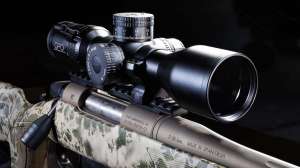
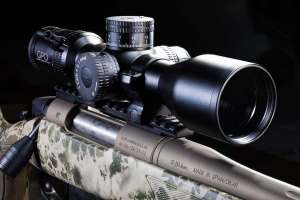
The DPX 50’s blue power button was located near the front end of the unit and just above the main tube. Ergonomic focusing wheels on the right and left sides of this button made focusing easy with either my left or right hand.
The control for the MAIN and QUICK Menus sat on the left center of the main tube, with the battery compartment atop the tube and directly to the right of this menu control. To the right of the tube, another turret. Unscrew the turret cap to reveal a USB-c port for charging the internal battery and for downloading media, as well as firmware updates.
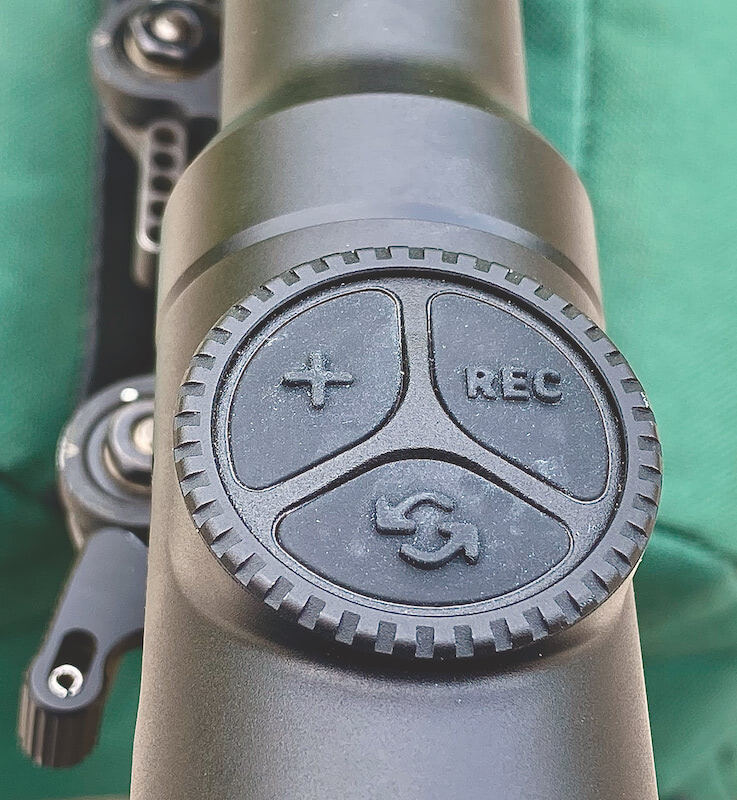
Located within the circular, rubberized pad at the top of the ocular lens were three controls. Magnification is adjusted with the top left pad, Media selected with the top right pad, and the MODE pad, bottom center, to switch the unit between thermal and digital day vision. MODE also operated the picture-in-picture function, available to both the daytime and thermal channels.
The DPX 50’s 640 thermal sensor and 50mm objective lens provided very sharp images during the night and good images during the day. Actually, “good” was very impressive as my daytime shooting occurred with the temperature at 85 degrees Fahrenheit and the humidity hovering at 75% – a combination of environmental factors capable of distorting images for any number of thermals.
The DPX 50 offered a choice of eight color palettes, including White Hot, Black Hot and Red Hot for prime object detection. Rainbow and Ultramarine help increase a hunter’s chances for recognition and identification, while Pulsar rates the Red Monochrome, Sepia and Violet options as best for extended nighttime observation.
Zeroing is accomplished manually or with the unit’s one-shot FREEZE function. Settings are saved in a shooting profile, and the Thermion allows up to five shooting profiles for several types of weapons or cartridges. Each profile can hold up to 10 zeroing distances.
The unit’s 10 reticle options are available in nine different color modes.
Daytime
Daytime viewing is possible through the unit’s CMOS 3840x2160 digital sensor, with the smaller daytime objective lens located atop and at the end of the main tube. Using the MODE pad, a hunter selects the daytime option, then uses the roll knob atop the daytime unit to open the objective lens.
Based on the distances I viewed, I believe a good marksman can engage targets out to 300 yards using the daytime digital mode and the zoom magnification.

Super Duty Rifle
I mounted the Thermion Duo DXP 50 on a Geissele Automatics’ Super Duty MOD 1 (Model 08-395S) AR-platform rifle chambered in 5.56 NATO.
The Super Duty featured a 16-inch chrome lined barrel, a Geissele Length gas system, a full-length rail, and a B5 Systems Enhanced Sopmod Stock. Even with the end of the Thermion sticking back over the end of the upper, the Airborne Charging Handle made racking the rifle very easy.
This represented my first experience running the Super Duty and it was not only extremely accurate but functioned smoothly throughout my shooting.
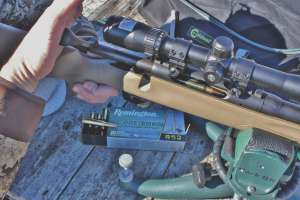
My ammunition for the test was Remington UMC .223 Rem., launching a 55-grain full metal jacketed bullet.
One note, though, about mounting the DXP 50 onto a rifle. While standard 30 mm rings will fit the main tube, that large objective requires substantial mounting height to keep it off the barrel.
I used a Leupold MARK AR one-piece 30mm Integral Mounting System. Made of lightweight aircraft-grade aluminum, the IMS rings held the Thermion tube firmly in place while the Torx screws aside the bottom plate secured the mount tight to the Super Duty’s rail.
Zeroing Required
One of the first things a potential customer of the DPX 50 needs to know is that both the thermal and the digital daytime viewer require their own zeroing. Pulsar’s menu made both zeroings fairly easy.
I used the manual process for zeroing for the daytime mode, the FREEZE function to zero the unit in the thermal mode.

Thermal Shots
I switched the DPX 50 to the thermal mode and started off at 50 yards. As with other units, the FREEZE function requires the shooter to take an initial shot or two at the selected distance, determine the point of impact, and then FREEZE the unit with the reticle aligned with the original point of aim. Then, use the Menu knob adjustment to move the secondary zeroing reticle to the actual point of impact, and save this setting.
At this juncture, the next shots should be at or at least much closer to the target.
At 50 yards, my shots were several inches high and left. FREEZE got me onto my small HandHots heat pack in a few shots, and then I fine-tuned that zero.
I moved my set up to 100 yards, my target a larger 4.75x3.5-inch HotHands heat pack. As expected, the original 50-yard zero had my first shots hitting high and also a bit left. Time to re-FREEZE. Actually, I moved the secondary reticle a little too far, and my next three shots hit the heat packet but low and right.
I made another adjustment and drilled three shots center of the heat pack that grouped in at a very impressive .65 inches, a testament to both the precision of the unit’s controls and the accuracy of the Super Duty rifle.
I ran three more three shot groups on a second heat pack and the results were the same: damned accurate, both the DXP 50 and the Super Duty.
More Features
The Thermion Duo is powered with two rechargeable batteries: one built-in with a capacity of 4.9 Ah, the other replaceable with a capacity of 2 Ah. A single charge guarantees up to 6 hours of dual battery life. Embossment on the body of the replaceable battery makes sure the battery is positioned correctly within the battery compartment.
Thermion 2 LRF riflescopes operate in temperatures from -13 to +122 °F. The AMOLED display is frost resistant, too.
With an IPX7 waterproof rating, the DUO works fine in conditions of high humidity and heavy rain and can withstand half an hour of immersion in water to a depth of 1 meter.
Duo Sales
“While thermal is a 24-hour scope, the Thermion Duo doubles down on the statement, giving hunters and shooters alike what they want for day, full color, and at night thermal, in the same scope,” says Kevin Reese, senior media relations and advertising for Sellmark Corporation, Pulsar’s parent company. “In fact, the full-color daytime field of view is similar to shooting and hunting with traditional optics, at least in terms of look and feel.”
Stress all this to potential customers upfront, Reese advised, whenever they express any interest in the Thermion Duo DXP50.
As with any thermal unit, be ready to turn on said unit and give your clientele a hands-on rundown of the features.
“For static demos, pick color reticle types and styles that richly contrast with the field of view.” Reese suggests. “I like red or green. Decrease brightness just a tad and increase contrast for richer imaging in both modes. Picture-in-picture is always good to have up, too.
“In my demoing at trade and consumer events, I like to show thermal in the field of view with full-color daytime imaging in the picture in picture. This way, with the quick push of a button, I can reverse the modes, bringing full-color to the field of view and thermal to the picture-in-picture.”
Make sure to mention the unit’s thermal detection range, the advantage of picture-in-picture with increased magnification for more precise shot placement, as well as the Duo’s rechargeable battery, sensor resolution, Wi-Fi connectivity and integral photo/video for capturing memories.
In-Store Help
Sellmark/Pulsar regional sales managers are always available for remote training, in-store visits, and can and will furnish creative assets to retailers.
“More importantly, our entire sales team is in-house,” Reese notes. “When retailers work with our sales representatives, they are working with people within our building who truly know the products because they use them themselves.”
Sellmark has over 5,000 dealers worldwide and thousands of dealers within the United States. Dealers can work directly with Pulsar or, depending on their business model, access Pulsar products through distribution.
“Potential dealers definitely should reach out to us to see if we're a fit for what they're trying to do,” Reese adds.
Those interested in becoming dealers can email Sellmark at customerservice@sellmark.net. They can also reach the company reps by phone at (817) 761-1771. Additionally, they can click on "Become a Dealer" at the top the Pulsar homepage at www.PulsarNV.com to receive dealer information and have any questions answered.