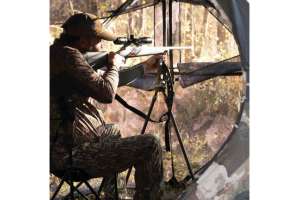

A couple of minutes can seem like an eternity when sitting in an elevated blind, especially when your scope’s crosshairs are fixed on a big whitetail buck and you’re waiting for legal shooting time to arrive.
Sometimes, the extra moments are a blessing, letting you work on slowing your adrenaline-hyped respiration and pounding heart. Deer rarely stay still unless they’re feeding or nervously scanning for danger. Staying focused and on your target is essential. A quality scope with a crisp, easy-to-see reticle is important at any time of day and nearly indispensable during the fuzzy light of an arriving dawn or the murky dusk of afternoon twilight.
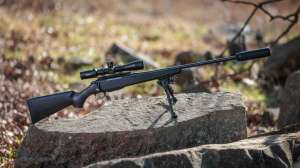
The daybreak scenario went down in the rolling plains of West Texas last fall, hunting at the 43,000-acre Lowrance Ranch. I was in a comfortable blind, my Bergara B-14 Timber rifle, chambered in potent .300 Win Mag, locked in a solid rest. At first, the big buck, a heavy-racked, 10-point hombre the ranch managers had nicknamed “Tres” appeared as a stealthy shadow 200 yards to the left. The free-range deer (no high fences at Lowrance) was moving toward a couple of does already on the scene a good 100 yards ahead.
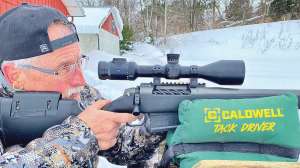
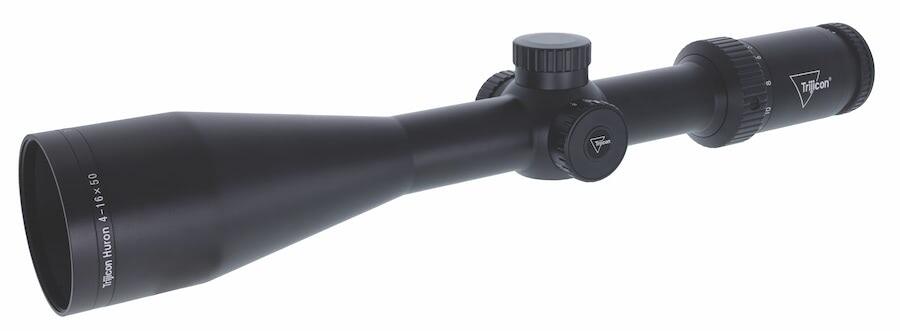
I tucked into the rifle and found the buck in the new Trijicon Huron scope I added for the hunt. As the deer advanced, I tracked it along the edge of a thicket. The scope is a 4-16x50mm variable, something I like because my aging eyes appreciate the light gathering help of a 50-millimeter objective and I had the ability to dial up and dial in on any shot out to a few hundred yards. As it turned out, I rotated the magnification to 14 as the deer neared the does. Some might say that is overkill for a deer just 100 or so yards away, but it gave me a hell of a near-full-body view, letting me clearly watch the whole show as the buck gazed in pre-rut lust at the does.
I was in the blind with Eli Arends, a young guide from Nebraska who helps out at Lowrance during deer season. I asked Eli to give me a tap when legal shooting time arrived. Tres was offering a straight-on frontal pose — a doable if not ideal shot — but as if on cue at the appointed moment the deer turned broadside and began chewing a licking branch above a scrape.
Tap. Tap. “We’re legal,” Eli whispered.
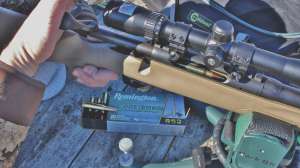
The buck gave a powerful kick at the impact of the 150-grain Winchester Deer Season XP bullet. Deer scattered and the scene quieted. Eli gave me a high five. My hunt was over on the morning of day three.

Trijicon Expands Huron Line
The Huron line debuted in 2020. Deer hunters were the target market. The four original scope models were 1-4x24mm, 2.5-10x40mm, 3-12x40mm and 3-9x40mm. This January, Trijicon launched two additional models, the 4-16x50mm that I used and a 1-6x24mm version. Between the six models, Trijicon covers a wide swath of hunting options.
Eddie Stevenson, who handles media relations for Trijicon, explains that the original offerings were all selected to address magnifications a majority of whitetail hunters use whether hunting in the woods or more open country.
“All of the scopes were a 3x or 4x erector system (the zoom range from low to high power magnification) that delivers a good field of view on low magnification with the ability to make a longer shot on high magnification,” Stevenson says.
Josh Lyall, Trijicon’s marketing director, who also tagged a beautiful buck on the Texas hunt, says success with the initial models prompted the expansion, noting, “The Huron line has been a good seller for us since 2020, so we decided to add more options.”
A big driver in the expansion was consumer demand, says Stevenson, with consumers at tradeshows and retail counters asking for additional choices.
“The 1-6x24 addresses a few different end-use applications,” Stevenson says. “This versatile magnification was being requested by hunters with lever guns, muzzleloaders and straight-wall cartridge rifles. These are generally hunters that are in the woods or tight cover that need a wide field of view on 1x but want a little more magnification on the upper end than the 1-4x24mm offers. Whitetail hunters are the intended target but the 1-6x24mm will also make a great hog, black bear, or dangerous-game scope.”
Consumers also requested a 50mm objective that provides a good exit pupil at higher magnifications to boost performance in low-light conditions, as well as more magnification than the current 3-12x40mm.
“The new 4-16x50mm addresses both of these requests, Stevenson says. “The 4-16x50mm is very versatile with a good field of view on 4x if hunting in the brush but also offers great upper-end magnification if hunting over a field or clearcut where a longer shot might be required.”
Marketing Considerations
The Huron line was ambitiously launched at the same time Trijicon launched the Ascent tactical scope, the illuminated reticle Credo hunting scope and the Tenmile, an optic geared toward long-range shooting, as the name might suggest. The debut received a significant marketing push. The concurrent launches gave consumers numerous choices for premium optics, organized according to the consumer’s hunting objectives and the level of features they were looking for in an optic, Stevenson explains. The key was clearly explaining the differentiation between the new models, letting consumers, and the retailers who were advising them, pick a scope that best suited their hunting needs.
The Huron line might be considered the most “stripped down,” absent a battery-powered illuminated reticle like those in the Credo or the non-battery tritium and fiber optic illuminated reticle AccuPoint models.
“Not everyone needs an illuminated reticle,” Lyall says. “And obviously it adds some cost and weight to the scope.”
All of the Huron models have a BDC Hunter Hold reticle, with two additional reticle options available in the classic 3-9x40mm, a standard duplex and a German #4.
“The BDC Hunter Hold reticle is a generic “bullet drop compensation” reticle developed around the trajectories of all popular deer hunting cartridges with hunting-appropriate bullets from a .243 Win to .300 Win Mag,” Stevenson says. “Using a 50-to-200 yard zero, most of these cartridges fall plus or minus 2.5 inches out to 500 yards. At 50 yards, the bullet is still rising and crosses the line of sight. At 200 yards, the bullet is descending and, again, crosses line of sight. Depending on the bullet, minor adjustments can get you dead-on at 200 yards. From there, your first stadia line (the sub-marking on the downward crosshair) in the reticle is your 300-yard hold, the second line is 400 yards, and the third is 500 yards.
“Of course, you should always verify with your rifle and preferred ammunition to know exact point of impact at these distances,” Stevenson adds.
In terms of construction, all Trijicon variable powered scopes use the same anti-scratch glass and materials. All housings are crafted from 6061 aircraft-grade aluminum and all Hurons have 30mm tubes, except for the 1-inch 3-9x40mm model.
“Our glass is what sets us apart,” Lyall says. “This same glass goes into some of our products that sell for $2,800 – but the Hurons cost about $600 and up. Minimal distortion, great light transfer – everything you need for whitetail deer hunting. You get Trijicon durability at a good value.”
Some optics manufacturers tout things such as light transmission ratings or percentages but Stevenson says Trijicon doesn’t get into that game, saying such specifications can be skewed.
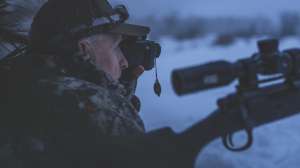
There are light wavelengths that provide very high transmission but are not visible wavelengths to the human eye,” he explains. “Everything we do in the design and development phase plus the selection of materials and coatings used is done keeping high visible light transmission in mind since much hunting takes place early and late in low light. The best way to evaluate light transmission is to get behind a Trijicon scope in a low-light environment and the quality of the glass and coatings will be very evident compared to other, less expensive scopes.”
Based on my dawn’s early light encounter with Tres, light transmission was more than adequate – more like exceptional.
Trijicon is known for “durability testing” its scopes, something one might expect from a company so successful in supplying optics for the U.S. military. Stevenson outlined what the testing involves and how retailers might explain to consumers the rigors that went into getting a reliable product atop their rifle.
“Our testing methodology falls under what we call The Science of Brilliant,” Stevenson says. “This includes numerous tests that we put every model of scope through to ensure they meet Trijicon’s standard for durability.”
Here is a look:
- Alaska-to-Africa Temperature Shock – Thermal shock testing from -20F to 140F. Scopes are held for 24 hours in both cold and hot storage. In either case, once pulled from freezer or oven, the optic is quickly brought to ambient temperature. This simulates going from hunting in arctic conditions and taking the scope into a heated cabin or going from the trunk of a vehicle in the desert southwest in summer into your house. In both scenarios, the contraction and expansion of the dissimilar materials will expose issues in the form of leaks or glass cracking if tolerances are not correct.
- Immersion – All hunting optics must pass 30 minutes at a depth of 3 meters/10 feet with no water intrusion, enabling confidence the scope will handle hunting in the rain or if dropped while crossing a stream.
- Solid Zero – On a recoil simulator, scopes are subjected to 5,000 rounds of SCAR-H, a known scope wrecker, and 5,000 rounds of M4. These are two very different recoil impulses. Trijicon makes sure any point of impact shift is within their tight specification, that the scope will come to zero, and no leaks or glass dusting occurs.
- Vibration – Ensures a mounted optic will maintain zero through vibrations and abuse that might be encountered bouncing around in a Humvee, pick-up truck, ATV or UTV. All scopes encounter this at some level so zero must be maintained.
- Drop – Accidents happen, and rifles are dropped. Trijicon conducts drop tests with scopes mounted on rifles, dropping at various heights and onto different materials, such as hard-packed soil, plywood and concrete.

Get Some
Mike Norman, the firearms manager at Green Top Sporting Goods in Ashland, Virginia, mounted the optic on my rifle and expertly bore-sighted it for me. I zeroed it at a friend’s backyard 100-yard range. We squeezed off one shot and then used the perfectly precise elevation and windage adjustments to make an ever-so-slight correction. The next three shots were sub-MOA.
The 4-16x50mm Huron I used was a “test and evaluation” model. My friend Thomas is a deer hunting diehard, incredibly successful at tagging big Virginia bucks for more than 50 years. After the rapid, impeccable zeroing of the rifle/scope combo, he deadpanned, “Ken, you might want to think about keeping that scope.”
Yes, deer hunters who value affordable, effective gear and optics that have uncluttered, crisp reticles might find a lot to like with the Huron line of Trijicon scopes.
Retailers interested in learning more about the new Huron scopes and seeing samples should reach out to their local Trijicon account manager. If interested in becoming a Trijicon Dealer, the best first step is to fill out the “Become A Dealer” form on the Contact page of Trijicon.com.
The MSRP for the Huron lineup:
1-4x24 - $685
1-6x24 - $735
2.5-10x40 - $735
3-9x40 - $735
3-12x40 - $735
4-16X50 - $985