
When the big tom gobbled loudly only 20 or so yards behind the blind, both my son and I were jolted from slumber and jarred into action. We’d set up the blind at the edge of a large agricultural field hours before, put a hen decoy in front and called intermittently with no luck.
Jacob, now an officer in the U.S. Marine Corps, was only 9 years old at the time and had little faith in the setup. Surely, he had said earlier, a turkey wouldn’t just walk right up to that pop-up blind and not notice something that wasn’t there the previous day. As the morning wore on, I was beginning to agree with him.
However, the loud gobble right behind us had softened our skepticism. By the time the mature gobbler stepped out in front of the blind only 10 paces away, we had quickly developed a newfound love for pop-up blinds. An accurate shot to the noggin started that turkey’s journey from field to table.
Ground blinds—both the pop-up variety and the more modern hub blinds—are extremely useful to today’s hunters. They’re light, easily transportable and quick to set up, and they do a great job of hiding hunters from their sought-after game animals.
Interestingly, different kinds of game animals tend to react quite differently to ground blinds. Deer often shy from blinds that have been placed recently, so “brushing in” a deer-hunting blind to conceal it better is a smart move. Turkeys, as described in the anecdote above, often seem like they couldn’t care less about a blind sitting right on the path they walked down the day before. Best advice: brush the blind in well for deer, and a little brush to break up the outline won’t hurt when turkey hunting, either.
Some Things To Consider
Hunters often consider several factors when choosing a pop-up blind, so smart retailers also keep those things in mind when choosing blinds for their inventory.
Style is important, as pop-up blinds and hub-style blinds are somewhat different. Pop-up blinds are usually lighter and easier to transport, while hub-style blinds tend to be bigger and roomier inside. For this story, we’re lumping both kinds together as pop-up blinds.
Size is another important consideration, as those who prefer to hunt with a partner require more room inside the blind than those who hunt alone. Also, with smaller blinds, it’s often easier to find the perfect place to set them up, and larger ones often are harder to blend into the background. For those hunting with a gun, a tall blind might not be important, but bowhunters tend to prefer tall blinds for obvious reasons.
The weight of the blind is also important to many hunters. Those who like to run-and-gun prefer a lightweight blind that’s easy to fold up and tote quickly and easily to the next hunting spot. On the other hand, a hunter who puts up a ground blind with the intention of leaving it in the same place and hunting from it all season won’t be so focused on the weight of the blind.
Another consideration is camouflage. Blinds that match the typical flora in your area will blend in better and yield more success. On the other hands, blinds with camo patterns that look out of place in a particular location will be noticed by more game animals.
One last factor is windows. The size and shape of windows are important, as bowhunters prefer taller windows than those hunting with firearms do. Likewise, many bowhunters prefer blinds with shoot-through materials to cover the windows, whereas most gun owners have little use for that feature.
Of Ground Blinds and Treestands
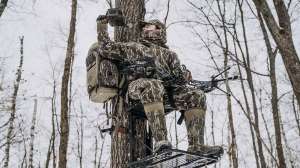
Avid treestand hunters tend to have little use for pop-up blinds. However, there are places where blinds shine brighter than a tree stand. Sometimes there’s not an adequate tree in the area you choose to hunt. Also, ground blinds are safer, as hunters avoid climbing a ladder, which they are often doing in the dark.
Of course, since they are portable, pop-up blinds can be more easily moved from place to place than most tree stands. And when it comes to introducing youngsters to hunting, pop-up blinds excel. Not only are they safe to get into and out of, but they conceal movement well — an important consideration for fidgety youngsters just learning to sit still in the woods.
Lastly, in inclement weather, pop-up blinds can be super comfortable compared to a treestand. They keep hunters out of the wind and rain, and if it’s really cold, hunters can turn on a little gas heater inside to thaw out their fingers and toes.
Let’s take a look at three good ground blinds, from least expensive to most, that you might want to consider stocking for your customers.
Ameristep Doghouse Run & Gun
On the budget end of the spectrum, Ameristep’s Doghouse Run & Gun blind is a great option for hunters not willing to spend a fortune on a pop-up blind. In fact, the turkey hunt described earlier took place in Ameristep’s original Doghouse blind, which I still occasionally use some two decades later.
The Run & Gun is a slightly downsized version of the original, making it somewhat more portable while still having plenty of internal room for two hunters. The Durashell Plus fabric has a Mossy Oak Break-Up Country camo exterior, along with a black ShadowGuard interior to eliminate shadows and silhouettes. Its dimensions are 55x55x61 inches, and it weighs only 8 pounds. Setup and takedown are super easy, as is packing it to get ready for travel to another hunting spot. A carry bag and tie-down straps with stakes come in the package. Retail: $114.99

Primos Full Frontal
In the middle price range of our three blinds, the Primos Full Frontal One-Way See-Through hunting blind is as special as the name makes it sound. From the inside, you can see right through the side of the blind to watch for passing or approaching game animals without having to peek through the windows. Of course, animals on the outside can’t see through the material.
The blind’s fully adjustable window system allows users to configure the shooting windows just about any way they want to, and a spring steel-assist door system allows for easy and silent access when entering and exiting the blind. It is plenty big for two hunters to hunt in for extended periods of time, and the Veil Camo patterns blend nicely with many different environments. Weight is 17 pounds with the carry bag and stakes. Retail: $274.99

Rhino Low Hub Pro FD
This hub-style blind might cost hunters more than twice what the Ameristep does, but the sheer number of features it offers might make it a best-seller for you. With a floor footprint of 68x68 inches and a width at the hub of 89 inches, the Low Hub Pro FD is about as roomy a blind as you’re likely to find, enough to accommodate three hunters with extra room for gear, tripods, cameras and more. Yet, it weighs only 20 pounds. And for bowhunters wanting to shoot standing up, the height is a full 75 inches.
The low hub system allows for a lower window profile and more shooting opportunities through the huge window system with see-through mesh and silent slide windows. An improved full-door system makes blind entry and exit easier than ever. It’s available in Realtree camouflage and includes a backpack-style carry case, rope tie-downs and ground stakes. Retail: $329.99