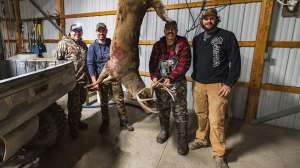

On the wall in my little home office, proudly displayed among prized mounted heads of big game, is a framed 11x14 photograph. Taken by my good friend and hunting buddy, the late Durwood Hollis, it shows me posing with a pair of little forked-horn 1½-year-old California mule deer bucks (the legal bag limit) killed 30 minutes after sunrise on what was to be my last hunt in that state’s A Zone before I moved to Alaska. It’s a place where success rates are measured in single digits, and I’m as proud of those two little bucks as any animal I’ve taken anywhere on the planet. The inscription on the photograph reads, “If it’s legal, it’s a trophy. Bob Robb, August, 1990.”
Those of us immersed in the hunting community understand what “trophy hunting” is all about, don’t we? And yet, the term remains a lightning rod, particularly among the staunch antihunting crowd who keep trying to influence the general public to believe all hunting is bad.
I’ve been thinking about this a lot lately in light of the fact that grizzly bears in some areas of the Rocky Mountain West might soon be delisted from federal endangered species protection, and thus, hunted on a controlled basis. If and when that happens, you can bet your bottom dollar that the animal rightists will be out in droves, both protesting and fundraising, off this “trophy hunt” in a very big way.
If grizzly seasons do occur, tags will be extremely limited, and costs will be stiff. Can you imagine the amount of money that would be raised for conservation if the first tag issued in, say, Wyoming, was auctioned off as a governor’s tag? Well over six figures, I’d wager. The opponents of such a hunt would scream to high heaven that such a “trophy hunt” is unnecessary, and that bear alive would be worth far more in terms of tourist dollars.
Of course, that’s poppycock, given the fact that there are way more grizzlies in the region today than necessary to maintain a healthy population. As we’ve seen for decades in cases where apex predators like mountain lions and grizzly bears are not allowed to be sport hunted by law, it’s not a question of whether or not many of them die, but instead, who pulls the trigger — a sport hunter who pays a premium for the privilege, or a government control agent who kills cats and bears that kill livestock and cause property damage, all at public expense. For reference, 75 grizzlies were killed in the Yellowstone ecosystem in 2025, 73 the year before.
The term “trophy hunting” actually dates back to the beginning of the Boone & Crockett Club and President Theodore Roosevelt, a fervent hunter who became appalled by the rapid slaughter of game animals out West back in the late 1800s. In 1888 he helped found the B&C Club, whose core mission was to end the slaughter by instituting regulated hunting. By selectively hunting, which occasionally meant taking older, more mature males, game herds were allowed to grow and remain healthy. This led to some early big-game competitions to see who could take the bucks and bulls with the largest horns and antlers, as defined by the B&C Club’s method of scoring. The winner of the competition would receive a trophy; hence the term “trophy hunting” was coined. The trophy hunter was, in fact, the polar opposite of the commercial hunter of the day, whose goal was to kill as many animals as possible, regardless of their age or sex. In essence, they were the first hunting conservationists.
A survey of the general public’s attitudes towards hunting published in June, 2023 by Responsive Management, showed that while 74% of Americans approve of hunting for meat, only 24% approve of hunting “for a trophy.” Interestingly, when asked the question: “No matter your opinion on hunting, do you agree or disagree that it is okay for other people to hunt if they do so legally and in accordance with hunting laws and regulations?”, 86% of people agreed — down from 93% in 2011.
Animal rightists use the “trophy hunting is all about ego” argument as a way to try to influence public opinion while distorting one key fact. That fact is that, both by law and the ethics that are the foundation of sport hunting, edible meat is never wasted. The fact is that “trophy hunters” and “meat hunters” are really birds of a similar feather. While meat hunters are primarily out to tag any legal animal they see as a means of filling their freezers, a trophy hunter will pass on younger bucks and bulls in the hopes of finding an older male. The most serious may end up not shooting an animal at all, while others may hold out until late in their hunts, then fill their tag with a legal animal so their freezers might also be filled.
For serious big-game hunters, a true “trophy” is not just about antler or horn size. It’s about the hunt itself, the effort required, a testing of woodsmanship skills that are really prehistoric. More than anything, it’s a personal thing that no one can define for anyone but themselves. Those young bucks described earlier were the result of many years of paying my dues in that rugged wilderness while hunting hard in triple-digit temperatures, mostly unsuccessfully.
In a world dominated by social media, clickbait, and the coming of AI, it is more important than ever for hunters to be mindful of the fact that posting any questionable hunter success photos, distasteful braggadocio, and slovenly actions afield can negatively go viral instantaneously. And never forget that, in the end, any successful hunt conducted legally and ethically is worth celebrating. After all, if it’s legal, it truly is a trophy.