
Outdoor writer Patrick F. McManus wrote that camping was “A Fine and Pleasant Misery” — one of his humorous essays in a book by the same title. And he was right. Camping knowledge and gear have vastly improved over time, and thousands of people are still drawn to the challenge and thrill and mystique of living outdoors for days at a time, away from the normal comforts of home. Whether they’re camping for the first time or the hundredth, it’s easy to get overwhelmed by the myriad gear choices available today. As you help your customers sort out their needs and choose their gear, try simplifying the matter to these five categories: creating heat, seeing, eating and drinking, sleeping, and cutting. Gear for camping is more than these, of course, but it is not less. With that, here are some ideas on how to sell the most basic of camping gear.
Creating Heat
The campfire, as most of your customers will know, is the centerpiece of most camping experiences. Whether they build a campfire to warm themselves or their space, heat water or cook food, or simply gather around to share stories, it’s an important part of the outdoor experience serving a variety of needs. Whether roasting marshmallows in a social/communal experience or needing a life-saving means of survival in the wild, being able to build a fire is one of the oldest and most basic outdoor experiences known to the human race. You know fire-building technology has only increased over time — to the point where very handy, windproof, mini torches that light with the push of a button are available as point-of-sale items in most gas station C-stores. Moreover, we have an abundant variety of self-contained, portable stoves to safely provide instant heat. All good things!
But along with the technologically advanced means of creating and managing fire and heat, keep your customers aware of and skilled in the basics — gathering tinder/fuel and creating a spark. Basic flint and steel fire-starting tools generally last a long time and even come in portable kits, including a source of fuel. Learn your customers’ needs, but expand their thinking, too: As with many outdoor gear items, be ready to talk about not only one solution to a problem, but also the wisdom of having more than one solution to a problem. Usually there’s more than enough budget and physical space for a person to equip themselves with more than one fire-starting tool. A push-button mini torch, pack of survival matches, and a flint/steel/tinder kit provide three easily-
Consider Stocking: Saddleback Leather Fire Starter Kit
This kit offers a flint and steel as well as the ability to shave bits of magnesium into a tinder pile made from shards of waxed canvas — a very portable and durable means of starting a fire. Wrapped in a waxed canvas pouch and secured with a leather strap, the Fire Starter Kit includes a couple dozen scraps of waxed canvas that can be pulled apart to create a pile of individual strands of flammable tinder — sort of like a handful of candle wicks. Shave a few bits of magnesium into the tinder pile, have some kindling at the ready, and then strike the steel against the flint to send a series of sparks, which should readily catch.
Seeing
Having a source of light such as a flashlight is an easy addition to a “must-have” list of camping items. Lighting technology has of course advanced significantly over the past several years to that point that just because you can buy a two-D-cell plastic flashlight for less than $5, doesn’t mean you should. A simple light has its place, but tubular flashlights have limits at the campsite. Consider instead a headlamp, which frees up hands while staying mobile, or even better, a dedicated camp light. Portable, rechargeable and able to be mounted, hung, clipped or attached to a variety of things around a campsite, camp lights do everything a tubular flashlight and lantern can do, usually with a smaller form factor and increased versatility — including being able to be magnetically mounted, or placed on a surface using an integrated kickstand, and having not only the ability to adjust brightness but also color of light.
Consider Stocking: Fenix CL27R Rechargeable Lantern
This camp light features five lighting modes: floodlight, spotlight, floodlight and spotlight, continuous red light, and flashing red light. The floodlight color temperature can be changed from 2700K to 6500K; the spotlight’s color temperature is set at 5700K. Max lumens at 1600 with a max beam distance of 591 feet. The USB Type C rechargeable battery offers a max runtime of 285 hours. Dual rotary switches control the amount of lumens and color temperature while a push button provides control over the red light as well as showing current battery power in reserve. With a front case, made from aluminum alloy, this light measures 4.32”x3.61”x1.56” and weighs under 11 ounces.
Eating and Drinking
YouTube channels such as Luke Nichols’ Outdoor Boys provide unique perspectives on camping in remote, wilderness areas such as Alaska — and of course some of the gear associated with such an endeavor. Food cooked at a campsite always seems to draw significant interest from viewers, and Nichols usually includes in each of his videos how he prepares and enjoys his meals. His water bottles, portable camp stove, and beat-up metal cookware usually make an appearance in his videos along with a variety of hearty meals and, of course, skillet bread with butter and honey. But Nichols and others like him provide inspiration for your customers and their approach to the camping gear choices providing the most basic of needs: food and drink. So the sales tips to keep in mind here include: Have ready access to a handful of engaging videos showing creative ways people eat and drink when camping beyond the normal hot-dogs-on-a-stick fare. Consider an in-store demo on food preparation. And provide checklists to help your customers thoroughly plan for their own nourishment on a camping trip.
Sleeping
Customers gearing up for a camping trip may be overly focused on gear used when awake, giving less thought to getting a good night’s sleep. While “outdoor tired” may have the effect of bringing on exhaustion that makes any bedding seem adequate, not all campsite bedding is created equal. Modern sleeping bags can be technological wonders that can help campers sleep better and thus feel better the next day.
Be sure to ask your customers to describe their sleeping arrangements. If you hear phrases such as, “Oh, I’ve got an old sleeping bag I’ve used for 20 years” or “I’ve got my grandpappy’s cot from WWII,” try to introduce them to more current options with some quick facts on textiles and insulating materials, notes on size and weight savings and packability, and the benefits of adding an inflatable sleeping pad. Even better, have this gear set up or available to set up so your customer can try it out right there in the store.
Cutting
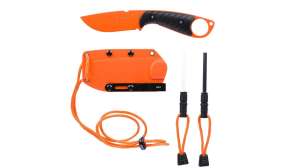
Campsite life, of course, requires cutting tools, from pocketknives to hatchets, so a variety of opportunities for gear sales abound for retail stores. As usual, take time to listen to your customer and understand their needs. In most situations, they probably already own a decent folder but may not need to actually chop any wood. This is where a lightweight, fixed-blade knife such as Spyderco’s Moran Upswept can be eminently useful. Point your customers to the versatility of such a tool: lightweight, so it can be carried around easily in a sheath that attaches to a belt; and a fixed blade for added strength. Since a knife like this will probably end up doing a variety of cutting tasks, including food preparation, point out the pros and cons of various blade shapes and styles. A simple blade with no serrations may be just right for a campsite, as it may be easier to cut, clean and sharpen. Other useful features may include the type/style of handle, depending on, for example, the likelihood of cold, wet hands needing to grip it well.
Consider Stocking: Spyderco Moran Upswept
Designed by Bill Moran, a legendary knife designer, the Upswept measures just over 8 inches in length, with a blade length of 3.92 inches. The flat ground blade sports a thickness of .118 inches. The knife weighs only 3 ounces and includes a lightweight sheath with an excellent belt clip. To reduce slippage when holding, the fiberglass-reinforced nylon handle also features an inlay of Kraton.