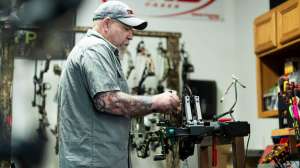

On one of his podcasts earlier this year, Mel Blackwell was discussing the Chinese fable of the three laughing monks. In it, the trio embraced the Zen approach to life, of transcending negativity through joy and embracing the present moment. The monks walked from town to town, standing in the public area and laughing until everyone was laughing with them.
Blackwell is an Alabama author of Uncommon Sense: The Fight to Fix Your Workplace Culture in the Wild West of Business. A longtime hunter and angler, Blackwell has been involved in the corporate world for almost 40 years as a startup advisor or founder, turnaround specialist and fixer. The latter is what he deems his “black hat” persona that sometimes is necessary to weed out the problems of a broken corporate culture and get the fix in place. That involves hard conversations, shifts, firings and getting the employees to believe in the same thing. He has been involved with 15 mergers and acquisitions in 12 industries, along with other work to help companies get on the right track to success.

“Laughter is an offspring of joy that I hear the monks talking about,” he said in the Mel Blackwell Experience podcast, available on Apple and iHeart platforms. “Laughter in the halls at work is part of a good culture ... not making fun of someone, but a healthy and happy spirit.”
Blackwell has delivered bad news, been praised, taken excoriation and proverbial arrows, revived companies, sparked change and more. He learned through trial and error. Decades ago, in one of his first jobs, Blackwell handled the Southeast region for a Midwest-based company. He called the owner, who had hired him as a mid-20s eager beaver, about a problem. The owner’s reply? In short, “You’re in charge down there, you figure it out and fix it. That’s why I hired you.” /click/ Terrible boss? No. Harsh? No. Just an owner who believed he’d hired a smart guy who could handle the situation (Blackwell did!) and didn’t need to be soft-gloved or mollycoddled.
It’s lessons like that one that Blackwell discusses in Uncommon Sense. Along with the book and podcast, it is available on Audible.com as an audio book. The goal of the book is to help any business, from a small independent retailer to a major corporation, get its business model dialed in, eliminate or fix problems, and set the stage for growth and success.
Blackwell met with Archery Business this spring in an extensive Q&A to talk about his proven — and perhaps surprising — tactics for fixing bad cultures in struggling businesses.
AB: Thanks for visiting with us about your new book. And congratulations — writing a book isn’t easy. Why did you do it?
MB: I started writing it in early 2025, based on a Word document I started in 2006. I would get in these corporate fix-ups and it was very instinctual. There's no script. When somebody would ask me to explain how I’m going to make this work, I would literally tell them I can do it faster than I can tell you how I'm going to do it. They really couldn't get their head around it. It wouldn't be the things they had tried that didn't work.

AB: What was it?
MB: It was always culture. And somebody would say, “Well, what is culture?” And I would be like, well, culture is the water inside the aquarium, right? It's everything in there that sustains life. The structure of your business is the frame of the aquarium and that is really important. People don't understand the association that structure has to do with culture. They think structure is just, you know, you build an org chart and you put people in positions. That’s not it. It actually becomes the very frame of the culture. So, it has to be built correctly. And so, going into all this to write the book, I had to stop and think, What did I do? I never had really scripted out what I did, because it was always different.
AB: Every time, right? Every company is different?
MB: This scenario is different. What was the same was culture, and that became fascinating, because I could go from industry to industry and see it each time. I could spend some time in the outdoor world, or publishing, or environmental testing labs. Then I'd go to do ERP software, and then international exhibits and events. But I did all these roles not as a consultant; I actually embedded as president of the company or another high-ranking executive. It's different because, well, I would deploy with the mission, and I would die on mission, or I would get everybody out alive, and we would all survive. It's an insane career to do that. A consultant can do it, can go in and get engaged a little bit and then leave. For me, it usually comes down to “I need this job. I need to make a living.”
I also didn't want to go in there and just sell a bunch of BS, because the way you fixed the company was you built the team. I wanted to build the team. I wanted to coach the team. To coach the team, you have to eat the dog food. You have to be in there first. You have to get into everything. So, it was fascinating, every one of these engagements that I did throughout a 35-year career. When I sat down to write the book, I had no idea what I'd call it. I had, you know, almost 20 years worth of bullet points where I would say that it was Mel-isms — like, If you're going to be dumb, you better be tough. I would just write that down. All these were things I used in business. I was trying to get everybody on one side of the road.
Many of the businesses that I’ve helped were a convoluted mess when I arrived. Nobody knew who's responsible, things weren’t working. Everybody's blaming each other. Every single time in my career, it was always culture. And so I decided, I'm gonna write a book about culture.
AB: This reminds me of the successful coaches and teams. Professional, college, high school ... structurally, they’re all the same — players, coaches, assistants, managers, administrations, fans. But the successful ones, such as Nick Saban at Alabama and Dawn Staley at South Carolina, made it about superior expectations and the process. That’s the “culture,” right?
MB: I started calling this the wild west of business, because early on in a culture fix, the first thing you must do is what I call make the town safe. You have to get rid of whatever sort of bandits who are truly against the direction that the business should go. A lot of times you go in and everybody says, “Yeah, you need to create one side of the road — mine.” But usually, it's creating a new line, and everybody's gonna have to get in it, and everybody's gonna have to change a little bit.
The culture stuff is fascinating because once you start delving into culture change, you do get into strategy, you do get into tactics, you do get into process. But you gotta have culture first — it drives everything. If something isn’t aligned with the culture, it won't work. That's why somebody's process can be good, but it doesn’t work in that culture.
There are two visions in every company, and people deal with only one. The first is the destination, the second is the journey. Everybody is fine talking about the destination. We're going to do this but sometimes people will lose confidence in you, not because of where you told them you're going to take the company, but because they don't think you can get them there. The sub-vision of any business is what I call the “how-journey.” And I spend all my time on the how-journey. I don’t want to try to bastardize where they want it to go, but a lot of folks in a company do. They're fighting over that, saying, “Well, I don't think that's the right vision. I think we should be doing this, or Great-Granddaddy said this or that.”
The first thing you have to do is make sure everybody is in — you know, involved in this thing. You really want to go where we're going, because, by gosh, resistance is futile. We're going there. Yes, that's the first alignment. Second, the best companies, the best cultures, figure out how to get there originating from the bottom, back up. And this is where most companies fail. The executives keep trying to tell everybody how we're going to do it. That doesn't work. People in the business worship problems. I call it problem worship. Oh, the mighty problem!
One company I was with had the worst problem worship culture I've ever seen. Everybody's just talking about the problems. You'd sit through a meeting and think, I'm scared to death of this place. I know that we need to solve these problems, and the people who solve the problems should be the one closest to it. But in a broken business they don't know how, they don't know if they're supposed to, and their bosses won't get out of their way; they won't let them do it. You have people afraid to take the risk of solving these problems. The way you start to fix it is with a vision and shared language. I start saying funny things. I start using what I call Mel-isms to break the ice. I would say, you're asking a cat to bark.
And you'd see people, they're afraid to laugh, because it's a lot of whispering in these broken cultures. But they’re starting to laugh and now we're communicating. We’re talking. What do you think? I mean, you're trying to put somebody in the wrong seat. That's not who they are. They're not going to do well. It's your fault. Cats go meow, doggies go bark. And so, you start using these Mel-isms, these languages, and people begin to start laughing and cutting up. And it's amazing. The culture transformation starts out as a group thing and comes back up from the company, one at a time.

AB: Is it easier to do this in a small business with fewer employees than one of the bigger companies with hundreds of employees and layers of administrators?
MB: It's not necessarily easier. People go to big box stores for a reason. It's convenient. ... I talk about it in Uncommon Sense, a business in Survival Mode versus Thrive Mode. The Survival Mode is they could be getting good results, but it's too hard, or it's not sustainable, or they know they have to hand this off because they're getting older and they don't have a good succession plan. Or we're really struggling. A lot of times people think that’s not a culture thing but a “re-figure out our destination” thing. But that's culture. It really is. If you change your destination, you could lose half your people because they're there to go where you said you were going to take them. This isn't touchy feely stuff. It gets real.
All of this (in Uncommon Sense) was developed in conversations with people from the janitor to the guy who hired me. I mentioned it in the book; think about the Pale Rider who rolls into town. The town is oppressed. Nobody will man up. The women are all hiding behind their men who are hiding behind something. Is the sheriff good or bad? I don't know. Is the mayor good or bad? I don't know. Land barons outside of town are just rustling through and shooting the place up. The governor's probably corrupt, too. So that is a good analogy I've come up with, and sometimes around the board room people roll their eyes at me. The further I go down in the business, the more it resonates. That's where traction is going to come from in business — traction, momentum, the real pull on the rope. But if we create one side of the rope culturally, it does no good if I don't put people on it who can pull us where we want to go. The culture stuff is inside the walls of your fort. All we're trying to do is get united, get a good, shared language, and then you have to have those two visions — it's where we're going and it's how we're gonna get there.
They have no confidence in me when I walk in, because I’m not from their industry. I get them to join me by explaining the process. I tell them that I need you to help me figure out how to do this. You start engaging people down in the business. I'm gonna give you the tools to make decisions. You get to make mistakes, all this kind of thing. Unleash them. Let them do their job. Our job at the top is to remove obstacles, make decisions at the speed they need us to, even if it's if you need me to make a decision faster than I can. I call it the speed of business. My job is to make a decision. I will roll some freaking dice and give you a decision. I'm not going to make you wait past your window of opportunity because I didn't know what to do.
Example: I love to hunt but I don't go into woods I don't know much about without a compass. Business is the same way. Look at it like that and it takes the pressure off. Gotta make a decision? If it turns out not to be great, we'll adjust it tomorrow. When you say that to senior executives, they just kind of look at you like, this guy. I think I did a pretty good job in the book of trying to give a blueprint for how you can start as the sheriff is riding into a town and what in the world is he going to do to turn this thing around?
AB: And they don’t believe they will be able to do it, or don’t believe your journey.
MB: Exactly. But in this thing, it becomes “be your best self at home, at work, in the community.” Some people are uncomfortable with the home and community part. But the best pledge is let's do the best work of our career right here and right now together. And one more thing, I need you to be your best version of yourself. That's your definition of best, not mine, at home, at working in the community, and I want to do the same. Now we're encouraging everyone to be our best self. Then it occurred to me the way that culture change proliferates is where it really works. It goes down with a vision, and the first of how we're going to do it, it comes back up one person at a time. ... you have a vision. Get people going on the how-journey, but they understand it's going to be determined as much by them as me. I don’t know how y'all do it in janitorial or out there in engineering. But here’s what we’re going to do now, and y'all are going to figure that out for me. I'm going to set really high standards.
One person who is all in on the how-journey turns into several people, and that turns into one team, and that turns into everything. It works. I tried to get that across in the book. And when I speak, that's what I talk about, because for many people that's the hardest thing for them to get their head around — how's this going to work?
AB: This makes me think of a basketball coach I know. His team had great success in the last 7-8 years. This year they had a couple of players who weren’t on board with the process. Instead of throwing them off the team, the season ended up being a complete mess — infighting, ignoring coaches, all the things.
MB: The reason you get rid of them is for the good players. A lot of people could have benefited but you copped out. It's tough. That kind of tenacity is what it takes to be the turnaround guy. Your company might need somebody to come in and help him do that initial cleansing of the culture, and then take it from there, because it's really hard to get rid of Uncle Joe or this other person. Yeah, he's probably done some really big good stuff at some point. But that’s the scorpion and the frog story, where the scorpion wants a ride on the frog’s back across the stream and then stings him. The frog asks why, and the scorpion says “because that’s my nature.” They both died. The frog was dumb, and the scorpion was evil. Some people don’t change. So why are you keeping them in your company?
I show employees that I'm gonna make this town safe. And they're thinking, You? You're gonna go take on these guys? Like, yeah, give me a week. And then I go in there and move them out. Then people will start, they'll take risks, they'll speak up in meetings. It's amazing how oppressed the culture is when you let bad guys run around in it. These are people who employees would say, “When you're not around, this guy is terrible.” You pay them to go away once you determine somebody's not the right person, rather than making everybody on the team suffer for six months while you let them prove it for the 85th time.
AB: We’ve all been in some kind of scenario like that, right?
MB: The CEO or president who says they can’t pay someone six months of severance will, within two weeks or two days, come to me and say it was a great decision. That's why it's culture, because it changes things, it opens eyes. Now, we're clicking on how, right? So now they're realizing, Okay, this guy actually knows how to make this place better. You just don't let the bad guys pillage and tear up your town if you have the power to make it safe.
Most executives don't want to admit it's a culture issue. It's so hard to run a business, even when everybody is on the same side of the road, because what you want to be dealing with are outside forces, market issues, competitors, etc. But the truth is we're always fighting our dang selves; if we could just quit fighting ourselves then we’d be more successful. And I call that a business in Thrive mode.
AB: You mentioned dealing with scorpions amid the employees.
MB: These are the people who go along with things in a meeting then walk away from it and run down you or the plan. They don't align with the brand, the destination, or how you're doing things. It's resistance — problems inside the gate. Let's get on the same page, same side of the road. Let's find a way we can communicate, like Navy SEALs, guys who give a signal and everybody within eyesight knows what it means. One guy who freezes in that moment will get us killed. And so it's trying to be that we're gonna move fast, we're gonna get this done, we're gonna have fun, we're gonna go have a beer. We're gonna screw up, and we're gonna fast-fix. I call it fast-fail fast-fix.
AB: Why write a book in today’s digital world?
MB: It's just being able to sit down and be reflective. I've been running from broken town to broken town, doing some of the same things in every town, and different things and ... it’s tough wearing the black hat but hoping you’re the good guy, right? Because good guys do win. And so it was probably the self-reflection to be able to sit and take time to actually list what works because it was always in my head. So all of that, I think, was really helpful. It was good for my brain, like somebody finally wrote the song that has been bouncing around their head. I sincerely hope my book helps people.