
The deer attractant market stands at an inflection point. What was once a straightforward choice between established natural products is evolving into a more sophisticated landscape where synthetic formulations are claiming an expanding share — not just because regulations are forcing the issue, but because the technology has matured to deliver genuine performance advantages that benefit everyone in the supply chain.
For retailers managing inventory, hunters seeking consistent results, and manufacturers looking to innovate, synthetic scents — such as those sold by Odin's Innovations — represent an opportunity that extends far beyond regulatory compliance.
The Market Opportunity
The scent control and attractant segment — encompassing attractants, cover scents, and lure scents — represents an estimated $350-450 million addressable market within the broader outdoor recreation industry. While this is a specialized category, the dynamics shifting within it reflect broader trends affecting retailers and consumers across the hunting accessories space. Current market intelligence suggests synthetic products are gaining share across all major categories:
Current Market Split: Synthetic vs. Natural
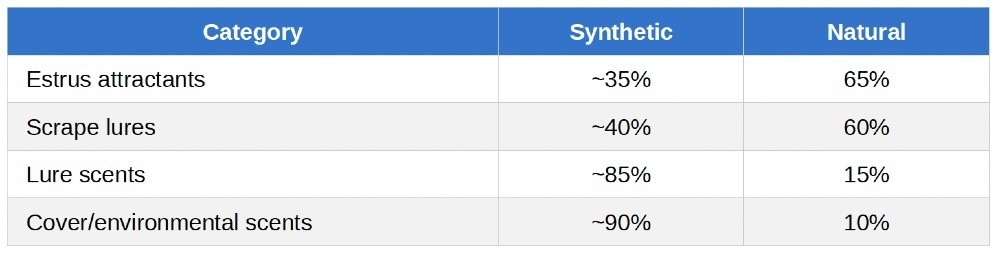
These numbers tell a story of accelerating adoption. Three years ago, synthetic estrus products held only 20% market share. The trajectory is clear: hunters and retailers are embracing synthetic options at a pace that surprises many industry veterans.
Beyond Regulation: The Performance Case for Synthetics
While Chronic Wasting Disease (CWD) regulations have certainly influenced the market — with numerous states and Canadian provinces restricting or banning natural deer urine products — the growth of synthetics is driven by factors that would exist regardless of regulatory pressure.
Consistency and Reliability
Natural deer urine is, by definition, a biological product subject to natural variation. Hormone levels, diet, health status, and collection timing all affect potency and scent profile. A bottle collected during peak estrus from one doe will differ from another, even within the same operation.
Synthetic formulations eliminate this variability. Advanced chemistry allows manufacturers to identify and replicate the specific compounds that trigger deer response — aldehydes such as dodecanal and 2-nonenal, with molecular weights under 200 to remain volatile enough for effective air transmission. Once the formula is optimized, every bottle delivers identical performance.
For hunters, this means predictable results. For retailers, it means fewer customer complaints about "this bottle didn't work like the last one."
Extended Effectiveness
Traditional natural urine products face a fundamental challenge: they begin degrading immediately after collection. Even with refrigeration and proper handling, shelf life is limited. Once opened and exposed to field conditions, natural scents lose potency within hours.
Synthetic formulations can be engineered for stability. They don't spoil, don't require refrigeration, and maintain full potency from manufacturing through storage, transport, retail shelf, and field application. Many synthetic products continue attracting long after application, whereas natural scents dissipate or degrade rapidly.
This extended effectiveness translates to value for hunters — they can use what they need when they need it, without worrying about waste or degraded performance.
Innovation Potential
Perhaps the most compelling advantage of synthetic scents is the opportunity for innovation that simply isn't possible with natural products.
Advanced delivery systems — such as biodegradable bead infusion, time-release mechanisms, and optimized spray formulations — require the stability and consistency only synthetic products can provide. Manufacturers can fine-tune scent intensity, adjust volatility for different weather conditions, and even engineer multi-phase releases that change over time.
Natural products, by contrast, cannot be chemically modified, heat-treated, or reformulated without destroying the very compounds that make them effective. The product is what it is — innovation is limited to packaging and collection methods.

The Retail Perspective: Why Stores Are Shifting Shelf Space
For multi-location retailers and chains, the business case for expanding synthetic offerings extends beyond consumer demand:
Inventory Management Advantages
Shelf Life: Natural urine products spoil. They require specific storage conditions, have expiration dates that matter, and generate returns when customers receive degraded product. Synthetic scents have indefinite shelf life, reducing shrink and inventory risk.
Seasonal Carryover: Unsold natural product inventory at season's end represents a loss — it cannot be reliably carried to the next season. Synthetic inventory rolls forward without degradation, improving capital efficiency.
Handling Requirements: Natural products often require cold chain considerations and careful handling to prevent contamination or spoilage. Synthetics ship and store like any stable consumer product.
Legal and Liability Simplicity
With regulatory landscapes varying by state and changing over time, synthetic products offer operational simplicity. They're legal everywhere, eliminating the need to track which SKUs can be sold in which markets or worry about regulatory changes affecting inventory.
Premium Positioning and Margin Opportunity
Quality synthetic formulations typically command premium pricing, supported by:
• Advanced R&D and formulation expertise
• Sophisticated manufacturing processes
• Performance consistency and extended effectiveness
• Longer shelf life and convenience benefits
Retailers can position synthetics as "advanced" or "professional grade" options, appealing to serious hunters willing to pay for reliability and performance.
Understanding the Synthetic Spectrum: Not All Products Are Equal
One critical point deserves attention: the market includes products marketed as "synthetic" that vary dramatically in sophistication and effectiveness.
At the lower end, some products labeled "synthetic" are simple mixtures of urea, water, and ammonia—essentially artificial urine rather than scientifically engineered pheromone formulations. These products have done little to advance the category or prove synthetic effectiveness.
At the upper end, legitimate synthetic development involves:
• Advanced analytical chemistry to identify active compounds
• Species-specific pheromone synthesis
• Formulation testing and refinement
• Field validation of effectiveness
This distinction matters. The growth in synthetic adoption reflects consumers finding products that actually work—not just products that comply with regulations. Retailers should evaluate synthetic offerings based on manufacturer credibility, R&D investment, and documented field performance rather than simply stocking any product labeled "synthetic."
Market Trends: Three-Year Forward Projection
Based on current adoption rates, regulatory trends, and product development trajectories, the market is likely to evolve as follows over the next three years:
Projected Market Split (3 Years Forward):
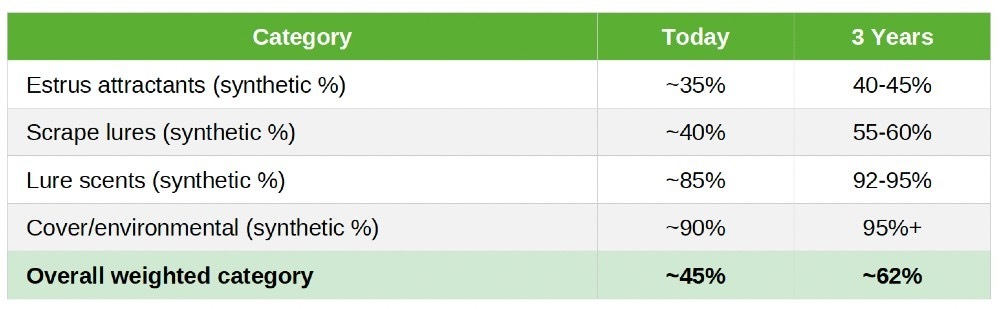
Several factors will drive this shift:
Regulatory Expansion: Additional states and regions are likely to implement restrictions on natural products as CWD awareness grows and prevention efforts intensify.
Retailer Preference: Major chains and multi-location dealers will continue prioritizing shelf- stable, low-risk SKUs that reduce inventory headaches and improve margins.
Product Performance: As synthetic formulations improve and field results become more widely documented, consumer acceptance will grow beyond just regulatory compliance.
Generational Shift: Younger hunters entering the sport have less attachment to "traditional" natural products and greater comfort with technology-enabled solutions.
The Natural Product Reality: Still a Market, But Evolving
This analysis should not be read as predicting the disappearance of natural attractants. In unrestricted markets, natural products retain advantages:
• Decades of field-proven effectiveness, particularly for mature bucks during rut
• Complex biological compounds that remain difficult to fully replicate
• Traditional appeal and brand loyalty among experienced hunters
• Often lower per-unit costs for established operations with existing infrastructure
However, even manufacturers with strong natural product portfolios are expanding synthetic offerings. The writing on the wall suggests a future where synthetics dominate most categories, with natural products holding niche positions in specific applications and unrestricted markets.
Practical Implications for Different Stakeholders
For Retailers and Dealers
Merchandising Strategy:
• Expand synthetic product selection beyond basic compliance offerings
• Create premium shelf presence for high-quality synthetic formulations
• Educate staff on the performance advantages, not just regulatory requirements
• Emphasize convenience, consistency, and extended effectiveness in customer
interactions
Inventory Planning:
• Gradually shift inventory mix toward synthetics to reduce shrink and improve capital efficiency
• Maintain natural products where legal and demanded, but recognize the declining curve
• Consider synthetic-heavy positioning in stores located in or near restricted areas
Customer Education:
• Point-of-sale materials explaining synthetic advantages beyond regulations
• Staff training on differences between commodity "synthetic" and premium formulations
• Seasonal promotions highlighting shelf life and multi-season value
For Hunters and Consumers
Performance Considerations:
• Modern synthetic formulations offer consistent results across bottles and seasons
• Extended field effectiveness means less reapplication and better value
• No spoilage concerns allow you to carry over inventory and buy in advance
• Legal in all jurisdictions—no need to check regulations when traveling
Product Selection:
• Look for manufacturers with demonstrated R&D expertise and field testing
• Higher price points often reflect genuine formulation sophistication
• Consider synthetics for their own merits, not just as a regulatory workaround
The Path Forward
The deer attractant market is experiencing a technology-driven transformation similar to what other outdoor categories have undergone. Just as modern optics, materials science, and digital technology have improved hunting equipment, advanced chemistry is elevating scent products beyond what biological collection alone can deliver.
For retailers, this evolution presents an opportunity to capture higher margins, reduce inventory risk, and position themselves as offering the most advanced products available. For hunters, it means access to more consistent, convenient, and reliable tools that enhance their time in the field.
The question is no longer whether synthetics will gain share—the data shows that's already happening. The question is which retailers and manufacturers will lead this transition by offering products that deliver genuine performance advantages, and which will simply react as regulations force their hand.
The market is moving. The opportunity exists now for those ready to embrace it.

Key Takeaways
For Retail Decision-Makers:
• Synthetic scents improve inventory management through indefinite shelf life and no spoilage
• Premium synthetic formulations support better margins than commodity natural products
• Legal everywhere, reducing regulatory tracking and compliance complexity
• Growing consumer acceptance driven by performance, not just regulations
For Consumers:
• Advanced synthetic chemistry delivers consistency natural products cannot match
• Extended effectiveness and no spoilage mean better value and convenience
• Modern formulations enable innovations impossible with biological products
• Performance advantages extend beyond simply complying with restrictions
Market Direction:
• Synthetic share growing 2-4% annually across all categories
• Retailers prioritizing shelf-stable SKUs will accelerate adoption
• Natural products will remain available in niche applications and unrestricted markets
• The "synthetic ceiling" is likely 60-70% market share, not 100% — room for both