
Time is valuable for everyone nowadays, and today’s archery consumer is no different. For this reason, it’s important to take care of a customer’s needs promptly, then send them on their way so they can get back to work, run other important errands, or spend precious time with family.
The problem is, during busy times of the year, archery shops have a hard time handling multiple customers at once and, inevitably, long lines develop as customers wait for the next sales associate to assist them. The longer these customers wait, the greater the chance they’ll become impatient and irritated — something that can leave a bad taste in their mouths. This could result in some customers never returning again — a bad omen for someone’s long-term business plan.
To avoid all this, it’s important to keep enough staff on the floor and evaluate the number of workstations you’ll need to handle busy times on the floor. Here are some great insights and tips to help you find the right balance of staff and workstations for your shop’s customer volume.
Observing Customer Flow
Every shop’s customer volume is different, depending on several factors. For example, a pro shop located in the heart of prime whitetail country in a big metropolitan area is going to have a much higher number of customers compared to a pro shop located in a small town out West. There are simply more bowhunters (and deer and permits) in the eastern and midwestern states compared to the number of bowhunters in the western states.
For this reason, the number of techs you’ll need on the floor at any given time will often be dictated by your shop’s unique level of customers. But how do you determine the correct number of staff to accommodate this customer size?
Unfortunately, there is no secret formula for doing all this, but you can observe carefully how customers flow into your store and line up behind the counter during peak shopping moments, then begin to gauge the number of techs you’ll need to accommodate this type of volume.
Archery veteran Jim Velazquez, who has owned and operated a number of pro shops during his extensive 50-year archery career, believes creating a high-quality experience for the customer is the most important factor when assessing staff and customer volumes.
“If you can’t greet every customer who walks through the door, then this is your indication that you probably need more techs on the floor,” said Velazquez. “The last thing you want to do is make a customer feel like they aren’t there, and this can happen very easily during high-traffic periods.
“Also, be sure the customer knows you’re there if questions arise. This will make them feel more valued, without projecting any awkward sales pressure.”
Striving for the Right Setup
But what if you’re tied up with a customer and working on a bow? Is it possible to greet and multi-task at the same time? Velazquez believes it can be done quite effectively, provided the shop and workstations are set up in a good place for increased customer activity.
“I like to look at how customers form lines behind the counter,” continued Velazquez. “If I notice there are always more than three customers standing around the counter or in line, waiting to be helped, then I’ll know it’s time to put another tech on the floor.”
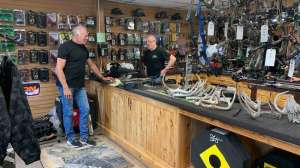
But Velazquez admits that adding techs will do little good if you can’t watch for customers and greet them as they come in. He feels you can do this even while working on a bow. “The key is to have the workstation facing forward, so you can have a good view of the sales floor,” said Velazquez.
Improving Workstation Efficiency
One way to improve customer service is to reduce the amount of time you work on archery equipment. After all, the faster you can get that arrow rest or sight attached to the bow, or peep sight tied in, the quicker you can free up time and get to the next customer.
A workstation facing the sales floor certainly has benefits, but it can also cause issues, too. Since it’s in plain view, customers tend to hover around the workstation while the tech goes to work, watching closely and asking a lot of questions along the way. This isn’t necessarily a bad thing, since it creates an interactive shopping experience, but in some instances, it can take away from efficiency.

“Personally, I find it distracting to work on a bow while a customer asks me about every step in the process, particularly when I know the floor is busy and I have other customers waiting in line,” said Velazquez.
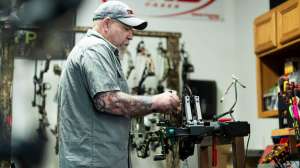
Over the years, Velazquez has modified his front-facing workstation by placing it well behind the counter and behind a four- to five-foot wall. “This setup has worked nicely for me over the years,” said Velazquez. “I can tip up on my toes, peer over at the sales floor, and say hello to customers as they walk in. I can do all this while still servicing a bow without the distraction of customers hovering over me. It’s a safer, cleaner setup in my opinion, too.”
Velazquez believes that one forward-facing workstation is all you need in most cases, while the other workstations should be located in the back somewhere, well away from customers. Once a new-bow sale is made and accessories are chosen by the customer, a tech can quickly leave the sales floor and do the work at one of these out-of-sight workstations. Here, the environment is quiet and void of distractions — perfect for servicing bows.
“This is where you should go to handle more extensive repairs, too, such as synchronizing cams or replacing strings and cables,” said Velazquez. “As long as you have at least one staff member greeting customers on the floor, having techs at these backroom workstations isn’t a problem.”
Generally speaking, low-volume shops can do well with one workstation up front and one to two in the back. High-volume shops will need more: at least one workstation up front and up to six in the back.

Setting Up for Fast Action
An effective workstation is not a glass counter! A bow placed on this surface will tend to move around nonstop and make a lot of noise. It will also block what’s in the glass case from a customer’s eyes. A carpeted countertop works much better for laying a bow down safely and bolting on accessories. But even then, this is not an ideal workstation if it’s void of all the right tools.
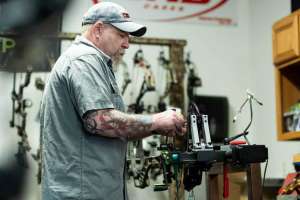
“Whether you need to replace a peep sight, time the cams, or set the draw length, a bow press is often needed and remains an essential part of every workstation,” said Velazquez. “The way I see it, if you have three techs on the floor, you need three workstations, each with a bow press.”
Beyond a top-notch press, Velazquez equips his workstations with a bow vise, level, T-wrenches, D-loop material (pre-cut with burned ends ready to go), different size peep sights, various serving material for tying in peep sights (or center serving or nock sets), axle clips and washers, and so forth.
“There shouldn’t be any walking around from one workstation to the other to find important items,” said Velazquez. “It should all be in one place, otherwise things tend to get chaotic and inefficient.”
What about training shop techs to complete bow repairs in a certain amount of time and insist that they adhere to these time limits? Is this a good idea? For example, two hours of service time could be suitable for a complete bow set up and maybe 30 minutes for a new arrow rest and paper tune.
According to Velazquez, setting time limits on bow work is a huge mistake. It can detract from the overall shopping experience for the customer.
“Every customer is different, and some you’ll have to spend more time with,” said Velazquez. “For example. I’ve set up bows for some folks pretty quickly, because they were already an experienced archer with good shooting form. However, I’ve had others who had never shot a bow before. These customers require additional time, because you’ll have to walk them through each and every step. They’ll also have more questions for you in general, and this takes time. Rushing the process will make everything unnatural and less satisfying for the customer.”
Final Thoughts
There are many aspects to running a professional archery business, but none are more important than delivering high-quality customer care. Consider the tips outlined in this article for running a more efficient and professional archery shop — by greeting customers consistently, servicing and repairing equipment promptly, and creating that positive shopping experience they’ll never forget!
Sidebar: Coordinating Longer Repairs
Not all bow work can be handled on the spot, and coordinating these repairs can be helpful for improving customer service and efficiency. For example, if a customer wants new strings on his or her bow, in a custom color configuration, this is probably something you can’t handle right away. But you can address the customer’s needs and draw up the order, then send them on their way.
Of course, it’s not easy spotting a customer with a lengthy repair request such as this. However, sometimes you can attempt to draw it out of them during that initial, “Hello!”
Velazquez says it can work pretty well if you know what to say. “After my ‘hello,' I like to tell customers, ‘Just let us know if you need anything — or if there’s something we can get on order for you right away.’ “
For those customers who know what they want, they usually don’t have a problem speaking up.
“At that point, I’ll step away from what I’m doing or get another sales associate to draw up the order. Handling these types of requests this way can speed up efficiency while improving customer care.”
The best-case scenario for these types of transactions is to have a person on the floor who just runs the cash register, and nothing else. They can assist with these types of orders, so the shop techs aren’t pulled away from customers they’re already helping. This adds professionalism, but not all shops are equipped with this kind of staffing to assist customers in this manner.