
Pine Ridge Archery’s parent company, DU-BRO, got its start in 1959 providing parts and materials for the model aviation hobby sector. Customers required high-quality products with exacting standards so they could assemble their favorite aircraft to display. It was only natural that those standards and quality would carry over when DU-BRO dived into the growing archery market.
Since then, Pine Ridge Archery has continued to ride the waves of industry changes. The early years included compound and traditional bows evolving. Crossbows began to slowly — like tortoise-crawl slowly — gain a toehold. By the 2000s, the barn doors were blown open with innovations, race to speed and crossbows demanding attention. Today, hunters and target shooters have many bow options at numerous price points, and Pine Ridge Archery is there to help.
Pine Ridge Owner Brian Bychowdki and Head of Marketing and Sales Brian Schiller collaborated on this issue’s Spotlight about their company, thoughts on the future, and how they stay dialed in with customers. Note: Today, in addition to manufacturing products for radio-controlled aviation, cars and boats, and the archery industry, DU-BRO also offers products for the fishing industry.

AB: Thanks for taking time to talk with us this month. Pine Ridge Archery is part of a solid legacy company, DU-BRO, that’s been around for more than six decades. What sparked the creation of Pine Ridge Archery in 1997, and what’s the story?
Schiller: Pine Ridge Archery has a long history of providing useful products to archers and bowhunters. Our focus has always been to make products that we as bowhunters and target archers would use. Since we manufacture almost all our products in our factory in northern Illinois, we can maintain our high expectations and quality control on everything that leaves our door.
The philosophy of being in control of our own destiny is not something new for us as a company. Our parent company, DU-BRO Products, Inc., began in 1959 through the hard work and innovative mind of Dewey Broberg. Our dedication to keeping our brands synonymous with quality has not changed since the beginning.
No matter what product we are working on, our customers are always on our mind. We strive to manufacture the best products at the best prices just as we have for more than 60 years. Be sure to explore our full product line and we are sure you will find all the items you need to make you a better archer or a better bowhunter.
AB: You offer an extensive array of products, from Nitro XL Buttons for strings, glue for arrow fletching, bow supports, and more. How do you describe your product lineup to someone who doesn’t know what you sell?
Schiller: We don’t make the bows; we make them better. That’s not saying we think any of the bows are bad. We just provide all those little utility items that help a bow shoot well, make your target or hunting experience better, etc. From kisser buttons, peep sights, string dampeners, limb dampeners, speed bombs, bowstands, gear hangers, the list could go on and on. It is those smaller, essential items that help make a bow more accurate, efficient and quiet.
AB: I’m new in the industry and still learning the ropes. Explain to me how Pine Ridge Archery helps independent retailers.
Schiller: Dealers have always been a pivotal focus of our business model when it comes to our archery division, for a multitude of reasons. As stated, we started in the model aviation industry back in 1959. Back then, the hobby shops were thriving and helped us grow to what we are today. Slowly, with the age of the internet, those hobby shops faded over the years. We have had to go more direct to consumers in that division because the demand was still there, but the hobby shops were not.
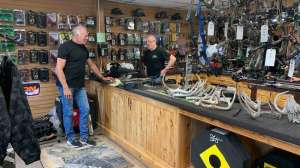
There is something to be said about being able to go into a store to touch, feel and see the true craftsmanship of a product before you buy it. Our archery dealers provide that. They can also educate consumers in a personal way that we cannot. We believe this is essential not only to the end user, but also the dealer, as they build confidence with their consumer base.
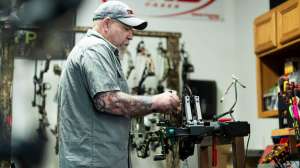
A lot of our products also need a bow technician to be set up properly. The need for a bow press to remove the string and cable, or the knowledge to properly align our D- Loop is essential in setting up a properly tuned compound bow. Without dealers, there are limited bow techs, which mean less opportunity for our products to end up on an archer’s bow.

AB: With your large line of accessories, how do you stay on top of industry trends and adapt to changes? Go with the main things you believe hunters and shooters need? Watch social accounts? Scatter tea leaves on the tabletop to read them?
Schiller: A good number of us at Pine Ridge Archery are archers and hunters. Many times we have been on the range or in the woods and discovered a problem we may have, so we come up with a solution. We bring the idea back to HQ and come up with what we like to call the “bar napkin drawing” and progress from there.
We have brought in some technology over the past few years to accelerate the development process. This allows us to transform that napkin drawing into a prototype in the matter of hours or minutes rather than days or weeks. From there, we move to field testing, adjust, and move to build the final product. For us, being able to act quickly allows us to stay even or ahead with the rest of the industry. We make products that work and help archers, and their bows become more efficient.
AB: Tell us a little about your business. How many employees do you have? Have things been up-and-down in the last year or so with economic changes, in regard to employment and also securing products?
Bychowdki: We have 12 full-time employees and anywhere from 20-30 temps, with many being here for more than 15 years. It has certainly been a roller coaster with the economy these past few years, but we have seemed to maintain a steady workflow with times being busier than others as the seasons of our three divisions change. Thankfully, we have not experienced any real product shortages due to the fact we make almost all of our products in our 40,000-square-foot manufacturing facility here in northern Illinois.

AB: Without diving deeply into politics, are your products made in the United States or overseas or a combo of both? Supply chain issues have hit all industries everywhere. Has that been a challenge, or are things moving about the same or better than the last year or so?
Bychowdki: More than 98 percent of our products are made right here in America, with about 95 percent of those made here in our manufacturing facility. We have always strived to make as many things as possible in our facility, from the actual product to the printing, packaging and shipping. We believe the more we can do in-house, the more control we have over managing any possible shortages or mishaps, as well as maintaining our high standard for quality control.
This, paired with our customer service being in-house, we believe makes us stand out compared to our competition. In some aspects, things are actually better for us. We have taken on more outside work with our injection molding and small parts machining capabilities by solving other manufacturers’ shortages from overseas, tariffs and labor shortages. We offer shorter lead times, quality materials, and confidence for our customers.
Moving forward, our plan is to continue to grow our manufacturing facility not only for us, but also for others in our industries, so we can all continue to progress and not have to worry about politics ruling our businesses, supply chain issues, or any unforeseen circumstances that can arise in our current trade climate.
AB: Where do you think the archery industry is headed in the next 5-10 years regarding hunter participation? Stable growth? Minimal increases? Potential downturn?
Bychowdki: We saw a boom in all outdoors industries during the Covid years. It did taper slightly, but we believe the archery industry will continue to grow steadily as long as we can maintain those who came in during the boom. Hunter participation will continue to grow if we maintain viable areas for folks to enjoy hunting. With the threat of public lands being sold and increased license fees, this is a big threat to hunter participation. Landowners continue to increase private land lease rates as well. These factors will continue to hurt our industry if a resolution is not achieved. The harder and more expensive we make it for a person to get in the outdoors for the hunting season, the less folks will be inclined to get involved.

AB: How about the archery industry brands and manufacturing side in the next 5-10 years?
Bychowdki: We hope the industry brands continue to grow. With the involvement of investment companies buying up all the smaller mom and pop manufacturers, it seems to have made our market stale in some respects. The ones that stand out are those smaller manufacturers/suppliers, as they seem to be the ones bringing innovation and new products that make sense to the market.
Support for dealers and shops is extremely important as well. When these large companies continue to slash the dealers at their knees, by offering their products directly to consumers at lower prices or at dealer cost, it hurts the pro shops that make our industry survive. Without the pro shops and bow techs, our industry will not survive.
AB: Are your customers primarily from the bowhunting side, competitive target side, or both? It looks like you’re able to help everyone from deer hunters to Olympic-style shooters.
Bychowdki: We certainly cater to every archer — Olympic, 3-D, compound, traditional, crossbow — and even the gun hunter. Our product range is so vast that we have something for everyone. Overall, it’s about a 50/50 split between target archers and hunters.
AB: Any special things you have to consider to cover the three different bow types?
Bychowdki: We have employees, family and friends who are involved in all aspects, so the idea for new products continues to flow for all three categories. We try to accommodate as much as possible. With the growth and deregulation of crossbows, it is something we continue to look at and make more products for while still maintaining our line of accessories for compound and traditional bows.
AB: What sets Pine Ridge Archery apart from other accessory providers?
Bychowdki: We feel like it’s our quality, customer service, and attention to details that helps set us apart — topped with our in-house manufacturing capabilities that gives us the capabilities of a 99-plus percent fulfillment rate, fast shipping, and dealer commitment.
Let me give you an example: Joe’s Bow Shop has a fantastic weekend of people through its shop, runs out of product on Sunday, and Joe emails us a purchase order on Sunday night. It’s typically shipping out Monday afternoon in full, and Joe’s shelves are restocked by Wednesday or Thursday, depending on where Joe’s shop is. If Joe is in the immediate surrounding states of us, a lot of times he is getting product the next day.
AB: Thanks very much for taking time to visit with us. Is there anything else you’d like retailers to know about Pine Ridge Archery?
Bychowdki: First of all, we would like to thank you for your continued support and business of our brand, company, and way of life. We are honored to continue to work for people like you, who support, eat, and breathe the archery lifestyle.
Customer service is something we take a lot of pride in. We want you to know we are here for you whether you have a question, concern, or a problem. We value everyone’s opinion and take it into consideration with every decision we make to improve. We want you to know whenever you call, you will talk to a live person on the phone, have a human being respond to your emails, and most importantly never outsource the things that matter most to us.
We are made in the U.S.A. We strive to continue to keep jobs here at home where they belong. We design, test, and manufacture every part that we can here at our factory in northern Illinois. If we ever have to outsource, we do everything we can to ensure you that we are supporting American jobs and businesses.