
“In any team sport, the best teams have consistency and chemistry.” That’s a quote from legendary NFL Hall of Fame quarterback Roger Staubach. Why is it significant? Many archery pro shop owners would consider those words also ring true for their own “team” of staff members — and especially, as it relates to their shop’s tech service. How about the consistency in your own shop? Do the bows you and your team service head out the door looking eerily similar? Here’s why they should.
“I think it’s absolutely essential; if you don't have consistent service practices, it’s detrimental to your business,” said John Schaffer, owner of Minnesota-based Schaffer Performance Archery. The unique business combines a pro shop and manufacturing facility for Schaffer’s award-winning bowsights and arrow rests.
“Once we figure out a way to do things — maybe it’s how to tie in a string loop, or time the bow, or level a third-axis bowsight — once we figure out a solid way to do it, it gives good confidence to our customers. And if a guy comes in and gets it done one way, rest assured they are looking at their buddies’ bows, and it automatically gives them reason to question who’s got the better setup.
“And carrying that to the next step, if your employees are doing things very individually, then you have customers who want to work with only one particular guy. You don't want that. Then, there’s no point in having the other employees. Our goal here is that any customer who has their bow serviced, we shouldn’t be able to tell who did it. If you don't do that, if one guy is different, he is undermining other people in the shop. That would be a big no-no.”
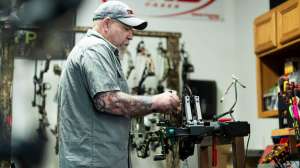
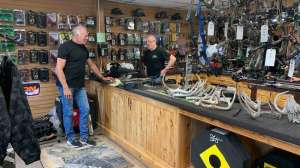
Dan Ellyson is the co-owner and general manager of A-1 Archery based in Hudson, Wisconsin. He says it’s vitally important — for several reasons — for his daily team of five to seven employees to have consistency in its tech work. One of the biggest factors is consistency helps the high-volume shop run smoothly, as it runs several thousand bows through its shop each year.
“If we use a very specific way to, say, tie in a kisser button, or a drop-away arrow rest, we don't have to be continually asked why one way is better than another,” Ellyson said. But he also said that some customers will want an explanation of the hows and whys, and some others might want things done a different way. Flexibility rules.
“Everything you do has to be defensible,” Ellyson said. “You might have a customer who’s watched a YouTube video on how, say, John Dudley ties in a peep sight, and they’ll want it done that way. And that’s OK, we’ll do what the customer wants, but that’s rare.
“One of the reasons for how we tie in a peep sight, is it separates us from the competition,” Ellyson continued. “On some knots, you’ll have to cut the entire knot off the string, and during that [tedious] process it’s easy to cut the string. How we do it here, we can just cut the knot, and we eliminate the likelihood of cutting a string.”
Standing out from how the competition does things is important for A-1 Archery, a big reason being that it instantly allows the A-1 staff to recognize if the shop has ever worked on a bow that comes back for repairs. “For us, if a bow comes in, we’ll know instantly if we’re the only shop to work on that bow.”
And that can be important. Especially, Ellyson says, when a customer returns packing a bow that has problems and wants his shop to make it right. There are always a few customers who will say they’ve never had their bow serviced elsewhere — even though that is obviously not the case. At that point, Ellyson explained, frank conversations are held to determine the next course of action, including the cost of service/parts.
“Conversations like those are usually the byproduct of a problem,” Ellyson said. “Maybe their limb is cracked, and they might be trying to blame you for it. And it just helps us see the history of a bow when you can see your own work. It’s our signature, basically.”

Striving For More
What are the best ways to set up customer bows? If you spend any time researching YouTube you’re likely to find many tricks to doing things fast and easy. But Schaffer’s shop strives for something more.
“We don't have a goal here to get a customer out the door as soon as possible,” Schaffer said. “The ways that we do the actual tying of knots here, and lots of other stuff, they’re set up in ways that are the very best ways to do it — and we take a lot of time to do them. The best way is never the fast way.” Schaffer also said that his staff is always learning, and if someone finds or hears about a new and better way, the team is alerted. In Schaffer’s opinion, there is always room for improvement.
“We’re always open to new stuff. If we determine there is some great new technique, we‘re open to that. Recently, the last handful of years, we used to tie in a peep a particular way. And for whatever reason, we noticed on the newer bows that the peeps weren’t staying put as they used to on the older bows, they were walking up the string. So we had to change that process.”
Schaffer said some solid training is part of the process of bringing any new staff member on board, but it doesn’t really matter if the training comes from himself or another experienced full-timer. And that’s because the entire staff does everything the same way.
“The fact we do everything the same is nice, but it’s also good for inter-shop relationships, too. Imagine a scenario where one employee shows the new guy how to do something, and another employee tells him something different. It just makes it uncomfortable; the new guy doesn’t know who to listen to, and in the end it’s a disaster.”
Ellyson said his new A-1 employees are trained on specific techniques, but inevitably, over the years, he’s dealt with a few who have “gone rogue” from time to time — using a different technique or maybe a different material, to perform a specific task. Ellyson tries to address those cases with the specific employee as soon as he becomes aware of them.
“And what I‘ll typically do is ask them to prove out their approach. If it’s a better way than how we’re doing it now, we’ll take a look at it.
“A few months back we hired a guy who had previously worked at a Scheels location, and that was quite the learning curve for him. The issue was, there was no consistency in what they did over there, everybody kind of did their own thing. But when you come and work for us, you’re trained by multiple people, because any one of us can teach [our consistent techniques]. And I’m not shy — I keep an eye on our completed tech work, and if I see something I don’t like, something that’s not how we do it, I want an explanation of why it was done that way. Generally, new employees get on board really quick.”
Consistency Is Key
Should you strive to operate with consistency in all your shop’s practices? Well, only if you want to experience more smooth-running efficiency.
“In general, the better our consistency can be, the better our shop runs,” Schaffer said. “Another example is in our archery range. We have a rule that shooters should place one foot on each side of the [marked] lines. If only some of your employees are enforcing the rule and some are not, a customer might come in to shoot and decide to stand behind or in front of the line, because that’s how he’s done it in the past. And then, guess what? The employee who is suddenly enforcing the rule is now a jerk. Consistent enforcement is important for the shop.”
At some point, every shop makes some clear choices about its tech work, but Schaffer warns that cutting corners is never smart.
“Because we have our way of doing things, when a bow comes in from somewhere else, we can instantly see that we never touched it. It makes it simple to identify our work from somebody else’s work. And we do know, because we do things the way we do because they are NOT the easy way.
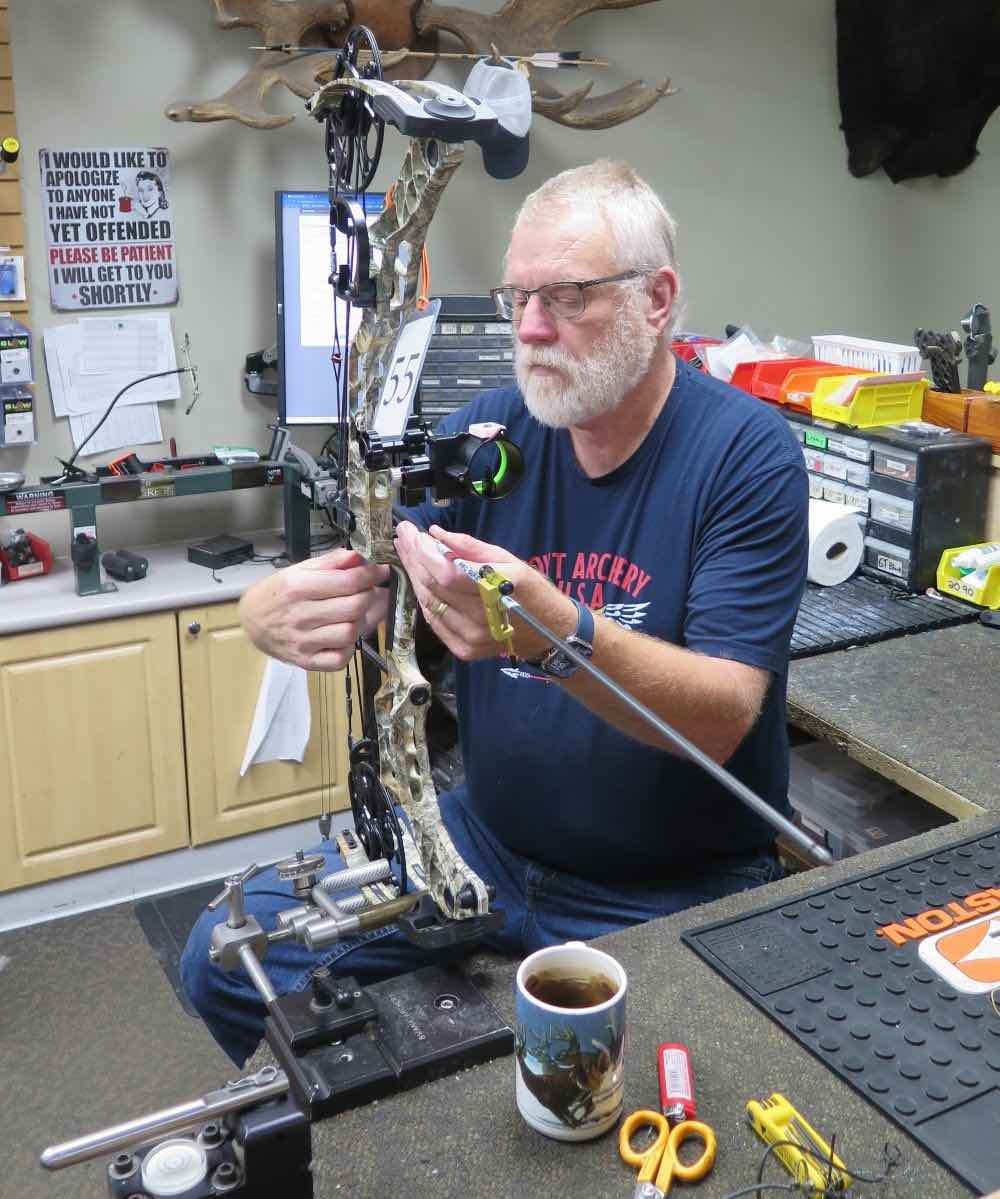
“As an example, to install a drop-away rest you could choose to use a simple rest-cord clamp, and I could set up a bow like that in two-three minutes and kick the guy out the door. But we take the time to tie in that rest cord so it won’t ever move. And when that customer looks at the attention to detail, he will show it to his buddy, who will say, ‘I want mine set up that way.’ And it will drive him into our store. That happens here regularly, because our customers tell us.”
Schaffer was asked if delivering that type of high-level service suffers at all during his busiest weeks.
“We don't cut corners on our bow setups ever. In those scenarios, we will add staff for the busy seasons. And when things get really busy, we will suggest that customers come back and get it done right. We never take shortcuts when things are busy, and people understand that. If you’re spending $2K on a bow setup, and Shop A has you in and out in five minutes, and the other shop takes a lot longer but does it right, which customer is going to have the better experience?
“No one wants to be spending a few grand, and get shoved out the door. We will tell them that we can’t spend the time on this that it needs right now, but we’re going to set up an appointment where they can circle back and get it done right. We do that fairly often during busy times, and customers appreciate that more than rushing through their setup, and kicking them out the door.”
Speaking of busy times, as stated, Schaffer does add part-time staff to assist in serving the increased volume of customers. But it’s important to know that part-timers needn’t be taught every single operation. Part-timers who are proficient in just a few key jobs are a huge help, Schaffer says.
“If a part-timer knows how to sight in a guy on the range, and cut arrows to size, that’s huge for us. They don’t need to know everything to be very helpful. Work the till, sight a guy in, cut arrows, that is all simple stuff, but it’s time-consuming, and you can hire a younger guy, or an older guy to do that.”
Final Thoughts
In the end, Schaffer says, taking control of your service and service practices is critical, because it’s the one key component that sets you apart from every other retail shop.
“Just being a store and selling stuff isn’t hard to do. But it’s not going to differentiate you from anybody. The main thing that pro shops have to provide is the service. The main reason customers are coming to you should be the service, and it’s vitally important that it’s good, and consistent. It’s why our customers come here. They can buy the gear anywhere.”
Sidebar: Could Your Shop Benefit From a Check Area?
Another help to A-1’s tech service consistency has been implementing a “Check Area” for bows that are especially difficult to tune. What is a check area and how does it work? Well, its simplicity might be surprising.
As A-1 takes in bows for tech service, it logs them in and stores them near the desk area — an overhead space that can hold about 200 bows. Only a few times per year does that area get completely full, but there is a smaller section within that same space that acts as the Check Area: It holds only bows that a tech worker has found problematic to tune.
Once hung in the Check Area, all employees are encouraged to inspect and otherwise weigh in on what the problem might be. Employees have varying levels of experience, and some might have more knowledge of the quirks of specific brands — even specific models within those brands. Once the staff has weighed in, problems are resolved remarkably quickly.
“All of us here are the shop shoot and tune with basically the same grips, the same releases, and that means that, 95 percent of the time we can all get bows to shoot the same bullet hole,” Ellyson said. “But if that accuracy is not repeatable, then you want to take a closer look at it. Are your bushings worn out? Does the bow have a weak limb? Is there a specific quirk that somebody has seen before? You don’t want to have to buy a new limb, if it’s a different problem that somebody has seen before.
“If a bow ends up in our Check Area, an employee is announcing there is a problem. But the cool thing is that a lot of the time [when others get involved] it gets resolved that same day.”