
As technology continues its push into the shooting sports, products once seen as the domain of the specialized few are today readily available to the average shooter and hunter.
And as they become ever-more technically proficient, shooting and hunting customers are more willing than ever to purchase the high-tech products that can actually help them in their pursuits.
Chronographs are a prime example of this appealing technology, and the new VelociRadar Chronograph from Caldwell Shooting Supplies can provide all manner of customers with data to help them become better shooters and hunters.
In the past, the chronograph was a very specialized piece of equipment, needed by only the most dedicated of reloaders and ballistic nerds.
Caldwell Shooting Supplies has offered chronographs for many years, including models like the Caldwell Ballistic Precision Chronograph. I used the Ballistic Precision Chronograph for over a year, and it worked fine. To a point.
That point was when I inevitably put a round through the guts of the unit! As I’d done more than once, on different chronographs despite trying my best to avoid wrecking said chronos.
Traditional Tech
These units used the traditional light system to record bullet velocity. Above the base of these chronographs are affixed a front and rear set of sun shields, forming triangles through which the bullet or arrow would pass.
A row of tiny lights is built into the undersides of both sun shields. As the bullet passes through under the front and then the far shield, the chronograph measures the speed with which the bullet crosses the first row of lights and then the second row. This provides the muzzle velocity.
Provides it, that is, if you didn’t slam a 5.56x45mm bullet through the chronograph base holding the unit’s electronics or clip off the leg of a shield. I’ve done both.
Significant Upgrade
Now, Caldwell has upped its own tech game in this arena with the debut of the new VelociRadar Chronograph.
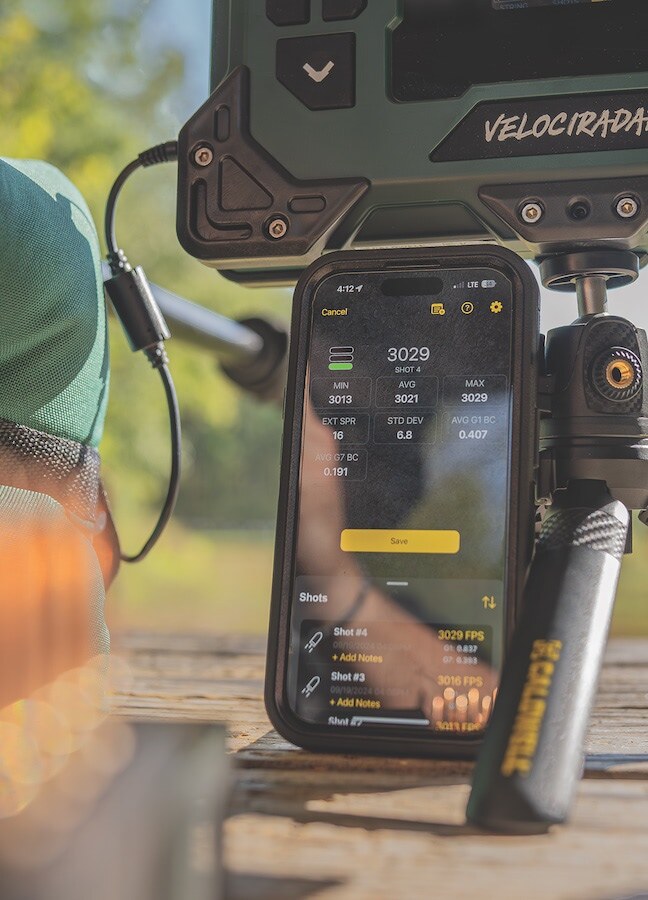
Most chronographs only provide velocity. But the VelociRadar uses what Caldwell terms “CHIRP radar” to track bullets downrange for more complete data of a round’s ballistic performance. Using this downrange information, the VelociRadar measures the drag on the bullet to calculate the ballistic coefficient and downrange energy.
Once a shot string is loaded, each individual shot can be examined separately. The shot strings also feature a D.O.P.E. function that shows the velocity, bullet drop and ft-lbs. of energy out to 600 yards.
And the unit sits next to the shooter and behind the muzzle! Perfect.
The View
An internal, rechargeable Lithium-ion battery powers the unit, including the 2.8-inch color display screen. The battery recharging cable is included. The unit works with one of two selected triggers: built-in acoustic and recoil. The user selects which trigger is desired. For the recoil option, the user plugs the recoil cord into the unit and attaches the recoil detection end to the firearm.
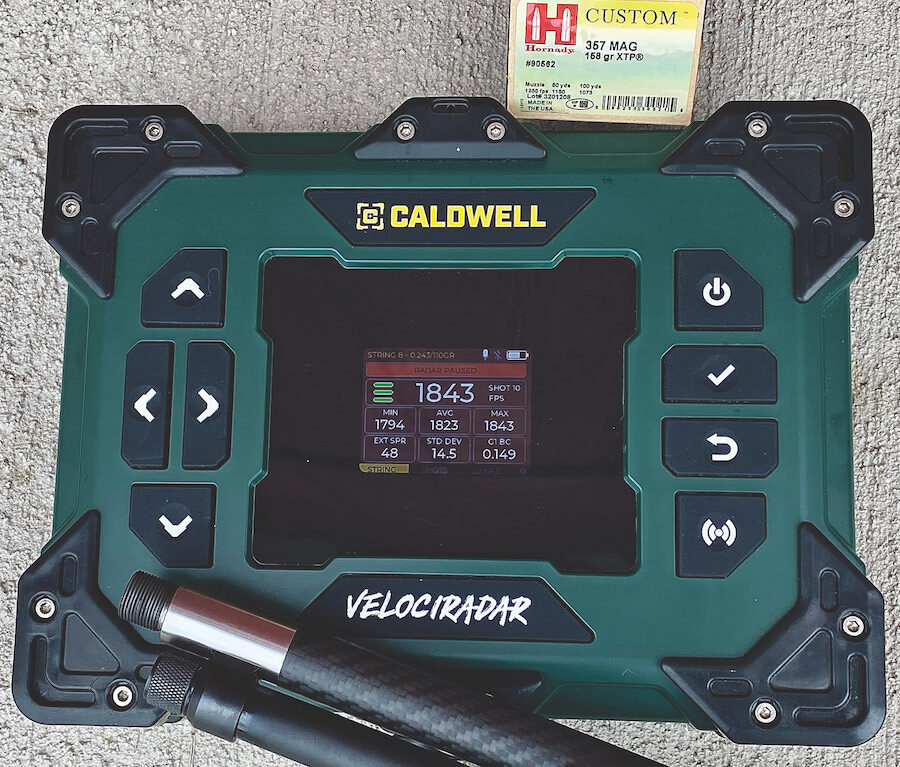
The VelociRadar controls are located on the front face of the unit and alongside the screen. Those controls are very straightforward.
Top right is the power button, followed by the menu button below it, then a return to previous app button and the acoustic trigger selection button.
Arrow buttons on the left side of the screen allow the shooter to move around with the menus and the various ballistic screens. For added protection of the unit, Caldwell built the chrono with heavy-duty rubber armor on the corners.
The VelociRadar also features a ball-head tripod which attaches to the bottom of the unit so the unit can sit alongside the shooter. The unit also operates via a cell phone or tablet by downloading the Caldwell app.
Bullets Down Range
At my outdoor range, I tried out my VelociRadar with two different firearms. For a long gun, I used a new SPD HUSH lever action from Henry Repeating Arms chambered in .357 Magnum. And to give the unit a pistol try, so to speak, I went to my 2K11 double-stack 1911 manufactured by Kimber USA and chambered in 9mm.
I started off my testing with the Kimber, using Winchester Target and Practice 9mm loaded with 124-grain full metal jacket bullets.
With the chronograph set up on its tripod, I first aligned the radar with the target. Easily done as Caldwell built a peep sight into the top of the unit.
I fired off strings of five and 10 shots with the Kimber. At the end of each string, I saved that string to the unit’s internal memory.
Of note, once a shot is fired, the shooter must wait for the VelociRadar to record that shot’s data before shooting again. Which means, popping off multiple rounds fast will only get the first round recorded.
One key use of a chronograph is to find out the real, hands-on velocity of the ammunition. For example, Winchester rated the Train and Practice at a muzzle velocity of 1,140 feet per second. But many factors can affect a bullet’s velocity including temperature, humidity and the elevation of the location.
For handguns, most ammunition manufacturer ballistics are based on use in a handgun with a 5-inch barrel. So, a shorter or longer barrel can well produce different fps readings.
My Kimber 2K11 does have a 5-inch barrel, so I wasn’t concerned about barrel length as a factor.
In my 10-shot string, the Winchester came in at an average of 1,113 fps, with a standard deviation of 23.3 fps. The VelociRadar also calculated a G1 ballistic coefficient (BC) of 0.135.
Suppressed and Not
One thing I’ve read many times about suppressors is that they do not diminish a firearm’s muzzle velocity and can even “enhance” the fps of a round going through and out of the suppressor.
Is that all true, I have wondered, or just some marketing chatter? I decided to find out, using the HUSH with and without a Banish 46-V2 suppressor made by Silencer Central.
I used Hornady Custom .357 Mag. Rounds loaded with 158-grain XTP bullets.
For 10 rounds of the Hornady through the HUSH and suppressed, the VelociRadar pegged the ammo with an average muzzle velocity of 1,852 fps. Without the suppressor? Those 10 rounds came in at an average of 1,826 fps.
True, an extra 26 fps isn’t going to matter much to the deer hunter taking on a whitetail at 60 yards with the HUSH. But it might well make a difference for the long-range hunter and competitor with a different rifle who needs to know the bullet drop of a round at 300-plus yards.
Hornady listed the ballistic data of the Custom .357 load on the box, with the muzzle velocity at 1,250 fps. Of course, that was for shooting the ammo through a handgun with a 5-inch barrel.
The HUSH features a barrel just a bit over 16-inches in length. All that extra barrel gives the powder more time to burn, and the 1,852 fps I recorded is an impressive 600 fps addition with this rifle and suppressor. It also took the 548 ft-lbs. of energy at the muzzle with a handgun and increased it to 1,169 ft-lbs. with the HUSH.
Sales
“Obviously, this unit fits the needs of reloaders as any chronograph does,” said Jarrod Grove, senior marketing manager for American Outdoor Brands (AOB), corporate parent of Caldwell and a number of other outdoor brands.
“But, the special features about the VelociRadar to stress are the ability to track rifle bullets down range and measure the velocity loss or drag. And then provide the user with a ballistic coefficient and a custom bullet drop chart for the actual firearm. This creates much more accurate data than what is provided by ammunition manufacturers.”
To display the unit, mount the VelociRadar onto the tripod and set it up on a counter or table. Make sure the unit is charged and turn it on whenever someone shows interest.
Pro tip: Have an employee actually run the unit with a handgun, a rifle and a bow and save the data strings. Pull up those strings to show customers how the unit works and the information they can record.
Also consider downloading the Caldwell app onto a store phone or tablet and let interested customers toggle through a few strings.
Customers may come into your establishment asking about the unit. The VelociRadar Chronograph is featured in a number of print articles including a very positive review at Guns and Ammo Magazine. The review is available online as are others.
There are also several YouTube reviews of the unit including a couple by the Ultimate Reloader. Not only do these speak to the consumer, accessing these reviews is a fine way for sales staff to learn about all that the VelociRadar can do.