
How often have you picked up your favorite rifle, looked at the bolt, and asked yourself, “I wonder why it was designed that way?”
Never? Do you know why? It’s because bolt-action rifles are so familiar that nobody questions the details. It doesn’t even occur to people to ask about the finer points. It’s just one of those matter-of-fact things we accept where the details aren’t needed … unless you happen to be a gun salesperson. In the public’s eyes, you are the experts and have the answers to all their questions.
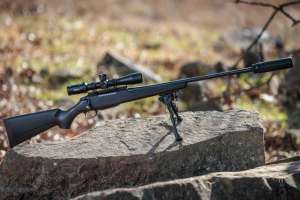
So, let’s dive in and look at what you’re expected to know, with the bolts from two different Ruger rifles, a Scout Rifle in .308 Winchester and a Precision Rifle in 6.5 Creedmoor, serving as examples.

Bolt Basics
In the simplest terms, a bolt is a part of a rifle’s action that can be opened to allow access for breech loading. It can then be closed and locked, allowing the chamber to withstand the energy and pressure of a fired cartridge. In addition, bolts typically hold other parts of the rifle’s action, including a spring-loaded firing pin and the parts needed to extract and eject spent cartridges.
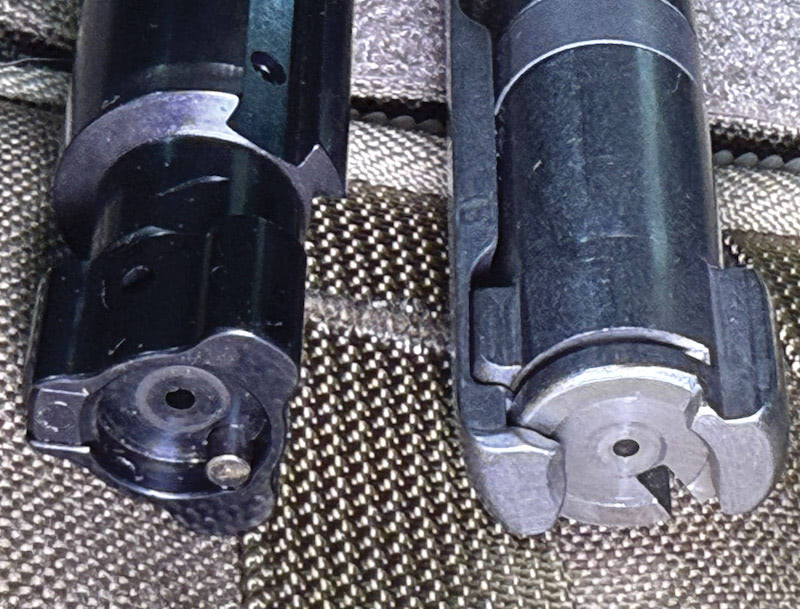
The main portion of the bolt that everything else is attached to is called the bolt body. The front is called the bolt head and comprises the lugs, bolt face, ejectors, and extractors.
The lugs are designed to mate with corresponding lugs in the receiver, locking the bolt in place for the firing sequence. The bolt face is the forward-facing end which forms the rear chamber wall. Its main function is to hold the cartridge firmly in the chamber for firing and to seal the breech against escaping gases so that the full energy of the burning powder is directed toward the muzzle. The bolt face has a small hole through which the firing pin can protrude to strike the primer. Extractors and ejectors pull the used cartridge case out of the chamber and eject it from the receiver, allowing a fresh one to be loaded.
The opposite end of the bolt body is where the bolt handle resides. This lever is used to open and close the bolt. The Scout Rifle has a solid handle designed for strength, while the Precision Rifle’s handle has two parts: the bolt handle and a separate, screw-on knob for easy customization.
You may have noticed differences besides the bolt handles. These represent two different concepts based on how the rifle is to be used. The Scout Rifle is designed for durability and quick operation in critical situations, whereas the Precision Rifle is designed for long-range shooting from more controllable conditions. The Scout Rifle has three lugs instead of the Precision Rifle’s two. If you look closer, you’ll likely notice some other key differences. As a controlled-feed design, the Scout bolt has a rugged, full-length extractor. The Precision Rifle is a push-feed design with a much smaller, barely noticeable extractor made into one of the lugs. It also has a separate spring-loaded ejector pin absent on the Scout. For a complete description of the differences between controlled vs. push-feed designs, please refer back to the Counter Tech column in the January 2025 issue of SSR.
Bolt-Action Past
The bolt-action rifle was first designed by a Prussian inventor named Johann Nikolaus von Dreyse in 1824. He worked to improve the rifle until its successful introduction in 1848. Metallic cartridges didn’t exist at the time. Instead, the powder charge was wrapped in paper and the primer was held against the rear of the acorn-shaped bullet using a paper mache cup. Firing the gun required a long, needle-like firing pin capable of penetrating the paper and powder to reach the oddly-placed primer. These “needles” were fragile and subject to breakage and became the rifle’s namesake. They quickly became known as “needle guns.” Soldiers were issued two spare needles when Dreyse’s rifles entered military service. Fortunately, the needles could be replaced on the battlefield in less than 30 seconds.
One may question the odd primer placement, but it caused the flame to travel from the front to rear for a more efficient and thorough burn than could be achieved from the rear. It left a clean chamber with no residue to clean before reloading. As a result, soldiers could fire the gun two to three times as fast as a muzzle-loaded rifle. Dreyse rifles were highly successful and were only superseded by Antoine Alphonse Chassepot’s design in 1863.
The “Chassepot” rifle moved the primer to the rear behind the powder charge, allowing for a shorter, more durable needle (firing pin). The Chassepot proved decisive in battle. By the time of the Austro-Prussian war of 1866, more than 250,000 needle guns were in use across Europe. Metallic cartridges were introduced in 1874. Modern bolt-action rifles are merely improved versions of these original designs.
Angle and Pull
Ruger did an excellent job ensuring that the Precision Rifle could be easily disassembled without tools for cleaning and inspection. Note the long spring-wrapped firing pin. This spring is compressed when the rifle is cocked and provides enough stored energy to forcefully strike the cartridge primer when the trigger is pulled. The Scout bolt is also easily disassembled for cleaning; only a small hammer and a drift pin tool is required.
The number of lugs on a rifle bolt varies by design and manufacturer. For bolt-action rifles, two and three lug designs are common. One key difference is the angle of bolt rotation needed to lock and unlock the action. Two-lug designs typically have a longer 90-degree rotation, while three-lug designs operate using a shorter 60-degree rotation. (Interestingly, Ruger lists the Precision Rifle as having a 70-degree rotation.) Academics, and those in the gun community who like to argue, will say one design is better or easier to operate than the other. Personally, I find it to be insignificant. Neither are difficult. Some of the difference may stem from how the firing pin is cocked. Some rifles cock the firing pin during the bolt’s forward movement when closing the breech. Other designs cock the firing pin as the bolt is rotated during cycling. The difference between the two isn’t enough for me to worry about, but I’m not into arguments these days.
It’s easy to assume that all bolts rotate, but that’s not true. The Browning T-Bolt rifle, for instance, is a straight pull design that is both fast and easy to cycle. Interestingly, the action of cocking the firing pin is split between the push and pull of the bolt, and unlike most bolt-action rifles, it uses two extractors rather than just one.
The Bolt Supremacy
In today’s world, the emphasis on rifle design is about firepower — how many rounds can be put on target in the shortest possible time. Rounds on target, however, isn’t always the solution. Sometimes a single, precise shot is needed. The overwhelming choice in these situations is almost always a bolt-action. The same is true for rifles used for hunting dangerous game and long-range shooting. Bolt actions allow for more precise designs and tighter clearances than semi-auto rifles. Tighter tolerances equate to more accurate and consistent lock-up. Accuracy, after all, is about consistency, and who doesn’t want accuracy?