Over the years, I’ve discovered you can know a great deal about a thermal weapon sight based on how easy or hard or damned near impossible it is to zero that thermal. Invariably, the easier the zeroing process, the better overall quality of the thermal.
That’s why I was pretty sure the WAVE Infrared ATRIS 650 LRF V² was a top-end thermal, even though I’d only shot under a dozen rounds in my early testing of the unit. Additional shooting and time with the ATRIS 650 LRF only confirmed that early impression.
Those first rounds were fired at 50 yards at my outdoor shooting range in north-central Wisconsin. The temperature was 48 degrees but felt like the upper 30s due to the 18mph wind gusts. Humidity stood at 79%.
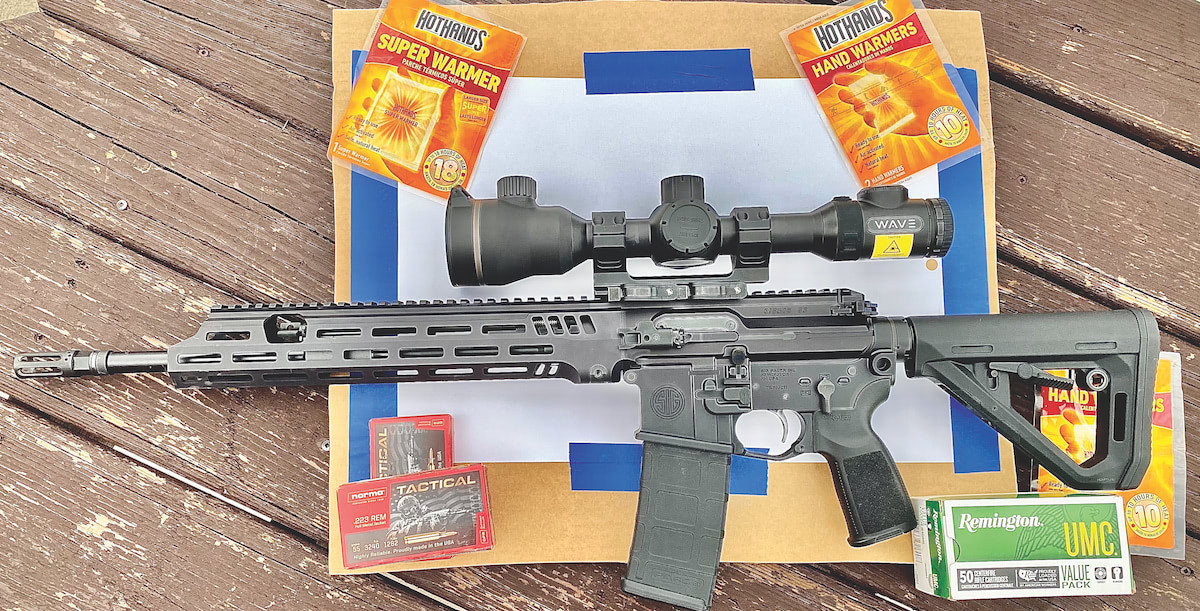
Using the thermal menu, I built the reticle I prefer, a green T-dot. I went through the palette choices and decided on Black, then entered the zero function and set the zeroing distance at 50 yards. My scope’s digital magnification stood at 3.5x.
For my target I used a small HotHands heat pack taped to a rectangle of cardboard. My first three rounds of .223 Rem. didn’t show up on the cardboard at all. So, I aimed at the muddy berm itself, watched the mud splashes, and figured out my shots were hitting low and right.
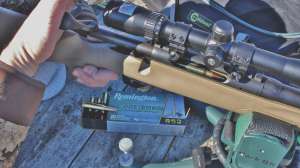
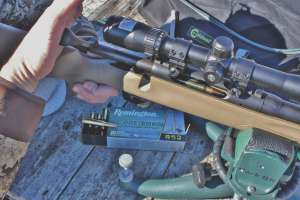
I’d mounted my test unit ATRIS 650 LRF onto a new Sig516 G3 AR-15 made by Sig Sauer. I had reviewed the rifle for sister publication Tactical Retailer, and it was an accurate, very reliable firearm, topped with a full-length rail that just begged for a thermal riflescope. My ammunition was Remington UMC .223 Rem. loaded with 55-grain full metal jacket bullets.
I aimed at the top left corner of the cardboard and fired two rounds. They cut into the cardboard side-by-side, approximately a foot low and half that distance to the right.
I re-entered the thermal’s zero function by pressing down on the central encoder button located atop the unit, essentially in the same position as the elevation knob on a day scope. Once in the Zero menu, I moved to the freeze function, made sure rifle and thermal were very steady, held the reticle center-dot on the corner of the cardboard, and pressed down once to freeze the reticle.
Then, I moved down the menu to the left/right and up/down controls and turned the encoder knob to make those adjustments.
Sounds like a small thing, turning that knob. But most thermal zeroing systems require the user to press down to make those adjustments. That’s a fairly awkward move as you are holding a rifle, plus the downward press invariably moves you off target. Real precision can be very tough to achieve.
But using the encoder, I moved the reticle over to my initial hits with a smooth and fluid turn of the knob that didn’t upset the rifle. Further, the ATRIS zeroing system showed a green line that moved right as I slid the zeroing reticle right, and then a green line that moved down as the zeroing reticle adjusted down.
When I’d created a new reticle over the impact area, I spun up to the save and exit function, pressed down and the adjustments were in place.
I shot twice at the HotHands. Those rounds hit the back tape on the right side of the heat pack, centered on the tape but 2 inches or so from the middle of the heat pack. I went back into the zero function, turned the encoder to move the point of impact just left of the tape hits, the green line tracking the movement, saved and exited and then shot five times.
All five struck the middle area of the small HotHands and formed a .80-inch group.
I was impressed with the precision of the zero function. And despite the cool temperature and the high humidity, the latter often a problem for thermal detection, the images I viewed were very clear and sharp edged, and the front focus control worked near perfectly.
This seemed like one hell of a thermal, I thought to myself, as I moved over to a 100-yard lane.

Range and Power
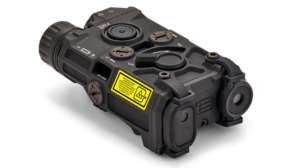
ATRIS stands for Advanced Thermal Rifle Scope and the ATRIS LRF V² definitely does not fit into the compact thermal category. Not with its 15 inches of length and weighing over 32 ounces with the single 26650 Protected Lithium battery installed. That’s a lot of thermal and it requires a substantial rail for attaching to a rifle.
The “LRF” in the name, of course, stands for laser rangefinder, a standard for many higher-priced thermals today. Rangefinding with the unit was very easy. I simply aimed at my target and pressed down on the LRF button located just ahead of the control pad, the pad sitting above the rear display lens.
The LRF worked on both scan and ballistic modes. Scan allowed for a quick determination of a distance, which appeared on the top right of the display. Ballistic also showed the distance plus fed that distance into the on-board ballistic calculator.
When in ballistic mode, the laser acquires the target, instantly calculates a bullet-drop compensation solution, and displays an aiming point specifically for that shot.
The user makes the scan or ballistic decision in the unit’s menu.
The unit featured a 640 x 512 thermal sensor, with a 12 Micron pixel size and a 50 Hz frame rate. WAVE rated the unit’s NETD capability at <15mK.
The 50mm objective lens is made of pure Germanium. The rear display lens is a ViewMax 2560 Display with Widefield Technology Display OLED. Base Magnification is 3.5x, while digital zoom runs from 3.5x to 14x.
A single, rechargeable 26650 Lithium Ion battery powers the ATRIS, a much larger power source than the more common 18650 batteries. WAVE rates battery life at 10-plus hours. The ATRIS includes one 26650 battery. The thermal can also run on an 18650 battery. Slide the included plastic sleeve over that battery to fit it securely in the battery compartment. No doubt battery life lessens with the smaller 18650.
The ATRIS is Wi-Fi and live-stream capable, and records audio, photographs and videos. Media can download via a USB-c port, which also handles firmware updates and the use of an external power source.
The free WAVE app will allow live video streaming to a phone or tablet, as well as providing management of media files through your mobile device.
Given its size, the ATRIS requires a stout mounting system and WAVE provides a sturdy OTM-30 QD mount with the unit. This heavy-duty mount went right onto my SIG516 rifle and secured the thermal firmly throughout my shooting.
At the Controls
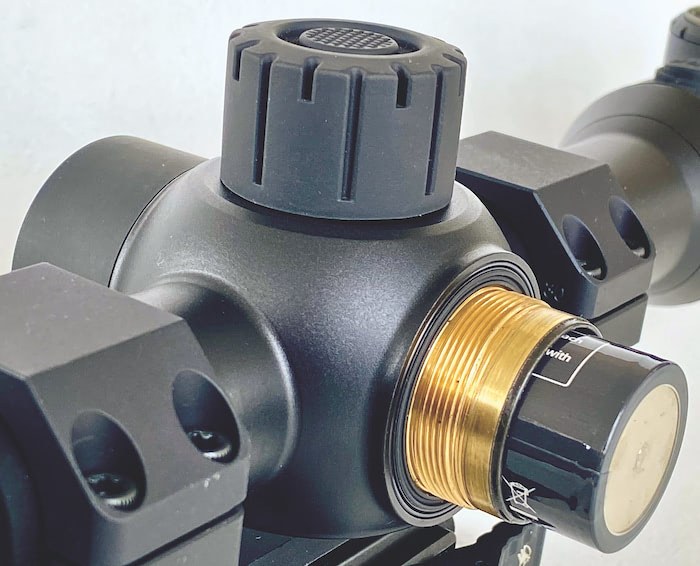
The simplicity of the ATRIS LRF V² controls is impressive.
At the front, top of the scope is the target focus knob, which spun easily for me to focus the images at distances close and far.
Next in line is the afore-mentioned encoder. Press down on the encoder and up comes the menu. Turn the knob to select functions and press down to enter.
The LRF button sits just ahead of the control pad, and the pad itself divides into three functions. The top button powers the unit on and off with long presses, while a short press puts the unit in the Standby mode.
The bottom left button controls the media capabilities, plus brings up the picture-in-picture function. The right rear button controls device calibration (NUC), color palette selection and image outline mode.
As with any thermal, the ATRIS takes some time to learn, but that learning curve is far less complicated than many of the units I’ve used.

Clear Signatures
My first shot at 100 yards hit high of a large HotHands packet. I’d already reset the zero distance at 100 yards, so I used the freeze function and adjusted the elevation, and my next shots hit mid packet.
By this time, the weather was quite blustery. While the HotHands showed up fine at this distance, I wanted to try something to test out the unit’s NETD <15mK rating.
NETD stands for noise equivalent temperature difference. Basically, the NETD rating signifies the smallest temperature difference a thermal imager can detect.
That difference is measured in mK or millikelvins. The <15mK rating on the ATRIS is a very, very good number, and means the thermal should be able to detect very minor heat variations.
I took a reflective paper target with five black diamonds embossed on the front and set it up at 100 yards. No heat pack and no sun to warm up the black diamonds, though of course some of the sun’s radiation still gets through cloud cover.
The target was in my vehicle during the course of my earlier shooting, and so it was somewhat warmer than the 48 degrees outside. But I assumed it would cool off fast given the winds and the thinness of the target.
From my shooting bench 100 yards away, the target’s rectangular outline showed up clearly. I had laid the palm of my hand against the black center diamond, and I could still make out a few warmer spots. I aimed and fired five shots. The shooting itself was not great, but I noticed that with each shot small black blobs appeared on the target.
Actually, they were behind the target, mud and water which splashed up when the bullets smacked into the earthen berm behind and stuck to the paper.
With that kind of NETD capability, the ATRIS will spot small heat differences out to many hundreds of yards, differences that can signal a hog or a coyote making its way through heavy brush.
Before I left the range and the 100-yard lane, I fired six rounds at the smaller HotHands pack. All six hit the pack, though the wind and the shooter combined to make the group larger than I’d hoped.
Sales Strategies
Fusion Thermal is the parent company of WAVE Infrared. Fusion debuted its original line of thermals over five years ago, still produces its line, and added WAVE to the corporate mix approximately three years ago.
Chris Wisecarver is the owner and founder of both Fusion and WAVE, and he has extensive in-store experience helping dealers navigate the world of thermal.
“Nothing in a gun store has a better demonstration capability than a thermal,” said Wisecarver. “Keep the scope on the counter and ask each customer who approaches if they want to see something really cool. Then demonstrate the device.”
Once these customers have a look, sales staff should stress how easy it is to learn and use this unit.
“The ATRIS 650 LRF V² is noted as having the best and simplest user interface of any thermal scope on the market,” Wisecarver said. “The 26650 Lithium Ion battery delivers industry leading runtimes without the use of hidden internal batteries, and when the laser is set to ballistic mode the device will quickly and accurately deliver a drop-down aiming solution for the distance.
“Even if they are not shopping for a thermal, they will leave the store intrigued and spreading the word about where you can go to find a great thermal.”
Getting On Board
In-store, WAVE provides its dealers with brochures, banners, scope stands and counter mats. Sales training is also available, on location and remote.
WAVE-approved dealers can buy direct or through Sports South.
“Potential WAVE dealers must have a physical store or a well-established ecommerce business,” Wisecarver noted. “No hobby sellers are accepted.”
To start the process of becoming a WAVE dealer, contact the company at sales@fusionthermal.com.
The ATRIS 650 LRF V² and other WAVE thermals are featured across the social media landscape, and the independent reviews of the units are very positive among the growing cadre of night hunters.
“WAVE is a brand made exclusively for the American sportsman,” Wisecarver added. “We specialize in thermal weapon sights that are dependable and simple to use.”