
The first red-dot sight (RDS) hit the market in 1975 thanks to Aimpoint, but it took some time for the optics to get traction. Today there’s a steady stream of RDS being launched every year, and most of them are…red. It’s become second nature to recommend a red RDS, partly because the market is flooded by them, but also due to their familiarity. Let’s talk red-dots — and green, and blue — and why the other colors are often the ones to recommend to customers.
Why Red-Dot Sights?
You won’t always face a hard sell for red-dots, but it does happen on occasion. Many gun owners still prefer iron sights, whether out of habit or because they don’t want to mess with electronics on their handguns. If a customer is open to hearing about adding an RDS, take that moment to educate them in an engaging yet educational way. Here’s a few tips.
Red-dots make defensive shooters more effective. The use of an RDS rather than irons allows the shooter to better visualize and track the threat. This is because iron sights demand front sight focus while RDS allows single plane focus. That improves situational awareness and allows the customer to see more of the threat instead of being lasered in on only one area that appears to be in another plane due to looking at the front sight. If a customer argues that point shooting is where it’s at anyway, they can be gently reminded that point of aim and point of impact shift enormously at close range. Shots fired to stop a threat need to be effective, and customers might be surprised how many aren’t. Placement matters.
Speed isn’t important to everyone who walks in your doors, but it does appeal to many, if not most. Adding a red-dot sight to a carry gun makes getting on target faster and more efficient. Yes, there’s a learning curve, but it isn’t nearly as challenging as some believe. Let customers know that if they opt for a red-dot, they’ll shave time off what it currently takes them to draw their gun, get it on target, and make that first shot. Seconds and fractions of seconds can make a significant difference when there’s a threat present.
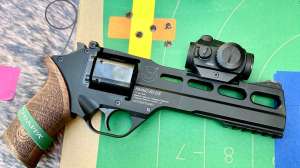
Gear compatibility is rarely an issue now. Most holster manufacturers offer a selection of optic-compatible options, meaning your customer will be able to find a good holster to go with their new choice of optic. Keep some quality holsters that are compatible with red-dots in stock so this can be demonstrated if need be. The same goes for mounting methods. If a gun isn’t optics-ready, there are endless choices for mounting plates. Even revolvers are starting to be produced for use with standard pistol red-dot sights (thanks to Taurus for the first model).
Some customers will ask you about the issue of a red-dot going down at an inopportune moment, and there are two answers for it. The first is that the batteries in an RDS have incredible lifespans — and some designs don’t need batteries — and the easiest way to handle it is to change all their gun-related batteries on the same day each year. That could be New Year’s Day, their birthday — whatever is memorable. However, it’s still unlikely the battery will simply die on them. Annual changes are more for peace of mind and to keep track of battery age. Second, inform customers about the possibility of backup iron sights, and have a selection on the shelf.
The Red Effect
One issue with red-dot sights is the color. For some customers, that red is harder to see, especially during long range sessions. Shooters with eye issues such as astigmatism might experience a glowing halo effect and other problems that make it all but impossible to accurately, reliably run a red-dot. Don’t dismiss these concerns outright, because it’s not an imaginary issue — it’s real.
If your customer is new to dot sights, ask questions. Ask if they have an astigmatism. If possible, have floor models in each color — red, blue, and green — to allow them to look through them for more than a few seconds. It isn’t possible to entirely eliminate a customer ending up unhappy due to the way they’re seeing red, but you can educate them. If the customer says they do have an astigmatism and ignores your suggestion to go with another color than red, don’t push. This is their choice, their gun, their optic. Inform and move on.
Going Green
Red-dot sights with dots that are actually green are becoming increasingly common. Most major manufacturers offer green as an alternative to popular red models, as do many smaller companies. Customers might think green is just a random color option not unlike slapping Cerakote on a gun, but there’s more to green than being…not red.
Green dots are easier to visualize in daylight. That’s a fact for all gun owners, and it’s backed by science. If you’d like to share a science tidbit with customers, here it is: Green light works more effectively with the human eye’s photoptic response by taking advantage of the eye’s natural sensitivity to this color. This is measured scientifically in nanometers to find out what wavelength the human eye sees best, and green’s a winner. Defensive use of handguns can take place at all times of the day, and using a green dot gives the customer a significant edge for target acquisition in the daylight hours without costing them anything after dark (when the eye continues to see green more sharply).
Other reasons to go green include avoiding the glow red gets with astigmatism, cutting down on color spectrum interference (customers can’t control the color of the target), and improved visibility for customers who are color blind. Green also doesn’t wash out or blur like red can, and it retains sharp edges and excellent clarity better, too. The argument in favor of recommending green dots to customers is strong.
Feeling Blue
A more recent arrival to the RDS world is the blue dot. Lucid Optics engineered the first blue reflex sight with the E7, and it’s proven to be a smart move. Similarly to green, the human eye is sensitive to blue, making it easier and faster to see. And for color blind customers, blue is ideal because even color blind shooters can typically see blue — it’s red and green that are affected the most. Using a blue dot offers benefits similar to that of the green dot, although blue has an edge in some ways. It’s a good idea to keep a Lucid Optics E7 on the shelf for customers interested in something a bit different for their dot sight needs.
I’ll Take One in Every Color
If you’re looking for quality options to stock, consider these models — one red, one green and one blue.
Sightmark Mini Shot A-Spec M2: Customers searching for a reasonably priced, high-performing red-dot sight will be interested in the Sightmark Mini Shot A-Spec M2. This red-dot sight is designed for use on handguns with an RMR footprint. The housing is made from 6061-T6 aluminum for durability and longevity with a matte black finish to cut glare. The Mini Shot A-Spec M2 is designed in Texas and made to last.
This RDS offers six daytime settings and three nighttime settings, giving customers the ability to fine-tune visibility according to their preferences and needs. Elevation adjustment range is 110 MOA with windage adjustment range at 120 MOA. That gives customers significant range to sight in their optic. This model features a 1- and 5-MOA reticle for enhanced visibility. Eye relief is unlimited. Keep in mind that this RDS is made for handgun calibers up to 45 ACP. It’s powered by one CR2032 battery.
MSRP $239.97
Visit sightmark.com to learn more.
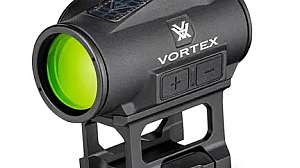
Vortex Defender CCW Micro Green Dot: When defensive use is the focus, steer customers to a low-profile, reliable design like the Vortex Defender CCW Micro Green Dot. This model does utilize a 3-MOA green dot at 1X magnification. Despite its being a micro dot, the sight’s large viewing window does a great job of giving the customer a broader, unobstructed field of vision. One feature to point out to customers is the aggressive Fast Rack texturing on the face of the optic that’s designed to make racking the slide off objects easier.
Eight daylight brightness settings, the lowest two of which are night-vision-compatible, give the user the ability to adjust according to the environment. Button lockout is included to stop the sight from being accidentally adjusted for brightness during use or storage. The Defender CCW Micro Green Dot is motion activated with an automatic shut-off at 10 minutes to preserve battery life. The battery itself is a top-mounted CR1632 with a stated run life of 9500 hours. This model’s footprint is Shield RMSc compatible.
MSRP $349.99
Visit vortexoptics.com to learn more.
Lucid Optics E7: While blue is making an appearance here and there, the Lucid Optics E7 remains the original. This is a larger dot sight, making it compatible with both pistols and long guns. The aluminum housing is 2.5 inches x 2 inches x 2 inches. Customers might be a bit put off by the larger size for handguns, but the benefit to using the E7 on a pistol is a larger viewing window (and that blue dot, of course). The fact that it can go from handgun to long gun is useful for those who don’t want to buy a new optic for every gun.
This is a closed-emitter optic, which you can explain to customers as increasing overall running life. The design helps protect the optic from inclement weather and increases its resistance to wear. Even with its larger size, the E7 isn’t bulky; this dot sight weighs in at 2.65 ounces. This optic is operationally parallax free, utilizes shake-awake technology, and is powered by a single CR2032 battery.
MSRP $299.99
Visit lucidoptics.com to learn more.