
Charter Arms is an American company, through and through, formed in 1964 by Douglas McClenahan, a product design engineer with experience at Colt, High Standard and Sturm Ruger. He was joined by childhood friend David Ecker in 1966 and they remained partners until the mid-80s.
McClenahan’s design of the Undercover model featured, for the first time, a one-piece frame with no side plate and a trigger mechanism assembled from the bottom, making for a stronger frame. The Undercover, which also featured the first hammer-block system and was the smallest and lightest .38 Special revolver around, came to be known as “The Original Pound of Protection.” The company positioned itself as the Chevrolet of the revolver business, doing everything Cadillac does, but at a more affordable price.
Shooting Sports Retailer recently talked to Nick Ecker, owner of Charter Arms, to find out more about the company and its plans for the future.

SSR: You’re a relatively small company, American owned and American made. What does that mean to you and your customers?
Ecker: Charter Arms is the essence of a company that is 100% Made in the U.S.A. We employ 40 people with complete benefits, as our employees are one of our greatest assets. In fact, we are so proud to be an American Made company that we have Super Bowl Monday as a paid holiday. Our product line embodies 12 calibers and 100 different models, and most of our vendors are within 50 miles of our plant with many servicing us for 20-plus years. Between our employees and vendors, the low turnover rates give Charter Arms an edge over other manufacturers. We all work together for the long-term goal, which is to produce the finest quality revolver at the lowest possible price. Also remember when you call Charter Arms a human will answer the phone with the purpose of serving you efficiently. Customer service is our No. 1 goal.
SSR: Who is the typical Charter customer?
Ecker: Interesting question, as our customers have evolved over the years. Originally, our core customer was looking for an alternative to more expensive revolvers on the market. This is still true; however, consumers are now looking for products that they can identify personally with, more color options, innovative designs such as the Pit Bull series (the only revolver that extracts semi-auto rounds without moon clips), and our Southpaw (the world’s only revolver made for lefties). We thank many of our customers for ideas, including the colored revolvers that are often chosen and recommended by women.

SSR: What are your biggest challenges in today’s shooting sports industry?
Ecker: Of course, the largest challenge in the manufacturing of firearms in the United States today is inflation. During COVID, the lead times on many raw materials increased from 8-10 weeks to, in many cases, up to 32 weeks. That coupled with reckless government spending increased the cost, not only of materials, but all processes including insurances and utilities. We decided on a program working with both our vendors and employees that have been with us for so many years. These programs included, but were not limited to, purchasing new machinery, buying in larger quantities, innovative shipping techniques, and new types of production. Absolutely no category was off limits, so today we have a better level of employee benefits, better quality, and minimized price increases.
SSR: How have your product lines evolved over the years?
Ecker: Over the years, Charter Arms has evolved as the consumer market has become accustomed to so many more choices now than say 25 years ago, relating to innovation in technology, worldwide suppliers, and demographics. There is a broader range of age, needs, size, and knowledge that the consumer has today. Especially in today’s society, people feel a greater need to protect themselves and their loved ones.
SSR: The Mastiff series is a little outside the lines of some of your other guns. How did that come to be?
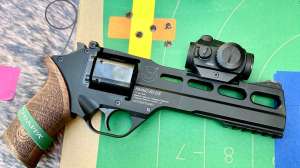
Ecker: The Mastiff is that change in consumer demand that we were discussing. Picatinny rails and optics on handguns, in general, were unheard of 25 ago. Consumers today want options to add the latest optics, flashlights and any other host of available options. Most of our barrels are made from castings and then broached to produce the rifling. This is a great cost saving for shooting at shorter distances (7-25 yards). The Mastiff Barrel is made from a buttoned barrel blank, whereas the outside diameter is turned to the bore. This is far superior for long-distance accuracy.

SSR: What’s the philosophy behind new product development?
Ecker: God gave us two ears and one mouth, which means we should listen twice as much as we talk. We do exactly that, because we answer our phones, as well as read and answer every email. People know that we do listen. Hence many ideas are presented to us. An example would be the diamond cuts that are now in a few models under the barrel, which was from a customer who did it with a Dremel tool. Well, not only did it reduce weight and keep debris from the ejector rod channel, but it has a great look! Another example would be when we first introduced The Pink Lady. It was our ladies who said “That’s Pepto Bismol pink, we want hot pink.” From that day forward, the ladies in the field and inside the plant picked the various shades; you must listen.
SSR: What’s in demand, and where do you see opportunity?
Ecker: We see opportunities every day. Our latest is traditional finishes on our steel models, and what I mean is that polished look from days gone by (80s and before) that took a team of polishing craftsmen to attain. Now, we have a process where we can attain that finish without the enormous amount of skilled labor. The consumer is now able to purchase a finish only available on guns costing upwards of $1,000. We also have some new models out, such as the only 2-inch .22 Long Rifle and .22 Magnum with a concealed hammer. It’s great for protection in a pocket or purse as the design is snag free.
SSR: What does Charter do better than the competition?
Ecker: Hands down, over any competition, it’s our customer service; a human answers the phone during normal business hours. Do we ever have problems? Of course, but sometimes the way you manage a problem lets the customer and the dealer know we are 110% behind our products and our job is to satisfy the customer. As far as the Charter Arms dealer goes, they never have to worry about their inventory being devalued because we made a deal to move the product due to over production or a slow period. Now, just to be clear, we do run short promos, say at a distributor show, but never saturate and devalue inventory on the dealer shelves.
SSR: What other product and marketing support do you provide for retailers? Are there any incentives or programs for new partners?
Ecker: We have a complete program of marketing support for all our dealers. That includes display pegs that stand the revolver up, saving shelf space and making the product more visible, counter mats, banners, range programs, etc. We track all inventory at the wholesale level. One reason is to direct dealers looking for products. We also list all dealers on our website to direct customers. I get a real thorn in my side when I see any company giving better deals to new customers, but not the same deal to the customers that are loyal and selling our line.
SSR: What will 2025 and beyond hold for Charter? What should dealers be excited about?
Ecker: Besides the new Off Duty chambered in .22 caliber, we just introduced our Coyote series, which gives customers another choice. The Coyote series is chambered in .380 and utilizes moon clips. We plan to expand this line next to chamber 9mm.