
John Wayne, Roy Rogers, Gary Cooper and other luminaries were among the first to proudly order a Weatherby when the firm was headquartered just down the street from Tinseltown. Mere mention of the company name at the counter to this day is guaranteed to turn heads, even those that have never watched “The Searchers” or “True Grit” or heard of Rogers or Cooper.
Modern memories are short when it comes to Hollywood stars, but long on influencers, and there’s no denying Roy Weatherby was among the first. He did it right, though, which explains the longevity. There was no internet to temporarily lift his company name to legendary status. Instead, he crafted quality rifles with a timeless look and performance to match. News of the famous following they attracted turned viral in magazines and newspapers across the globe, cementing it permanently into gun lore.
Modern versions of those high-end custom rifles can still be ordered from the factory, but today most of your customers consider other assets more important. They want tight groups, utter reliability and affordability.
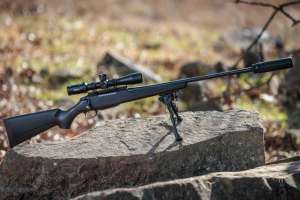
The tested Weatherby 307 Range SF — the latest sibling in the company’s 307 family — has all those attributes, and more. As word spreads, it’s going to be a popular choice.
On Paper
The rifle shines brightly downrange. In fact, it outperformed several of the fancier, metal-stocked and doubled-in-price contemporaries I’ve reviewed.
The tested 307 Range SF was chambered in .223 Rem. Out of the box, factory fresh, it placed three rounds in a .53-inch group at 100 yards using American Eagle’s 62-grain load. With Hornady’s 55-grain SP Brass Training ammo — not exactly a match-worthy choice — the measurement increased to .60 inch.
Averaged for three three-shot groups, figures increased to .74 and .81, respectively. PMC’s Bronze 55-grain FMJ boattails didn’t fare as well, coming in at slightly more than an inch.
Credit for those figures — through a factory-fresh barrel — goes entirely to the rifle. It’s comfortable, steady, familiar in configuration and a pleasure to shoot. I’m not a former SOCOM sniper and don’t play one at my local Comicon, so I shoot from a prone sandbagged position. It steadies these old hands and provides a more accurate assessment of the gun’s potential rather than caffeine intake prior to any range session. It wouldn’t come as a surprise if readers write in with even better results.
With practice, and less coffee, I’m confident groups will shrink. If you’re wondering, a Leupold VX-3i 4.5-14X 40 mm was mounted with Talley bases and rings for the session.
The results make it obvious why Weatherby backs the rifle with a 24-month MOA guarantee. The performance is a sum of the parts, though, including the trigger — and they picked a good one.
Go Switch
The Weatherby 307 Range SF uses the TriggerTech Field trigger, which is user adjustable for let-off weights anywhere from 2.5 to 5 pounds. Its single-stage operation was refreshingly crisp, creep-free and glossy smooth. Crawling behind it was such a pleasure at the factory setting.
Texturing on the trigger shoe itself minimizes the chances of the index finger slipping or shifting in inclement weather. It’s a simple touch ideal for hunters who don’t cancel plans when ice, snow and rain fall. The trigger guard is generous enough for unencumbered operation with gloved hands, too.
Magazine and Release
Weatherby’s 307 Range SF ships with a 10-round, polymer Magpul Pmag magazine. Its body is constructed from the same rugged, combat-proven material that’s served our forces so well in the global war on terror. It’s more than tough enough to survive opening-day torture. The magwell accepts AIC-compatible versions for each 307 rifle’s chambering.
The cartridge and Pmag combination taunted me long enough to give a standard AR-15 magazine a try. It doesn’t work.
Its magazine release is located forward of the trigger guard. A firm push from the rear drops the magazine, and it worked cleanly and flawlessly during testing. The spring is firm, a design that minimizes chances of accidental release in the field.
Taking Stock
The stock doesn’t scream Weatherby, at least not in the traditional sense. It’s black, synthetic and businesslike. There’s texturing in all the right places, sufficient enough to maintain a solid grip when Mother Nature gets angry, but not abrasive feeling to bare hands.
Two sling-swivel studs are at the forend, which eases bipod-mounting headaches. There the profile on the bottom is flat, another touch that promotes stability when sighting in from a bench or sandbags. It also beats those rounded profiles on some other synthetic versions that never seem to settle into a field-expedient rest.
Out back, the recoil pad is generous, even a bit of overkill for soft-shooting .223 Rem. loads. Hunters who choose a 307 Range SF in in 6.5 Creedmoor, 7 mm Backcountry, 7 mm PRC, .300 Win. Mag., .308 Win. and .338 Weatherby RPM will appreciate the added recoil mitigation much more.
The rifle ships with a pair of spacers that allow owners to extend length of pull to as much as 14 1/4 inches by inserting one or both between the stock and recoil pad. As it ships from the factory, the distance is 13 1/2 inches.
The stock’s cheekpiece is also height-adjustable. Three positions are available, and when the proper elevation is found, things lock tightly in place with four Allen headed bolts.
The Real Game Changer
Weatherby packed up and left California in 2019 and began operations in gun-friendly Sheridan, Wyoming. It’s there that the company designed and now makes its new 307 action. It was named after Wyoming’s area code, if you’re wondering. Don’t let that seemingly simple approach fool you, though. This design is adaptable and versatile and remains true to Weatherby’s tradition of performance.
All 307 actions are machined from billets of steel that have already been heat-treated. Pre-treating the steel eliminates changes in tolerance that can occur if baking follows CNC shaping. It makes the metal tougher to process, which adds time to the manufacturing process, but it’s worth the effort. The difference may not be visible to a customer at the gun counter, but let them work the action and they’ll feel the bolt-action’s glossy-smooth operation.
The action is designed roughly on the Remington 700 action, a footprint that makes it compatible with the huge number of aftermarket parts. The bolt-release location, on the receiver’s left side, is slightly elevated to makes compatible with most stocks available today.
That versatility allowed the company to quickly introduce five branches in the 307-rifle family tree — Adventure, Alpine, Hush, Meateater and Range — since it was first introduced in 2023. Combined with different barrel lengths, stocks and chamberings, odds are good there’s something ideal for your customer base and popular pursuits.
The safety, a two-position version, is on the right rear side of the receiver, a familiar position for most shooters. There is no rail on the 307 Range SF, but it is drilled and tapped for mounting optics.
The fluted push-feed bolt has an M16-style extractor, dual locking lugs and a graphite black Cerakote finish. During testing, there were no problems, with the cartridge picked up clean from the magazine and ushered into the chamber. Each session was stoppage- and malfunction-free.
Weatherby wasn’t content stopping there, though. There’s another very welcome touch.
Tool-Free Bolt Strip
No tools (or unfriendly contortions) are required to field strip the bolt. It’s fast and much easier than the wrestling match often required to unlock the innards of a typical design. I didn’t even need to call customer service for help.
Grasp the bolt firmly with one hand, then apply sufficient pressure to the bolt face with the other. Maintain that position and remove the handle. Everything comes out nicely, although my lack of coordination made it easier to apply that initial pressure on a rubber mat.
Reverse the process to reassemble. It’s a clever, mechanically sound solution.
Barrel
The 307 Range SF wears a 20-inch, free-floated barrel with a tungsten Cerakote finish identical to that of the receiver. It looks good. Rate of rifling in the test rifles was 1 in 8 inches. The barrel was threaded 5/8-24 and ships with a thread protector. Other members of the 307 family often come with an AccuBrake installed.
Its heavy bull profile proved ideal for precision at distance. The thicker diameter is also an advantage during high-volume shooting or long days at the firing line.
Overall
Weatherby has a winner on its hands. It’s innovative and reliable, and it lives up to the Weatherby legend in all the right ways. It may not wear finely oiled walnut furniture, but it’s an ideal choice for hunters, who understand their gear must survive, and thrive, when Mother Nature’s temper flares.
Specifications
Weatherby 307 Range SF
Chambering: .223 Rem. (tested); also available in 6.5 Creedmoor, 7 mm Backcountry, 7 mm PRC, .300 Win. Mag., .308 Win. and .338 Weatherby RPM
Method of Operation: Bolt action
Overall Length: Adjustable from 39 1/2 to 40 1/4 inches
Weight: 7.9 pounds (unloaded)
Receiver: Weatherby 307, tungsten Cerakote finish
Bolt: Fluted with toolless disassembly, graphite-black Cerakote finish
Trigger Let-Off Weight: Adjustable from 2 1/2 to 5 pounds
Barrel: 20-inches, bull profile, threaded 5/8x24, tungsten Cerakote finish
Rifling: 1:8
Stock: Synthetic black with height-adjustable cheekpiece
Length of Pull: Adjustable from 13 1/2 to 14 1/4 inches
Magazine: 10-round Magpul Pmag (AIC compatible)
Accessories: Two length-of-pull spacers, trigger lock
MSRP: $1,179
Website: Weatherby.com