
One of my uncles was a mechanic with an uncanny ability for repairing just about anything on four wheels and squeezing horsepower out of run-of-the-mill rides. I saw him last when I had just finished putting a racing stripe on my first car — a boxy two-door import sedan.
He studied the vehicle, checked under the hood, asked about the transmission, and then scratched his head for a few seconds. “How much horsepower did that fancy stripe add?” he finally inquired.
The lesson, delivered decades ago, still rings true. Many of today’s products catch a shopper’s eye quickly, but fashionable looks are no guarantee of long-term performance or reliability. Features rarely if ever used add bulk and weight — liabilities when afield.
I couldn’t help but think about my uncle when a CVA Cascade VH rifle arrived for testing. The gun, introduced in 2024, shuns fads, gimmicks and glitz. It just comes with all the attributes that make it an ideal choice for hunting.
Far From Plain Jane
The rifle is tailored for varmint hunting, hence the “VH” name. It wears Realtree Hillside camouflage, and the barrel and receiver are Cerakoted in a smoked-bronze finish. It’s a businesslike look ideal for places plagued by prairie dogs and coyotes.
Its one-piece, synthetic stock has a traditional look, although the height-adjustable cheekpiece is a dead giveaway of its new and forward thinking design. Its height is field-adjustable by simply turning the large knob on the right side of the stock. No tools are required, and modest texturing on the knob ensures a positive grip if changes are required in foul weather or when wearing gloves.
The flat profile on the stock’s forend is a less noticeable upgrade. The feature gets its main billing as an advantage for benchrest or sandbagged shooting, but the subtle touch is a big advantage when afield and struggling to steady a field-expedient rest.
The rifle ships from the factory wearing three sling studs. A spare up front, of course, is ideal for mounting an aftermarket bipod if a new owner so chooses.
Handling the rifle is a pleasure. Its SoftTouch finish ensures a positive grip with sweaty hands or in dusty conditions, yet it somehow avoids any sort of sticky feeling. It’s a warm change from the sterile feel of aluminum or slippery gloss of traditional wood. If a customer still isn’t quite sure it’s good enough to maintain a solid grip in a downpour, feel free to point out checkering in all the right places at the wrist and forend.
None of the currently available Cascade VH chamberings — .204 Ruger, .223 Rem., .22-250 Rem. and .243 Win. — are heavy recoiling, but CVA still ships each of the rifles with a Crushzone Recoil Pad. It’s soft to the touch and reassuring to newcomers and young shooters, but not tacky enough to annoy experienced hands by hanging on clothing. If high-volume varmint shooting is on the schedule, it’s a feature appreciated by one and all.
There’s no racing stripe, glitz or glam, just everything needed for the job. The real horsepower in this machine is hidden under the hood, however.
Bergara Barrel
Cascade VH rifles wear heavy sporter Bergara barrels, famed for their accuracy, reliability and precision. It’s a premium feature that’s hard to find on a budget-friendly firearm.
The test gun arrived chambered in .22-250 Rem, and its barrel — like all those in the VH line — is fluted. The design helps dissipate accuracy-robbing heat, trims weight and provides an understated look of distinction.
Barrels are threaded 5/8x24 lpi for mounting muzzle devices, including brakes, flash hiders or suppressors. A thread protector comes standard to shield things until the new owner decides it’s time to accessorize.
Rifling rate in the tested rifle was 1 full twist every 12 inches. The .223 Rem. version is 1:9 and both the .204 Ruger and .243 Win. have a rate of 1:10.
Cascade Receiver
The receiver is manufactured from 4140 steel, ensuring durability and longevity. It also ships wearing an attached 20-MOA Picatinny rail to minimize headaches during optic mounting, as well as minimize effort in finding compatible bases and rings.
The 20-MOA cant is a decided advantage when it comes to stretching distances, which is common with varmint hunting. The setup’s a budget-friendly solution if a customer already owns an optic likely to run out of elevation adjustment at long distance. It’s another subtle touch from CVA, and a welcome one in troubling financial times.
A two-position safety is in the traditional location, on the right side of the receiver, just behind the bolt handle. The bolt can be removed by depressing a bar on the left side of the receiver, with the safety in either position.
The 10-round, polymer CVA magazine that shipped with the rifle worked flawlessly, snaping smartly and intuitively into position with an audible “click” during testing. It was much easier than many of this rifle’s contemporaries.
A paddle directly in front of the magazine well is pulled toward the rear of the gun to release the magazine. It’s a nice setup that promotes using your hand to grasp the magazine before it plummets to the ground, or dozens of feet below the blind.
The release is also recessed into a cavity in the stock, placement that prevents inadvertent activation. The channel it’s located in, however, is large enough to ensure manipulation with gloved fingers when things get cold.
Bolt
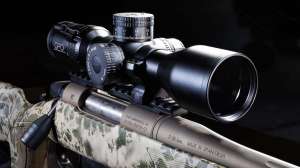
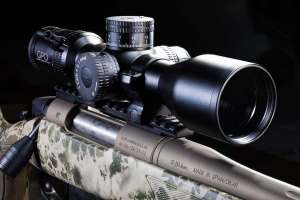
The-three lug bolt ran smoothly and effortlessly during multiple range sessions. With a 70-degree bolt throw, there was plenty of clearance — throughout travel — from the Nikon P-223 scope mounted for testing.
No stoppages or problems were encountered at all. It picked up cartridges so smoothly that on two occasions I stopped just to check if a round was actually chambered. The ability to retract that bolt without disengaging the safety was appreciated during those halts at the firing line.
The bolt cocks on opening. When the firing pin is ready to release, a small red bar appears just underneath the bolt shroud. It’s plainly visible to the shooter and yet another underrated feedback feature.
An oversized bolt handle, wearing three modest grooves around its circumference, ensures operation even when Mother Nature’s angry. Of course, all this is for naught unless the mechanism to put it to work doesn’t match that performance.
Trigger
CVA doesn’t get enough credit for its triggers. The tested gun displayed all the virtues we’ve come to expect from the company. There was no palpable take-up, creep or gritty feel. It’s a crisp and sweet single-stage and maintained that attitude after sending dozens of rounds downrange.
Let-off weight hovered just above 2.3 pounds on the tested rifle. It’s also user-adjustable at anywhere between 2 and 4 pounds. Simply use an Allen wrench and turn the screw just in front of the trigger shoe — clockwise to increase required pressure to release a shot, counterclockwise to reduce. The trigger guard, in the spirit of the rifle’s primary purpose and likelihood it’ll be put through environmental abuse, is large for gloved use.
All combined, it makes for a sound system, but the proof is in the groups it printed downrange.
Performance
For accuracy testing, the Nikon P-223 4-12x40 mm was mounted with Leupold rings. Winds were steady at 5 mph, full value from the right, with an occasional — and wisely waited-out — gust up to 15. Temperature was 49 degrees Fahrenheit, and five three-shot groups from three different loads were used for evaluation.
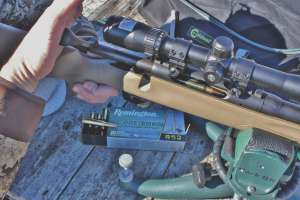
At 100 yards, from the prone position and sandbagged rest, Sellior & Bellot 55-grain softpoint boattails averaged 1.02 inches. The loads were the first sent downrange during the session.
Up next was Aguila’s 60-grain soft points. They shrunk the mark to .96 inch, leading me to theorize the barrel was just lapping in, although a more likely suspect was improvement in my comfort level behind the rifle.
Then came Hornady’s Varmint Express 40-grain V-Max. Its initial three-shot group took the crown at .575 inch. The next 12 shots increased the load’s average to .79.
The fact the rifle comes with a 14-day money-back MOA guarantee speaks volumes. Testing results indicate not many will ever take advantage of the offer, although it is a reassuring selling point.
At the Track
CVA’s Cascade VH wears a serious, businesslike look ideal for varmint hunting. Its no-nonsense appearance and familiar manual of arms may not attract huge crowds at its figurative pit lane, although fans will gather once its performance is on display.
Testing was pleasant, recoil almost absent and the precision delivered — with the right load, out of the box — for a firearm in this price range makes it a solid choice for hunting retailers. Customers who spend time behind their trigger will undoubtedly tighten their groups and return to your store for ammo throughout the year. It’s too much fun to collect dust in the safe.
If it was a muscle car, my uncle would label this one a real sleeper.

Specs
Model: CVA Cascade VH
Action: Bolt action
Chambering: .22-250 Rem. (tested); also available in .204 Ruger, .223 Rem and .243 Win.
Barrel: 22-inches, threaded, fluted heavy sporter profile with smoked-bronze Cerakote finish
Rifling: 1:12 inches
Trigger: Single-stage, user adjustable from 2- to 4-pound let-off weight
Stock: Polymer, Realtree Hillside camouflage
Magazine: Removable polymer box, 10-round
Weight: 8.9 pounds
Overall Length: 42.25 inches
Warrantee: 14-day moneyback moa accuracy guarantee
MSRP: $900