
What can you say to a customer to get them to move from "looking" to "buying?" Often, market studies hold the key to that question, but many small manufacturers and retailers don't have access to such data and, if they do, they aren’t sure how to use it.
But for hunting retailers, the research is there. Trade associations like the National Shooting Sports Foundation (NSSF) and the Archery Trade Association (ATA) provide valuable market studies and consumer surveys that, if leveraged, can inform your company’s sales, marketing and advertising methods.
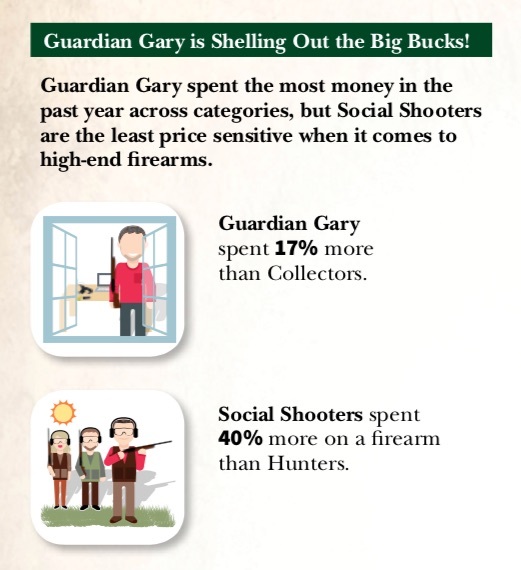
Take the latest research project of NSSF and Southwick Associates. The two organizations partnered to develop an in-depth, 150-page report to define and expand on eight main segments of gun owners. Baseline information of the report is free, which is enough to get most firearm retailers started on the path of targeted sales tactics. That's true, at least, if businesses know who to use this intel to their advantage.
What Is Customer Segmentation?
Customer segmentation is basically putting customers into groups based on their buying habits, motivation, gender, age, geography and so on. In content marketing, you'll hear digital media gurus talk about grouping readers by personas — it's all the same fundamental concept.
If you're a retail manager or shop owner, think of yourself as an investigator. You're trying to get into the minds of the people who walk into your shop or could potentially walk into your shop. In a way, this practice is mindfully stereotyping people. It's the thing many of us tell our children not to do. But in marketing, it’s encouraged. And it often works. Stereotypes have value.
To understand customer segmentation, let’s step away from customers and retailers and instead learn from detectives — criminal investigators, if you will — and how they “close the deal” by using defined groups they've created to narrow a search. One such criminal group is labeled family annihilators. As the name suggests, these are people will take out their entire family. In these cases, before a suspect has even been named, they already know family annihilators are almost always white, male and aged somewhere in their 30s. They also know these crimes are usually committed in August, before children return to school.
So when Chris Watts, the Colorado man, husband and father of two daughters, spoke to local news reporters in 2018 and pleaded for the safe return of his wife and kids, investigators already knew it was unlikely this family would ever be reunited. After all, the man — Watts — standing in front of the news cameras, making his case from his manicured front lawn was white and 33 years-old. He was dressed in shorts and a t-shirt. Why? Because the weather was warm. Not unusual for the month of August, just before his two daughters would start a new school year. In less than 48 hours, Watts would confess to murdering his family.
For a culture that values individualism, we aren’t so original. And that lack of individualism can be pretty valuable to a long list of professionals that includes both criminal investigators and business owners.
How Your Retail Business Can Leverage Well-Defined Consumer Types
So how do you apply these methods to retail sales?
Say a customer walks into your shop. You specialize in firearms. Now, if you have data that essentially tells you the firearms customers will likely be one of eight customer types — a hunter, social shooter, protector or collector, to name only four — then it's almost like your sales staff has been given a cheat sheet. Know the customer type, and know the customers needs, motivations and the problems he or she is likely trying to solve with one of your products. That kind of nuanced identification can go a long way is setting your store apart from competitors.
Lauren Sorenson, campaign and public relations manager for the successful lifestyle brand Life is Good, helps define tactics made available through customer segmentation.
“When working with personas, you are really just shifting your view of 'customers' to actual people with specific interests, wants and needs,” she says, in a blog post for HubSpot.
Sorenson's six core benefits of well-defined marketing personas also offers what’s most important: how to put each one to use so it’s not just a concept, but a true cog in the wheel of your business model. Granted, these six benefits apply primarily to those creating content to reach new customers and build online communities. But that's OK. The abundance of free, online information can be bent to apply to each business owners unique situation.
For instance, the first of Sorenson’s six core insights is how marketing personas can offer “an understanding of customer needs/interests.” She writes:
When you're trying to buy the perfect gift for your mother, spouse, or friend, you can easily visualize them in your head as you shop. You can imagine their needs and wants, the things they'd love, the things they'd be interested in, and all the things they hate. Customer personas work in the same way. They allow you to better understand the needs and wants of your customer base.
How to Leverage It: By knowing the problems your customers face, you can cater your content to your audience in a way that they'll find valuable. Use these insights into your customers' needs and wants to identify the topics your prospects want to learn more about, and create content around those topics.
If you’re a manager or owner of a retail shop or even a small manufacturing company, "content" to you may be the talking points you'll use while on the sales floor or on a call with a buyer. It’s all the same: intuitively knowing a person, based on a sub group you've already profiled and defined, in a way that reveals problems they’re looking to solve with a product you have on display.
And speaking of display, customer segmentation can and should inform how your products are grouped and displayed.
As Kris Hiiemaa writes for Erply, an open-source platform that provides point-of-sale support for retailers, “retail customer segmentation also gets retailers a better idea of who buys what, which can be used when expanding products or adding new merchandise.”
And while point-of-sale data can put a finer point on your store's unique customer subsets, the survey data and resulting personas offered in the hunting, archery and firearms industries — like the customers types defined by the joint venture between NSSF and Southwick Associates — can add value to a retailer’s bottom line.
In an upcoming article, Hunting Retailer will unpack the eight personas that define gun owners, and take a look at how these groups can improve your company's sales and overall performance.