
Archery and bowhunting manufacturers pay federal excise taxes (FET) that help secure the future of wildlife and wild places for sportsmen, sportswomen and all wildlife recreationists to enjoy. Understanding the FET collection and distribution process allows ATA members to embrace and celebrate their financial contributions, which generate sustainable conservation efforts nationwide.
A Well-Designed System
Few state wildlife agencies receive funding from general taxpayers. Agencies rely primarily on two funding sources: hunting and fishing license fees, as well as federal excise taxes paid on firearms, ammunition, fishing tackle and archery gear.
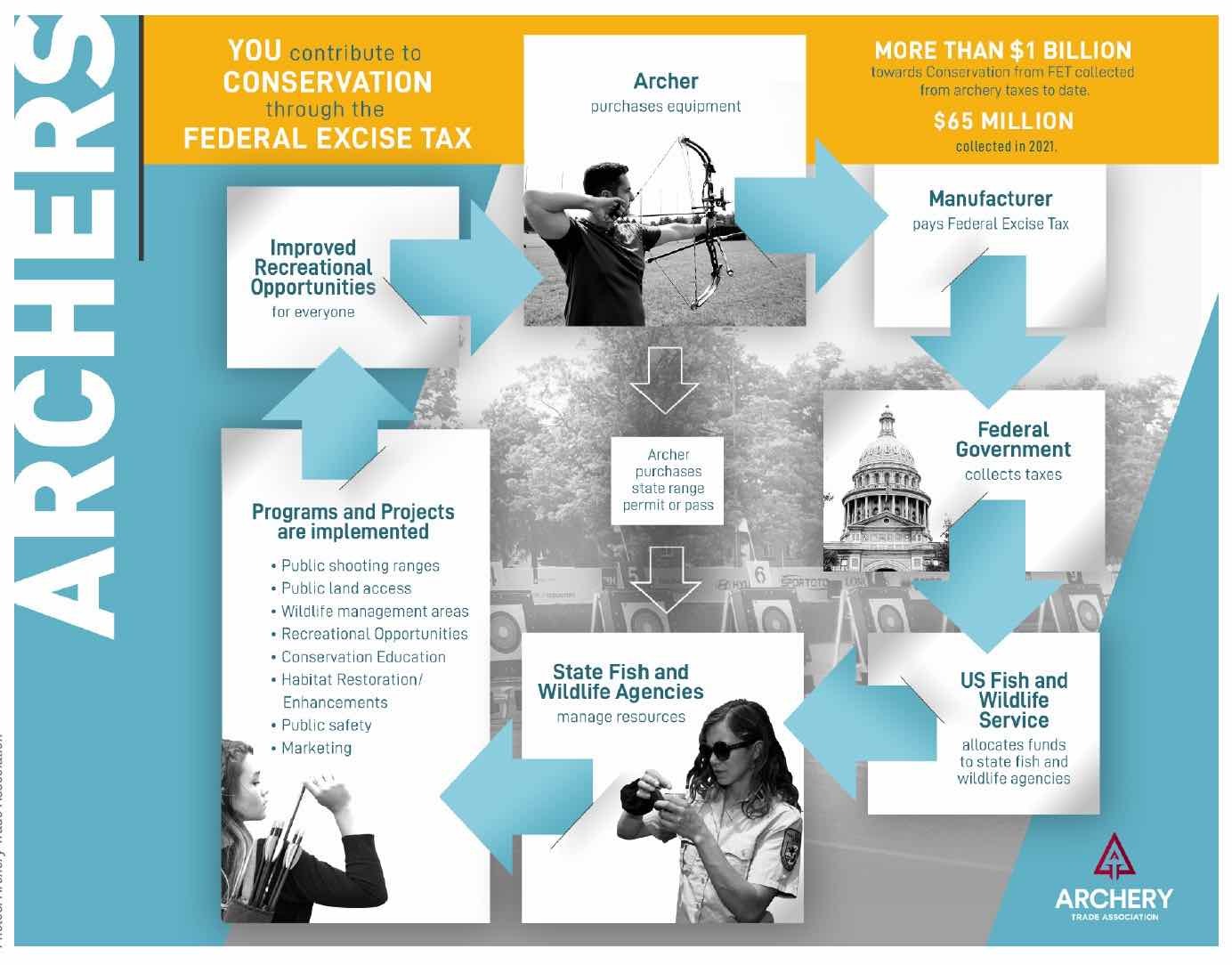
License sales are straightforward. The money that hunters, anglers and trappers use to buy a license goes to the state agency selling them. The FET process is more complicated. As described in ATA’s article “The Reason and History for the Pittman-Robertson Fund” on ArcheryTrade.org, the FET is a 10% to 11% tax manufacturers pay on the first sale of firearms, ammunition and some archery equipment. The tax originated in the 1937 Wildlife Restoration Act, more commonly called the Pittman-Robertson Act. Congress added archery equipment to the FET in 1972.
All firearms- and ammunition- and most archery-industry members who manufacture, produce or import taxable equipment must pay the FET. The IRS website (irs.gov) outlines who is liable for the FET and has a comprehensive list of which archery items are subject to the FET and which archery items are not. The site also explains how the IRS defines terms, such as manufacturer and importer, to determine the proper taxpayer.
FET revenues fund conservation projects such as habitat restoration, wildlife research and public-access programs. This process ensures our nation’s fish and wildlife remain healthy, abundant and available to hunters and anglers.
Bryan Burhans, executive director of the Pennsylvania Game Commission, said, “The P-R Act is foundational to how we’re able to carry out the various programs that an agency works on. There are so many different areas where those funds are used to benefit hunters and shooters.”
The Flow of Funds
All companies responsible for paying FET must file a quarterly excise tax return using IRS Form 720. The IRS collects all revenues generated by the FET and sends them to the U.S. Fish and Wildlife Service, which apportions the allotments only to state wildlife agencies and territories based on their geographic size and their paid hunting and fishing license holders. The fishing industry pays a similar FET through the Dingell-Johnson Act.
For states to receive these federal grant funds, they must include a 25% match of nonfederal funding in their proposals. Most states use money generated by license sales to pay the match. In other cases, state agencies partner with colleges, conservation organizations and other groups to raise additional conservation dollars to match the federal funding. These collaborations are mutually beneficial because once the state receives the federal fund approval, both parties work on the project. Volunteer hours (for hunter education programs) can also be converted and used as a match. Only projects meeting the intended purposes of the Pittman-Robertson Act are approved by the U.S. Fish and Wildlife Service and eligible for funding.
The state agency receives the funds after the work on an approved grant is completed. If a state doesn’t complete a project or allocate the funds after a certain period, the funding reverts to the USFWS for the Migratory Bird Conservation Commission, which uses it to buy land for the National Wildlife Refuge program.
Supporting the Mission
Paying an 11% tax might seem like a lot, but it’s a small price to pay to ensure our natural resources are properly managed so people have ample hunting opportunities and businesses can grow and flourish with vibrant consumer participation.
Keith Arnold, national sales manager for the TenPoint and Wicked Ridge Crossbow brands, knows his company is legally obligated to pay federal excise taxes. He also understands the magnitude of his company’s contributions and the investment value of paying taxes, so the brands proudly pay their share.
“Our hunting lifestyle has greater challenges today than ever before,” Arnold said. “With each day that passes, more land is developed and our youth’s attention finds new distractions. The FET program ensures that significant resources are focused on doing what most of us don’t have the time or bandwidth to do — work on protecting and furthering our passion so that future generations can do what we love.”
How States Leverage FET Funds
States must use FET contributions for habitat restoration, hunter education, wildlife research, public-access programs and other high-priority national conservation projects.
- For example, in 2023, the Pennsylvania Game Commission received a record $41 million in FET funds and used the money for several projects. Here are a few statistics from programs and projects in Pennsylvania that received FET dollars.
- National Archery in the Schools Program: With over 300 schools participating, more than 100,000 students in grades 4 to 12 engaged in the NASP in 2023. Of those students, 20% purchased a hunting license and 268 participated in the 2023 NASP International Bowhunter Organization’s 3D state tournament. Archery-dedicated youth programs create recreational archers and future hunters.
- Hunter Education: In 2023, 16,904 students graduated from in-person hunter and trapper education classes, 73% of whom were 20 or younger. Meanwhile, 6,592 students graduated from the online HTE course. These programs help get more people into hunting and bowhunting, buying licenses and equipment to participate.
- Range Development and Maintenance: The agency is currently creating or enhancing 16 shooting ranges for firearms and/or archery. At the completion of the 2024 fiscal year, the agency will have 52 different public ranges. Public ranges ensure people have opportunities to shoot recreationally and practice for hunting season.
The FET helps boost the archery and bowhunting industry by ensuring people have places to hunt and animals to pursue. And of course, this means more money in the pockets of archery store owners and manufacturers.
“Without P-R dollars, I think the impact on state wildlife agencies’ ability to deliver conservation would be catastrophic,” Burhans said. “Some states struggle to come up with the match required to obtain the funds. The program is essential to what we do to maintain conservation, and recruit and retain hunters.”
The Big Picture
According to the USFWS, the IRS collected nearly $1.2 billion in federal excise taxes for the P-R Act in 2023. The ATA reported $54 million came from archery and bowhunting manufacturers. While ATA members are busy running day-to-day operations and creating business and marketing plans, the FET dollars they pay quarterly are being put to work by state wildlife agencies nationwide, further ensuring the health of the industry and their businesses.
The ATA provides its members with FET information, advice and advocacy. The ATA created a free, comprehensive guide to federal excise taxes for its members and works directly with state wildlife agencies, the USFWS, the IRS and U.S. Congress on FET issues. If you have questions regarding federal excise taxes, contact Dan Forster, ATA’s vice president and chief conservation officer, at (507) 233-8143 or danforster@archerytrade.org.
Photos courtesy of ATA