
Spend enough time behind a gun counter and you’ll notice a pattern. Customers ask why one box of ammo costs more than another, why one is recommended for elk instead of deer, or why a competition shooter insists on a bullet that “won’t even expand.”
They are sensing that bullet design matters, even if they don’t yet have the language for it. At the gun counter, that language is part of your job.
From the outside, ammunition looks standardized. Same caliber. Same bullet weight. Similar velocities printed on the box. To a customer, it can appear that the only meaningful difference is price. The reality is that bullet design is where most functional differences live. Construction determines how a bullet survives firing, how it flies, and what it does when it reaches the target. Those three phases place conflicting demands on the projectile, and every bullet design is a compromise.
Discussion of brands and product-of-the-month recommendations will only cloud the vision of customers who haven’t first gained an understanding of bullet design. Instead, the objective is to help them understand why different bullet designs exist and what problems they are intended to solve. If you can do that, you’ll be able to recommend the right bullet and the rest of the conversation will likely take care of itself.
Baseline Structure
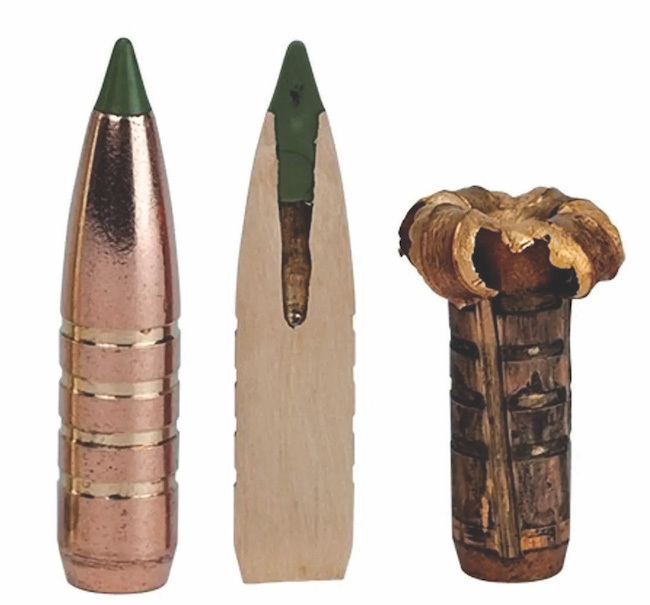
Most rifle bullets used for hunting and competition share a common foundation: a lead core enclosed by a copper or gilding-metal jacket. What varies is how that jacket is made and how it interacts with the core.
Traditional cup-and-core bullets are the simplest example. A copper jacket is drawn into a cup and filled with lead. These bullets are economical, widely available, and expand readily at typical hunting velocities. For deer-sized game, they have a long and successful track record.
Their limitation is structural. Because the core and jacket are not bonded, high impact velocity or heavy bone can cause the bullet to shed weight or fragment. Sometimes that is acceptable. Sometimes it is not.
Bonded bullets address this by chemically or mechanically attaching the lead core to the jacket. Expansion still occurs, but it happens more gradually, and the bullet tends to retain more of its mass. This improves penetration and consistency, especially on larger animals or at closer ranges where velocity is high.
Monolithic bullets eliminate the lead core entirely. They are machined or swaged from a single piece of copper or copper alloy. With no core to separate, weight retention is extremely high and penetration is deep and straight. The tradeoff is that copper is less dense than lead, so these bullets are longer for a given weight and generally require higher impact velocity to expand reliably.
At the counter, the important distinction is not how they are made, but what they do. Does the bullet open easily? Does it hold together? Does it penetrate deeply? Those are the questions customers actually care about.
Shape and Flight
Terminal performance matters to hunters, but flight behavior determines whether the bullet gets where it needs to go.
Ballistic coefficient is the shorthand used to describe how efficiently a bullet moves through the air. Higher BC bullets retain velocity better, drift less in the wind, and drop less at long range.
Flat-base bullets are often very accurate at short to medium distances and can be more forgiving in some rifles. Boat-tail bullets reduce drag and perform better at longer distances, though they can be slightly more sensitive to seating depth and rifle setup.
Polymer tips are a practical hybrid solution. They streamline the bullet for better aerodynamics while also aiding expansion on impact. For many hunters, this balances flight performance with terminal reliability.
One point that frequently needs clarification involves open tips versus hollow points. In rifle bullets, an open tip is usually a byproduct of manufacturing, not a feature intended to cause expansion. This distinction matters, especially when customers cross-shop hunting and match ammunition.

Specific Needs
A productive counter conversation usually starts with three questions:
- What is the target or game?
- At what distance is the shot most likely?
- Is penetration, expansion, or accuracy the priority?
For hunters, ethical performance matters. The bullet must expand within its intended velocity window and penetrate deeply enough to reach vital organs. For competition shooters, consistency and wind performance matter far more than terminal behavior.
Avoid equating price with suitability. A premium match bullet is not automatically appropriate for hunting. A controlled-expansion hunting bullet is not automatically ideal for long-range competition.
Explain tradeoffs plainly. Customers generally respond well to clear cause-and-effect explanations.
Common Misconceptions
Bullet weight alone does not determine penetration. Construction plays an equally important role.
“Match” does not mean “best for all purposes.” Match bullets are optimized for accuracy, not controlled expansion.
Velocity only helps if it matches the bullet’s design window. Too much or too little can both create problems.
Correct these points without lecturing. The goal is understanding, not winning an argument.
Expectations
Bullet design is about applied physics and materials science, not marketing language. When you understand why a bullet behaves the way it does, the ammunition aisle stops being a wall of similar boxes and becomes a set of purpose-built tools.
For hunters, that knowledge supports ethical outcomes. For competitors, it supports consistency under pressure. For the salesman, it builds credibility and trust.
That is what customers expect when they step up to the counter.