
Gun companies are producing more accurate rifles than ever before, thanks to improved materials, tighter tolerances, and better manufacturing practices. Additionally, there’s been a focus on long-range shooting, leading gunmakers to create rifles that are more precise at longer distances than were previously thought possible.
Hunters have naturally bought some of those rifles and discovered they can make clean one-shot kills at longer distances than before. This led to the rise of long-range big-game hunting, and scopes designed for this new pursuit quickly appeared. One issue was that ammunition excellent for killing big-game animals might not be suitable for long-range shooting. Conversely, a bullet that's accurate at long ranges might not have the power to fully take down an animal with just one shot.
The result is purpose-built ammunition that is not only accurate at longer ranges but also maintains the qualities that make it effective for game. Note that we’re not suggesting that hunters take shots at animals from beyond their ability to make a clean kill. That decision is entirely up to the responsible hunter, who knows his or her equipment and skills.
Since it’s important that your customers understand what makes a good long-range hunting bullet, let’s take a look at some of those properties.
Hunting Bullets
A good hunting bullet has several important functions, and whether it performs them well depends on the materials used and its design. First, a quality hunting bullet reliably expands on impact, creating a large wound channel and resulting in a quick, humane kill. Full-metal-jacket bullets like those used for range shooting aren’t designed to expand; they simply pass through the target, whatever it is. For example, a full-metal-jacket .223 Rem bullet will make a .22-inch hole in whatever it hits and passes through. In contrast, a good hunting bullet expands to roughly 1.5 to 2 times its original diameter. So, a .270 Win hunting bullet will typically expand to more than .40 inches, producing a much wider and more effective wound channel.
Second, and just as important, the bullet must retain enough weight as it passes through the animal to penetrate deeply and cause enough damage to quickly put the animal down. Bullets that fragment upon impact usually don’t meet that standard. High-quality bullets retain more than 90% of their weight when passing through a big-game animal.
Lastly, once expanded, the bullet must penetrate deeply enough to ensure a clean, humane kill. That can involve passing through the animal’s entire body or transferring all of its energy inside the animal.
Long-Range Bullets
Long-range shooting has its own specific vocabulary, so we’ll proceed carefully through this section. In short, a quality long-range rifle bullet features a high ballistic coefficient to reduce effects of wind and gravity, combined with exceptional consistency for match-grade accuracy.
Before we continue, let’s briefly examine the topic of ballistic coefficient. BC a measurement of a bullet’s ability to resist air resistance. A higher BC results in less drag, which means higher retained velocities, shorter flight times, and significantly less wind drift. Therefore, good long-range bullets have a higher BC than others.
Much of the BC is determined by a bullet’s shape. Most long-range bullets feature a sleek, slender “secant” or “hybrid” ogive (the curved front part), which reduces wind resistance. Many also have a boat-tail base to minimize drag, allowing them to travel through the air with less external force.
Consistent manufacturing of all cartridge components, along with precise uniformity in the powder charge used in every bullet, is also essential. Thanks to modern manufacturing, these practices are far more common than in the past.
Combining the Two
Combine the qualities of a good hunting round with the factors that make a quality long-range round, and you get the best of both worlds — a top-notch long-range hunting bullet designed for accuracy and terminal performance. The ideal long-range hunting bullet would have a high BC to cut through the wind, good expansion as it enters the target, and high weight retention as it continues to create its wound channel. That bullet would need to be manufactured using strict quality control, an excellent primer, top-grade propellant, and consistent performance for the same ballistics round after round.
Another important factor is that long-range hunting ammunition must be able to expand at lower velocities since bullets traveling longer distances are often moving slower when they hit their target. They should be able to expand and create lethal wound channels at speeds below 1,500 fps.
Here’s a piece of caution your customers will soon realize about quality long-range rifle ammunition if they haven't already: Top-tier rifle ammunition loaded with exceptional hunting projectiles isn’t cheap. Like most things in life, if you want the best, you have to pay for it. That said, let’s examine six new long-range hunting rounds that are worth your attention and shelf space.
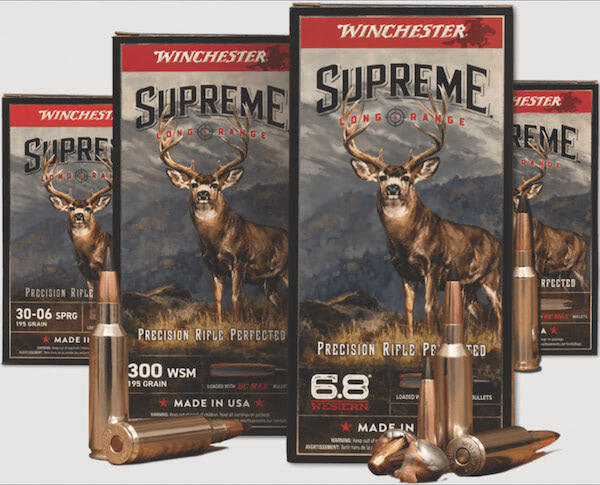
New Long-Range Ammo
Winchester’s Supreme Long Range is purpose-built rifle ammunition for hunting game at even the most extreme ranges. It features the new “BC Max” cup-and-core bullet, engineered with precision-drawn, thick-walled jackets for long-range terminal performance and match-grade accuracy. Features include a large-diameter tip that ensures positive expansion and maximum energy transfer at even extreme ranges, plus a heavy-for-caliber, extended boat-tail and heat-resistant tip, which combine for maximum BC. This round also utilizes a match-grade primer built to exacting specifications for shot-to-shot consistency, and is made on next-generation bullet assembly equipment engineered to provide industry-leading quality and competition-level accuracy.
Available loads include 195-grain .300 Win Mag leaving the muzzle at 2,900 fps, a 195-grain .300 WSM at 2,900 fps, a 195-grain .30-06 at 2,859 fps, a 140-grain 6.5 Creedmoor at 2,725 fps, a 140-grain 6.5 PRC at 2,900 fps and a 175-grain 6.8 Western with a muzzle velocity of 2,800 fps.
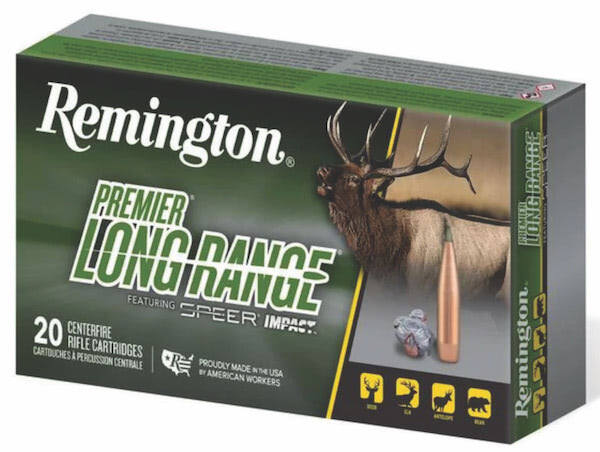
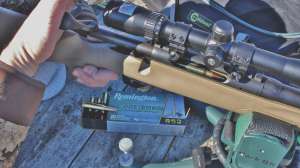
For 2026, Remington has expanded its 7mm Backcountry offerings with three loads designed for hunting at distance with suppressed rifles. First is the Premier Long Range Speer Impact load, featuring a 175-grain polymer-tipped, bonded-core bullet designed to hold together under high-impact velocities, yet still optimized for high weight retention and expansion as it slows.
The classic Core-Lokt bullet, one that has been putting meat on the table for decades, has also been added to the 7mm Backcountry fold for 2026. Additionally, a more modern upgrade of that bullet, the Core-Lokt Tipped, features a polymer tip to maintain a uniform BC value and also acts as a wedge to initiate expansion upon impact. All three loads drive the 175-grain bullet at just over 3,100 fps in a 24-inch barrel, and just under 3,000 fps in a 20-inch barrel with a suppressor.

Black Hills Ammunition is well-known for its top-quality rifle ammo, and its new MatchKing-X (MKX) features a redesigned Sierra bullet with a thinner nose cavity and softer lead core to promote reliable expansion and energy transfer down to 1,800 fps. The new offering for 2026 is a 6mm ARC load with a 107-grain MKX traveling at around 2,900 fps, a 6.5 Creedmoor load with a 142-grain MKX at around 2,800 fps and a .308 load with 175-grain MKX with a muzzle velocity of about 2,600 fps. Hunters can expect accuracy that’s similar to standard MatchKing bullets from a premium hunting load.

Federal is releasing an incredible 20-plus new centerfire rifle ammo options this year, including expanding its Premium line with new long-range hunting loads. Federal Premium Terminal Ascent bonded construction bullets feature high ballistic coefficients and nickel plating, plus the patented Slipstream polymer tip that initiates expansion. The two new loads are 6.5mm PRC 140-grain and 300 Rem. Ultra Mag. 175-grain.
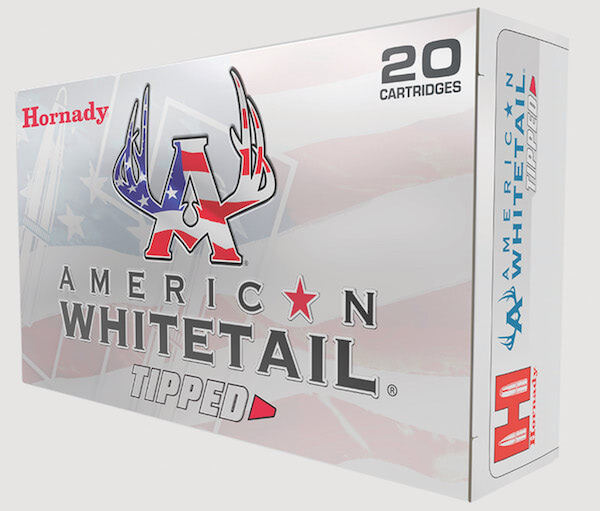
Hornady has added offerings to its American Whitetail Tipped ammo, which has been responsible for taking down many a deer over the past several years. Hornady has upgraded the classic line by replacing traditional soft points with polymer-tipped SST bullets for improved, flatter trajectories, higher ballistic coefficients and faster, more dramatic expansion on deer. It features InterLock technology, which retains core/jacket integrity for increased weight retention. New loads include the .243 Winchester with a 95-grain SST, the 6.5 Creedmoor and 6.5 PRC with a 129-grain SST, the .270 Winchester with a 130-grain SST, the 7mm-08 Remington with a 139-grain SST, the 7mm Remington Magnum and 7 PRC loaded with a 154-grain SST, the .308 Winchester with a 150-grain SST, the .30-06 Springfield, .300 Winchester Magnum and .300 PRC with the 165-grain SST, and the 350 Legend with the 165-grain FTX bullet.

Last but not least, Lapua’s new TRX (TrueRange Expanding) Tipped Solid-Copper ammo should be a winner for long-range hunters in areas where nontoxic ammo is required. This new polymer-tipped, lead-free hunting ammunition is designed for extreme precision and high BC values, and is touted to retain 100% of its weight. Offerings include 120-grain 6.5 x 55 SE and 6.5 Creedmoor loads, a 150-grain .308 Win load, and 165-grain .300 Win Mag. and .30-06 rounds.
For handloaders, Lapua offers several TRX bullets, including the 120-grain 6.5mm bullet, the 150-grain .30-caliber bullet and the 165-grain .30-caliber bullet.