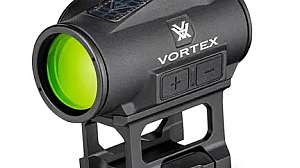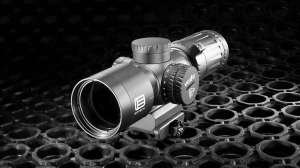
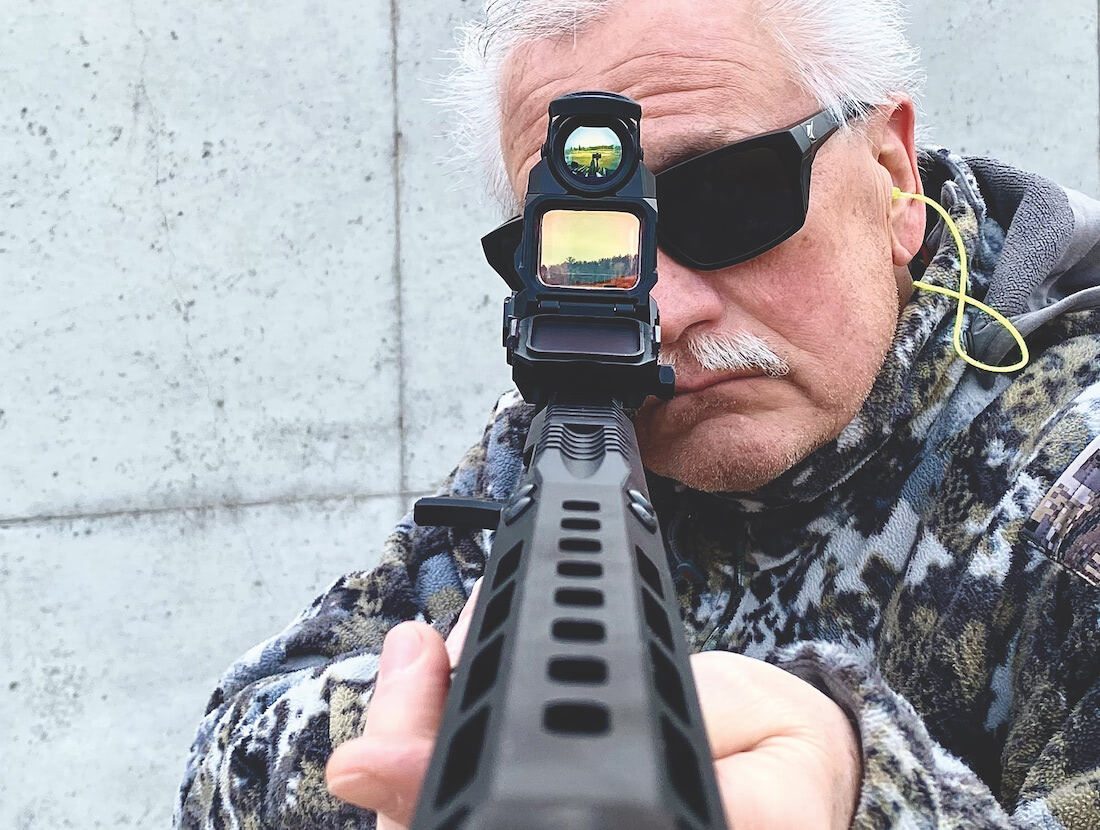
Best known for its quality red-dots, Holosun Technologies officially released the DRS-TH near the end of 2024, a “fusion optic,” as the company terms it, combining a red-dot with a thermal unit.
Having used Holosun optics in the past, I knew the red-dot portion of this unit would work fine. But the thermal? To me, that was the real question. And the thermal actually worked very well in my testing of the DRS-TH.
Now, this isn’t a dedicated thermal weapon sight with a large objective and 640 sensor delivering a 1,500-yard detection range and letting a night hunter count the little piggies circling momma sow at 300 yards.
But the DRS-TH effectively integrates a 256x192 thermal sensor and multiple thermal image palettes with a first-rate red-dot, creating a useful combination optic. With most nighttime forays at close ranges, anyway, the DRS-TH will certainly do the job for a night hunter and do so at an MSRP of well under $2,000.
Seeing Red
Let’s examine the red-dot component of the unit first.
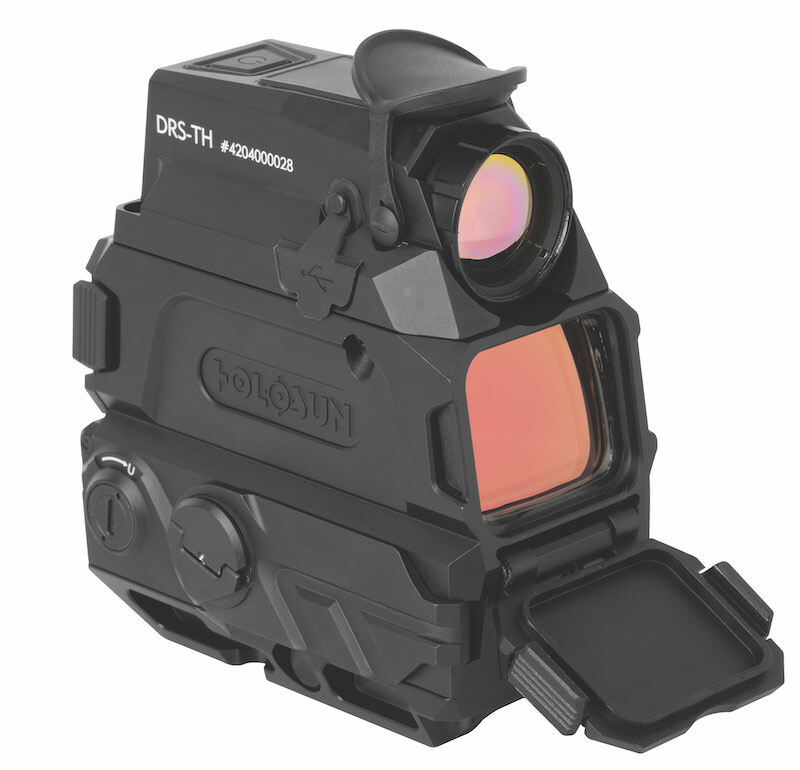
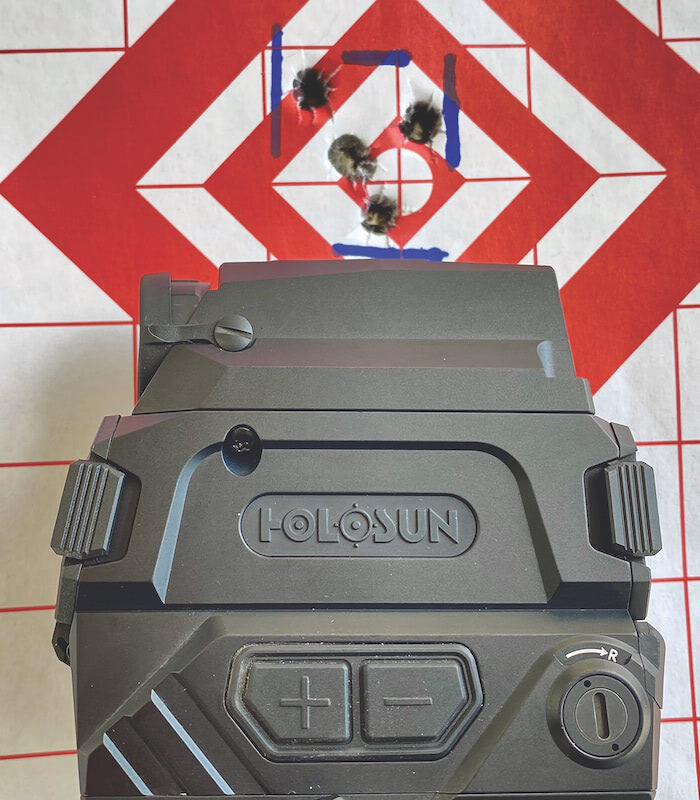
The optic’s LED reticle options are a 2-MOA dot and a 65-MOA circle around a dot. Both are red. The unit features eight Day and four Night Vision brightness levels. Brightness controls are located on the bottom left of the unit’s housing. The Elevation control is found on the lower right side of the unit, Windage on the lower left. Elevation and windage adjust at 0.5 MOA per click, and both have a total travel range ±50 MOA.
The rear lens is a generous 1.25- x 0.98-inch rectangle. The front and rear lens sport attached covers that flip away and down. The red-dot features unlimited eye relief.
Heat Seeking
The thermal unit sits atop the red-dot and as noted, features a 256x192 thermal sensor with 50 frames per second display resolution. The thermal has multiple image palettes, including White Hot and Highlight modes, and 1x, 3x and 5x digital magnifications.
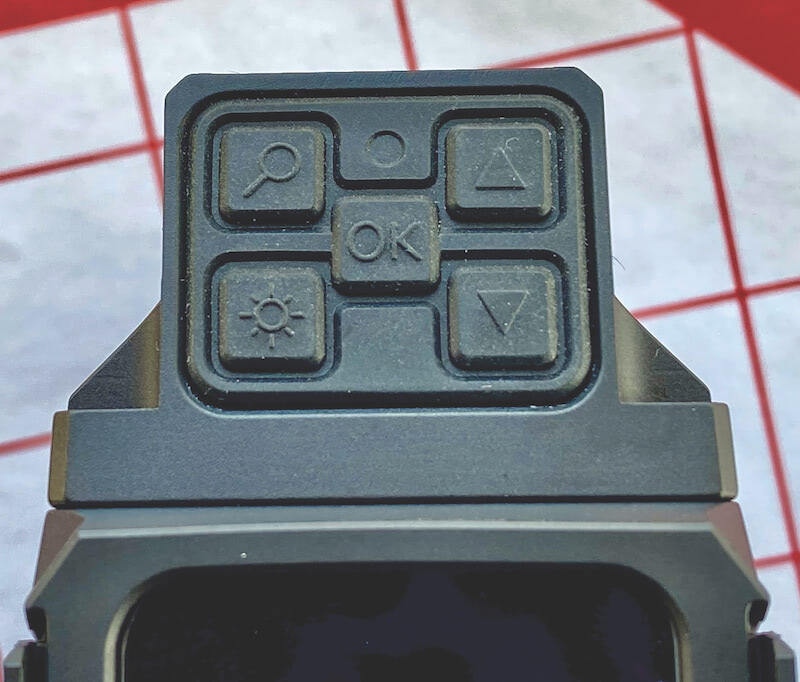
The thermal’s controls form a small rectangle at the rear of the unit. These button tabs allow the user to operate the digital zoom and pixel correction (top, left), brightness and images adjustments (bottom right), take photos and videos (top, right), and reticle adjustments (bottom, right).
At the top center of the control rectangle is an indicator light, showing red when the unit is ON. Just below this sits the “OK” button, which operates the Main Menu settings.
Last, the power button sits atop the thermal. A short press turns on the thermal, a longer press shuts it off.
To access photos and video, the magnetic charging cable (included) attaches to the charging port, with the USB end of the cable connected to a computer. Then, the thermal unit is turned on, and the computer will recognize the JPG photo files and MP4 video files. Files are viewed and downloaded as desired.
Power
A pair of 18350 rechargeable Li-ion batteries power the DRS-TH. The battery compartment is on the right side of the housing, forward of the elevation control.
The batteries charge while in the unit via the magnetic charging port and the provided charging cable. The magnetic end of the cable connects to the charging port, the USB end to a 5V/2A power adapter or an external power source like a battery pack. When charging, the thermal’s indicator flashes green; at full charge the green light remains on.
Holosun rates the fully charged batteries as providing 10 hours of thermal run time and up to 50,000 hours of red-dot only use.
AR in AK
I mounted the Holosun on a side-charging Bear Creek Arsenal (BCA) AR-15 chambered in 7.62x39mm. The rifle had a 16-inch heavy barrel with a 1:10 twist rate and operated from a carbine-length gas system inside a BCA mil-spec, forged AR-15 lower.
The Bear Creek rifle sported an 11.5-inch MLOK rail, a M4 flat-top billet upper receiver, a BCA Bolt Carrier Group, Flash Hider. The charging handle was BCA’s Gen2 model, located on the right side of the receiver.
For ammunition, I relied on Hornady 7.62x39 loaded with a 123-grain, SST poly-tipped bullet.
The DRS-TH featured a Picatinny mounting system already attached to the bottom of the optic and the unit easily attached to the BCA rifle.
Daytime
The sun shone brightly at my outdoor range, temperatures in the mid-30s that rose quickly and a light wind moving from right to left.
To zero the red-dot portion of the DRS-TH, I used the dot reticle surrounded by the 65-MOA circle. The other reticle options were a dot by itself or a circle without a dot.
The red-dot elevation and windage controls adjusted at .5 MOA and worked well. I got on target within a half dozen shots. Accuracy was solid, too. I placed a number of five-shot groups at 2.0-inches and better with my best coming in at 1.1 inches.
At this point, I turned on the thermal and scanned the rocks and wooden posts that had warmed up in the sun. Then, I pressed the reticle adjustment button on the thermal and brought up the thermal reticle.
I often check thermal accuracy and zeroing functions by shooting during the day. But I wanted to see how the DRS-TH actually performed in the arena for which it was designed: when the sun goes down.
The Dark
My nighttime shooting was at 50 and 100 yards. The temperature that night was 42 degrees Fahrenheit, the humidity at 78% and just a slight breeze.
The DRS-TH offers different thermal reticle options. One set of these reticles is scaled for use with a rifle chambered in .223 Rem., the other for .308 Win. These reticles can be zeroed independent of the red-dot. In fact, the red-dot does not have to be on at all to use the thermal.
But as I had taken the time to zero the red-dot, I decided on another option the unit provided: the thermal reticle is automatically co-witnessed with the red dot, at 25 yards, anyway.
So, I used the red-dot 65-MOA circle surrounding the red dot as my reticle at 50 yards. I boosted the thermal magnification to 3x. I shot at a small HotHands heat pack measuring 3.5 by 2 inches wide.
I shot a few times to the right of the small heat pack to make sure my zero was still good. It was. Then, I shot three times at the pack and the rounds hit the pack on the right side and came in at 1.0 inch.
I backed up another 50 yards and took on my second HotHands, this one the larger version measuring 4.75 inches long by 3.55 inches wide. I pressed the thermal digital magnification button once more for 5x. Here, I got a little fancy and brought up the thermal reticle, too. It overlaid the red-dot reticle and the two actually worked really well together.
My first three shots impacted just to the right and high of the right corner of the heat pack. That group measured 1.50 inches.
I adjusted the red-dot elevation and windage and fired five more times. My shots were still a little high, but centered on the pack and came in at 1.75 inches.
Both the heat packs showed up nicely at the 100 yard mark. Of course, a full-sized coyote or hog would’ve been an easy shot.
But at what distance could a hunter take a reasonable, ethical shot with the DRS-TH?
Stretching Out
To answer that question, I took the DRS-TH off my rifle and drove the countryside for a couple hours at night seeing what I could see and how far away. I used the thermal reticles and the red-dot reticle, too, alone and together, not to shoot but to see how they placed over given targets and various distances.
The humidity was high that night, 76% to be exact, the air temperature in the high 40s.
I set the DRS-TH on 1x thermal magnification, and the first thing I noticed was that the unit operated as an extremely functional little handheld unit. I spotted animals and other heat signatures out to 400 yards easily, and could ID a deer at 300 yards.
At 3x, and at least on that night, the images became a little blurry out past 100 yards, but I would’ve still been fine with making a shot out to 200 yards on a hog or coyote standing broadside.
At 5x and with that night’s humidity, the blur was significant past 150 yards. Within 100 yards, images were fairly detailed.
For the shots out to 200 yards, I likely would’ve used the thermal reticles as they were more precise. But for closer shots, including those on running hogs? The red-dot reticle with the circle and dot would be perfect.
Selling the DRS-TH
“The DRS-TH is built for hunters mainly, with some crossover into the tactical industry for LEO/professional use,” says Josh Erikson, marketing manager for Holosun Technologies. “The unit works great for hog hunting and there are videos on the Internet showing its effectiveness. Another section of the market is the airsoft community with an emphasis on the military simulation crowd.”
Of course, as soon as they show interest, educate potential customers that this unique-looking optic is a red-dot and a thermal together. And since the potential customer can use the unit as a red-dot most of the time, he or she isn’t stuck with making the decision to bring a thermal scoped rifle and a rifle with a daytime optic.
With the DRS-TH, the customer already has both.
“The way I demonstrate this at tradeshows is to start with the customer seeing only the red-dot and then turning on the thermal camera for them to see the overlay,” Erikson says. “Then, I close the front cap to give them the best contrast.
“I pan them around to a few different heat sources and swap modes from white hot to black hot to outline. From there I do a quick summary of the features with the ability to zero the red-dot and the thermal reticle independently, take photos and video record, digital zoom and then explain the runtime and how easy it is to swap batteries on the side.”
In Store
Holosun can provide its dealers with brochures, counter mats, DVDs and signage. Instructional videos are available, too, showing the DRS-TH used in the field and showing how the features work.
Holosun does offer some sales staff training, but it is somewhat limited due to staff size.
“We do co-op advertising with some of our larger vendors,” Erikson added.
Dealer Info
Any establishment interested in becoming a Holosun Technologies dealer needs to email the company at info@holosun.com, request and then fill out the dealer forms. Holosun will complete a verification process. Once the establishment is approved, the new dealer can then purchase products directly from Holosun or go through distribution.
Holosun is available through most of the larger industry distributors.
Media
While the unit was featured in magazine and web articles, with more content forthcoming, the DRS-TH has been especially popular on the YouTube circuit.
“We still have more content creators working on features, but I don’t have a timeline just yet for when we can expect their videos to go live,” Erikson says.
He noted that he expects a significant amount of additional print, web and video content about the DRS-TH to land in 2025.